by Luxman Aravind
For years, Sri Lanka has been told that a mysterious deep state was responsible for almost everything that went wrong in the country. It was presented as the hidden machinery behind extrajudicial killings, manufactured violence, political manipulation, intelligence operations and, eventually, even the Easter Sunday massacre. Rajan Hoole, an academic who became a human rights activist, wrote extensively about the idea after the Easter attacks. Sunanda Deshapriya, the journalist-turned-activist and refugee who left Sri Lanka amid threats, later developed the argument further. Their writings relentlessly attacked the previous political establishment and portrayed a shadow structure operating behind the formal institutions of the Republic. Cardinal Malcolm Ranjith subsequently became one of the most prominent public voices demanding answers over Easter, repeatedly raising allegations of hidden actors and obstruction. Even in April 2026, he was publicly alleging that officials belonging to a “deep state” were obstructing the investigation into the Easter massacre.
Yet, after all these years, the central question remains brutally simple: where is the evidence for the grandest version of that theory? There have been intelligence failures, criminal negligence, institutional incompetence, political manipulation and serious unanswered questions surrounding Easter. Those matters are real and deserve investigation. But they are not automatically evidence that a secret state apparatus deliberately planned the massacre. The recent conviction of 15 men for their roles in the Easter attacks has once again placed the Islamist extremist network at the centre of the criminal case. At the same time, investigations into possible failures or prior knowledge within the security establishment continue, including proceedings involving intelligence personnel. However, the investigation is being led by the two officers who were responsible for taking action on the intelligence alerts received by both the military and the police. Sri Lanka cannot replace evidence with a theory simply because that theory is politically attractive. Nor can the country close every question merely because extremist perpetrators have been identified.
For years, however, the deep-state narrative became almost impossible to challenge. Anyone questioning it could be portrayed as defending the old regime. Anyone asking whether the Easter conspiracy had actually been demonstrated could be accused of obstructing justice. The public was repeatedly asked to believe that behind the visible state stood another invisible state. But now something far more concrete is happening, and it is happening not in the shadows but in full public view. The question Sri Lanka should be asking today is no longer whether the “deep state” described by Hoole and Deshapriya existed in precisely the form they alleged, as their narratives have increasingly come to resemble little more than the politically motivated ramblings of commentators with ulterior agendas. The more urgent question is whether Sri Lanka is now witnessing the construction of something that could genuinely resemble a party-centred deep state.
This is where the rise of the JVP-led National People’s Power government demands much greater scrutiny. The distinction between a government and a political party is fundamental to democracy. A government governs through the Constitution, Parliament, the public service, the security establishment, independent institutions and the law. A political party exists to obtain and exercise political power. When the boundary between those two structures becomes blurred, democratic accountability begins to change. The danger does not necessarily arrive through a dramatic coup, an emergency declaration or tanks on the streets. It can develop through appointments, personnel networks, informal chains of command, political loyalty and the gradual transfer of influence from formal institutions towards the party organisation.
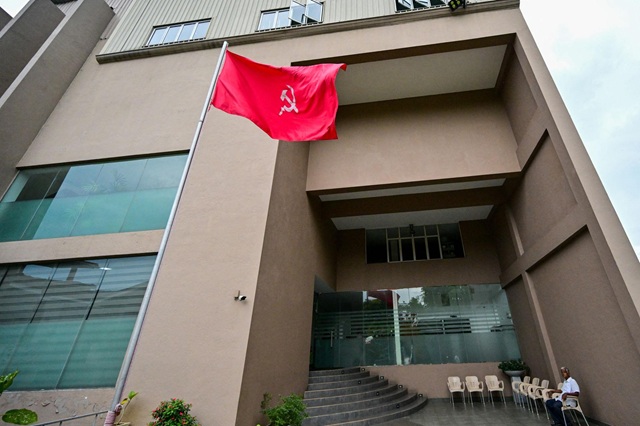
Tilvin Silva is an obvious symbol of this question. He did not contest the parliamentary election and did not enter Parliament through the National List, yet as JVP general secretary he remains one of the most influential figures in the governing political organisation. Foreign diplomats, political figures and other important visitors have met him at the JVP headquarters in Pelawatte to discuss matters of national importance. Such meetings, by themselves, do not prove that he exercises unconstitutional authority. But the very fact that the party headquarters has become an important venue for engagement with people seeking to understand or influence the direction of government raises a democratic question that should not simply be dismissed. In a parliamentary democracy, political parties have power because voters give them power. The state, however, is not supposed to become an extension of the party office.
The more disturbing allegations concern the manner in which the governing party is said to be embedding its people throughout the state structure. Claims have circulated that young ministers and deputy ministers with limited political experience are surrounded by assistants, drivers and other staff selected through party networks, creating an environment in which political loyalty can matter more than independent institutional judgement. If party structures are indeed determining who surrounds ministers, who communicates with them, who advises them and what information reaches them, then Sri Lanka is facing a problem much larger than ordinary political patronage. It would mean that the formal state is gradually acquiring an informal party nervous system.
The same concern applies to Parliament. The NPP’s enormous parliamentary majority gives it an institutional advantage unavailable to most previous governments. The issue is not simply the number of MPs. The question is whether those MPs possess genuine room for independent political judgement or whether the parliamentary majority functions primarily as an organised voting mechanism controlled by the party hierarchy. A large majority can strengthen democratic government when parliamentarians exercise independent constitutional responsibilities. It becomes something else when parliamentary power is treated as party property.
History has already recorded the dangers. Rajapaksa built an extraordinary concentration of power around his family. The rise, dominance and eventual collapse of that political order were deeply connected to the Rajapaksa family itself. The JVP-NPP structure is different. Its potential strength does not depend on one family. It rests on an organised party, a long-standing ideological movement that twice resorted to extreme violence against the state, and a disciplined political apparatus. That difference matters enormously. A family-centred state can weaken when the family loses legitimacy. A deeply organised party-state relationship can be much more durable because the organisation survives individual politicians.
That is precisely why the emerging danger deserves attention now, before anyone has to use the word “deep state” as an accusation. The real issue is whether independent institutions are being weakened while party structures become stronger. Intelligence services, the military, the police, the public service and regulatory institutions cannot be allowed to become politically dependent on whichever organisation happens to control the government. Sri Lanka has already experienced the consequences of excessive political interference in state institutions. Replacing one network of political influence with another would not constitute institutional reform.
There is another element that makes the present situation particularly dangerous. The opposition is fragmented, opportunistic and burdened by its own record. Many opposition politicians face allegations or unresolved controversies. That makes it easier for a powerful government to neutralise potential challengers through investigations, prosecutions and political exposure. None of these actions would automatically be illegitimate. If a politician committed a crime, the law should apply. But selective enforcement would be a fundamentally different matter. Sri Lanka should therefore watch carefully how cases involving major opposition figures develop, including those involving Namal Rajapaksa and Basil Rajapaksa. It would be irresponsible to predict convictions or claim that prosecutions are politically manufactured without evidence. It would be equally irresponsible to ignore the possibility that law enforcement can become a weapon in a political struggle.
The same caution must apply to the IMF. There have been reports and political speculation that the government could abandon or radically alter the IMF programme to prepare for elections. The more consequential question is what happens if economic pressure increases while the government prepares for its next political battle. A government with a huge parliamentary majority, a disciplined party structure, a weak opposition and control over an increasingly politicised information environment possesses enormous capacity to shape public sentiment. If economic relief, political messaging, prosecutions of opponents and state appointments begin moving together towards an electoral objective, Sri Lanka could enter a period in which the distinction between governing the country and securing the next political mandate becomes dangerously thin.
This is why the next few months could be more consequential than the last seven years of arguments about the old deep state. The old theory pointed backwards. It searched for an invisible structure supposedly operating behind the previous establishment, yet the current government is having an extraordinary struggle to prove the allegations it has made. The new question points forward. What happens when an exceptionally disciplined political organisation begins to occupy every layer of the formal state while the opposition is too divided to provide an effective counterweight?
Sri Lanka should not wait until the answer becomes obvious. By then, institutional correction may be impossible.
The country has already learned how dangerous it is when intelligence failures are hidden, political authority becomes concentrated and accountability is postponed. It should not repeat that history under a different political colour. The JVP does not need to be accused of creating a deep state for the danger to be investigated. The evidence should be examined now. Who appoints whom? Who controls whom? Who advises ministers? Who selects their staff? Who gives instructions to institutions? Who controls information? Who decides which investigations move forward and which disappear? Who has authority over the security apparatus? Where does the party end and the state begin?
Those are the questions that matter. Hoole and Sunanda, along with those who have repeated their assumptions rather than examined the evidence, must now look into the mirror and listen to their conscience. It is very easy to sell a tragedy, but extremely difficult to stand by the exact truth independently, especially when that truth challenges a politically convenient narrative.
For years, Sri Lankans were told to look for the deep state behind the curtain. Perhaps the greater mistake was looking in the wrong direction. A secret state is difficult to prove. A political party gradually absorbing the functions, personnel and influence of the state is much easier to observe. The irony would be devastating. Sri Lanka could spend seven years searching for a deep state that could never conclusively be demonstrated, only to discover that the real one was not hiding in the shadows at all. It was being assembled in daylight, one appointment, one institution and one political dependency at a time.