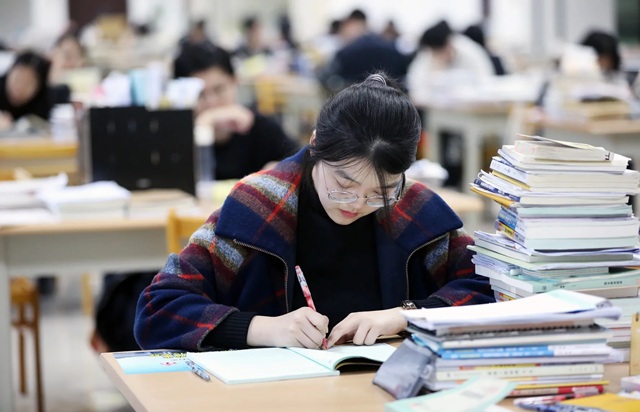
An increasing number of doctoral graduates from China’s leading universities and prestigious overseas institutions are taking jobs as secondary school teachers, as a growing supply of highly trained researchers collides with intense competition for university and research positions.
The trend is particularly visible at leading schools in major cities. A recently published roster of prospective hires at Shenzhen Middle School showed that all 21 incoming teachers hold master’s degrees or higher, including five PhD graduates. Among them are a Tsinghua University electrical engineering PhD recruited to teach mathematics, a University of Cambridge electrical engineering PhD appointed to teach physics, a Fudan University materials physics PhD hired for chemistry and a University of Chinese Academy of Sciences PhD recruited as a mathematics Olympiad coach.
Shenzhen Middle School has been building such a recruitment model for several years. In 2017, its principal, Zhu Huawei, said the school, as a bellwether for basic education in Shenzhen, should seek to become a world-class institution. In 2019, it attracted attention on social media after a hiring list included 20 graduates of Tsinghua University and Peking University, as well as one graduate of Harvard University.
The school now employs more than 100 teachers with doctoral degrees, more than 150 graduates of Tsinghua and Peking universities, and more than 100 alumni of leading international universities including Harvard, Oxford and Cambridge, according to the source cited by Caixin Global.
The same pattern is emerging elsewhere. In 2021, the Affiliated High School of South China Normal University recruited 40 new teachers, nine of whom were PhD graduates or postdoctoral researchers from institutions including Peking University, Tsinghua University and the Chinese University of Hong Kong. Suzhou High School’s 2025 recruitment cycle included 13 new teachers, 10 of them graduates of Tsinghua or Peking, while eight held doctoral degrees.
The movement has prompted debate about whether researchers with advanced qualifications are being underemployed. Qi Yifan, a Tsinghua PhD in optical engineering who was due to join Tianjin No. 1 High School as a physics teacher in 2025, defended his decision on social media. He argued that helping hundreds of students gain admission to top universities could make a greater contribution to society than working in an isolated research position.
Pay and benefits have also helped make teaching attractive. In 2019, Shenzhen’s Longhua District offered starting annual salaries of 260,000 yuan ($36,600) for teachers with bachelor’s degrees and 280,000 yuan for those with master’s degrees, alongside a 200,000 yuan bonus for full-time PhD holders and priority access to talent housing. Guangzhou offered moving allowances of 100,000 yuan to 200,000 yuan for incoming PhD graduates, while Shengzhou in Zhejiang province provided housing subsidies of up to 1.05 million yuan for PhD graduates from Tsinghua and Peking.
The pressure behind the shift is reflected in China’s doctoral education figures. Ministry of Education data show annual PhD graduates increased 82%, from 53,700 in 2014 to 97,200 in 2024, while doctoral enrolment more than doubled from 312,700 to 676,300.
At the same time, traditional academic employment has become highly competitive. Liu Shengjun, a professor at the Civil Aviation University of China, estimated in 2023 that domestic universities offered about 35,000 jobs annually, including administrative and logistics positions, producing a supply-to-demand ratio of nearly three to one for academic posts. Young academics also face three- to six-year evaluation periods under widely used tenure-track systems, during which they must publish papers and secure research grants or risk transfer or dismissal.
Xiong Bingqi, director of the 21st Century Education Research Institute, said the public should respect the choice by both schools and graduates. But he cautioned that doctoral qualifications alone do not guarantee teaching excellence. Schools, he said, should assess teaching aptitude rather than treating elite degrees as prestige measures, and provide the professional support needed to turn highly trained graduates into effective educators.