Over three decades, China has transformed from a relatively poor economy into the world’s largest economy by purchasing power parity, overtaking both the United States and the European Union. In 1990, China’s gross domestic product represented about 3% of the world economy, while 83% of its population lived on less than $3 a day. According to the World Bank, that proportion is now practically zero.
China’s economic rise has been accompanied by an extraordinary expansion of industrial capacity. In 2024, the country accounted for 28% of global manufacturing value added, up from 8.5% in 2004. It overtook the United States in 2010 and by 2024 its share exceeded that of the United States, Japan and Germany combined.
The country has also become dominant in a wide range of manufactured goods. In 2024, China accounted for 65% of the global value of traded toys and porcelain tableware, 74% of stainless-steel household goods and 71% of suitcases and toiletry cases. It also accounted for 68% of laptops, 61% of computer screens, 65% of air-conditioning equipment and 68% of video game consoles.
That industrial strength increasingly extends into advanced technologies. China produced 86.4% of the world’s solar panels in 2024, 80% of battery cells, nearly 72% of electric cars and 64% of smartphones. It also accounted for 54.4% of new industrial robot installations and 48.9% of the value of global drone exports. In 2024, Chinese factories installed 295,000 industrial robots, more than the rest of the world combined.
The expansion has involved domestic technological innovation as well as manufacturing scale. Chinese companies including CATL and BYD have developed battery designs that increase energy density, allowing more energy to be stored in less space. The International Energy Agency identifies such advances as part of China’s technological advantage.
China’s scientific and intellectual capacity has expanded alongside its industrial base. Chinese applicants filed 70,160 international patent applications under the PCT system in 2024, representing 25.6% of the global total. That compared with 54,087 applications from the United States and 48,397 from Japan. China had filed just 782 such applications in 2000.
Its academic output has also grown sharply. Between 2017 and 2023, China doubled its production of academic papers, publishing more than twice as many as the United States and 70% more than the European Union. The share of Chinese papers among the world’s top 1% most-cited research rose from 0.42% in 2006 to 1.29% in 2022. The United States stood at 1.72%, while the European Union was at 1.33%.
The expansion is particularly visible in medical research. Companies headquartered in China accounted for only 1% of global phase I–III clinical-trial starts in 2009. By 2024, their share had reached 30%, compared with 35% for the United States and 21% for Europe.
Chinese universities have risen rapidly as well. In 2015, none appeared among the top 100 in the Shanghai ranking; by 2026, 16 did. In the top 500, China had 115 universities, compared with 111 in the United States.
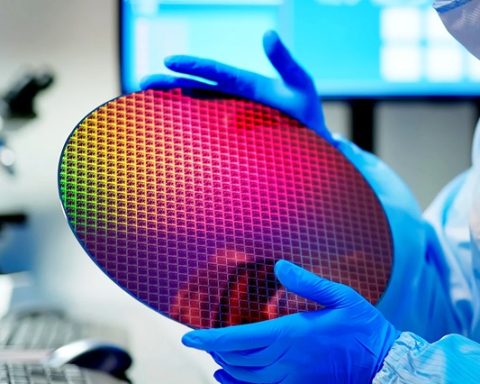
China’s remaining weakness is at the frontier of artificial intelligence. Its leading models are approaching US capabilities but, according to Epoch’s capacity index, have remained behind them. Since 2023, US models have led the index. Access to advanced AI chips is a major constraint: by the end of 2025, 96% of the accumulated computing capacity covered by the Epoch database came from chips designed by Nvidia, Google, AMD and Amazon, while China’s Huawei and Cambricon accounted for the remaining 4%.