Across some of the world’s driest regions, strange barren circles known as “fairy circles” may be revealing something far more valuable than an unusual geological curiosity: naturally occurring hydrogen beneath the ground.
In recent years, scientific measurements in Australia, North America, Brazil and Russia have found that fairy circles can form where naturally occurring hydrogen reaches the surface. The gas moves through the soil, displacing water and causing vegetation to die. As pressure falls, the ground collapses slightly, producing a shallow depression resembling a miniature caldera.
The phenomenon has attracted growing interest because it could provide a visible clue to underground hydrogen reserves. Unlike conventional hydrogen production, which requires industrial processes, naturally occurring hydrogen is generated underground through geological reactions.
The possibility of enormous natural hydrogen deposits first attracted attention in Mali in 1987, when well drillers encountered hydrogen gas. One frequently repeated account says a flame erupted from the well after a smoking driller approached it. The escaping gas was found to have a purity of around 98 per cent. The idea that the gas originated from a huge natural hydrogen reservoir was initially disputed but was later supported by further studies.
In Mali, sealing rock layers over gas deposits reaching depths of more than 1,200 metres allowed hydrogen to be extracted through drilling. Since 2014, a further 24 experimental wells have reportedly been drilled without a fall in gas pressure. Hydroma, formerly known as Petroma, believes oxidation processes in ore-bearing geological formations continually replenish the reservoir, now known as the Bourakebougou H2-Field.
The discovery helped drive wider research into geological hydrogen. In 2024, researchers at the U.S. Geological Survey estimated that more than 5.6 trillion tonnes of geologically bound hydrogen could exist underground. Even a fraction of that amount being recoverable could, according to the supplied research, potentially meet humanity’s energy requirements for the next 200 years.
Hydrogen is attractive because its reaction with oxygen produces energy while leaving water as the only waste product, unlike fossil fuels such as natural gas and coal. It can be used in fuel cells to generate electricity and is also being considered for power generation and industrial applications, including replacing coal in steel production. Its extremely high combustion temperature also makes it potentially useful for industrial melting processes.
Yet major obstacles remain. Hydrogen diffuses easily, can contribute to metal embrittlement and can be difficult to contain during storage and transport. These problems have helped prevent hydrogen from developing as widely as once expected in areas such as automotive technology.
The latest research from Edith Cowan University has added another potentially significant clue. Scientists studying the Pilbara region of north-western Australia found that magnetite in deeper geological layers may be responsible for the formation of fairy circles there. The circles develop when water at considerable depth, where pressure and temperature are high, reacts with the iron-bearing ore.
The study indicates that magnetite can react with water at temperatures above 200 degrees Celsius and release hydrogen. Crucially, the amount produced appears to depend significantly on the amount of mineral surface exposed to the hot water. Grinding magnetite could therefore accelerate hydrogen production, potentially making a controlled underground reaction possible.
Such a process could theoretically involve injecting heated, pressurised water underground and increasing the exposed mineral surface to enhance production. However, methods for efficiently capturing the resulting hydrogen have yet to be established.
That uncertainty has tempered talk of a new hydrogen rush. Unlike Mali, where sealing rock enabled relatively straightforward drilling, potential deposits in Australia, Brazil and the United States do not necessarily have the same natural containment.
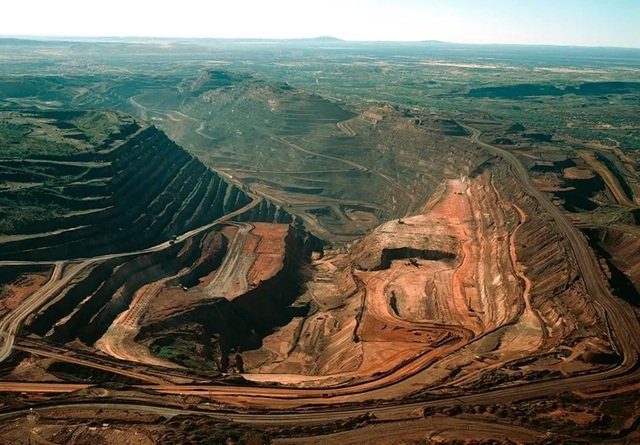
Australia nevertheless has an unusual advantage: the Pilbara is already a major iron-ore mining region, with companies possessing decades of experience extracting ore from the ground. Researchers now see the possibility of applying that expertise to an entirely different resource.
“This work helps bridge the gap between laboratory experiments and real geological systems,” said Stefan Iglauer, a co-author of the study and professor of energy engineering at ECU.
His co-author Alireza Keshavarz said Australia could be sitting on “a huge, untapped energy reserve”, with enough hydrogen potentially to benefit the country for generations and possibly make it a major exporter of clean energy.
For now, the promise remains greater than the production technology. The fairy circles may be pointing towards the resource — but finding a way to bring that hidden hydrogen safely and economically to the surface remains the real test.