Sri Lanka is not a country to be rushed, particularly in its southern reaches. That is the central impression conveyed by El País in its latest travel feature on the region: beyond Colombo’s intensity and congestion, the pace changes. Roads become greener, the countryside opens up and the journey begins to revolve less around ticking destinations off a list and more around allowing time to pass.
The comparison with Bali is revealing. Southern Sri Lanka today evokes something of Canggu a decade ago, before traffic, queues and crowds became defining features of the experience. There are surfers returning on motorbikes through narrow roads, rice paddies beside the route and cafés where specialty coffee sits alongside local breakfasts. Yet there is still room to move, fewer vehicles on the roads and a sense of hospitality marked by curiosity and kindness.
For a country whose modern tourism story has been repeatedly interrupted, that atmosphere carries particular significance. Sri Lanka emerged from a 26-year civil war in 2009 and spent years struggling to establish itself as a major tourist destination. The April 2019 attacks were followed by the pandemic and an economic crisis. More recently, intense rains associated with Cyclone Ditwah brought another disruption, mainly affecting the north of the country.
The result is a destination whose appeal cannot easily be separated from its recent history. Its tourism development has been uneven, and parts of the country retain a sense of discovery that has become increasingly difficult to find in more heavily visited destinations.
Timing matters, too. Sri Lanka is governed by two principal monsoons: the southwest monsoon between May and September and the northeast monsoon, concentrated mainly between December and February. That means there is always a part of the island where conditions are favourable for exploration.
A journey south can begin with a detour inland to Sigiriya. Lion Rock, the former royal fortress rising dramatically from the jungle, remains one of Sri Lanka’s most iconic sights. Nearby Pidurangala Rock provides a less crowded alternative and a different perspective on the monumental fortress. The route combines a tuk-tuk journey with a short walk and a rocky final ascent, rewarding visitors with a view of Lion Rock standing almost alone above the surrounding jungle.
From there, the character of the journey changes again in Yala National Park, where the emphasis shifts from monuments created by people to wildlife that has continued on its own terms.
Yala is one of the few places where visitors can relatively easily encounter leopards in the wild. The animals spend much of the day conserving energy and emerge around dawn or towards dusk. When one appears, the atmosphere changes. Deer become alert, peacocks issue alarm calls and the surrounding jungle seems to fall silent.
During the journey described by El País, a large leopard known to guides as Lucas appeared. Accustomed from an early age to vehicles, he sometimes allows himself to be seen and even walks alongside cars, although sightings are never guaranteed.
Leopards are only part of Yala’s attraction. Elephants, buffalo, crocodiles, monitor lizards and a wide variety of birds inhabit the park. During the dry season, animals gather around water sources, making wildlife encounters easier to anticipate.
Staying inside the park adds another dimension. At Wild Coast Tented Lodge, the jungle meets an Indian Ocean beach, with rainforest behind and the sea ahead. There are no artificial barriers separating guests from the surrounding environment. Monkeys may appear in the gardens, porcupines can be heard at night and crocodiles may be spotted near the property. After nightfall, guests are accompanied by a ranger to their accommodation.
The experience is deliberately structured around slowing down: safaris at dawn and dusk, long breakfasts, quiet time beside the sea-facing pool and a tea ceremony. As evening arrives, the day can end with a drink beside a fire on the beach.
From Yala, the route turns back towards the Indian Ocean and the small coastal communities that have become increasingly attractive to surfers, travellers and remote workers.
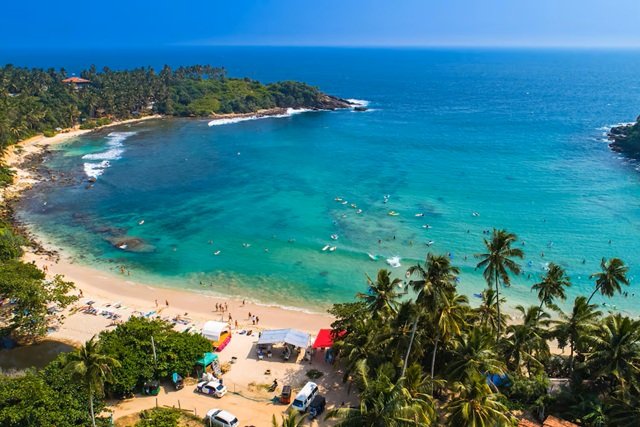
Hiriketiya is among the most intimate stops. The bay is compact and walkable, allowing visitors to move from the waves to a café, then to a hotel and back to the water without relying constantly on transport. Its combination of surfing, jungle and understated aesthetics has also attracted remote workers who extend their stays between sessions in the sea. Smoke & Bitters and Raa are highlighted among the places to eat.
Food itself forms an important part of the southern experience. Sri Lankan cuisine brings together subtly spiced curries, rice prepared in countless variations, freshly made rotis, dhal and hoppers, the thin and crisp rice-flour-and-coconut dish that works equally well for breakfast or dinner.
Further west, Ahangama provides a convenient base for exploring the coast. It attracts surfers as well as visitors looking for beaches, food and an easy-going atmosphere. Cafés overlooking the Indian Ocean have become meeting places for surfers, travellers and locals, with establishments such as Cactus, Ceylon Sliders and Kai contributing to the area’s distinctive character.
The Find, a nine-room hotel opened in 2025, embodies that slower approach. Its pool is only metres from the ocean, while its founder, Myles Pritchard, is described as appearing at breakfast after surfing in front of the property and sharing recommendations with guests. The hotel is not presented as a traditional surf house, but as an adults-only resort built around taking time and enjoying its setting.
A few minutes inland, the experience changes once again. Blue Waves Jungle Villa, owned by a Spanish couple, sits among rice paddies and offers a more agricultural view of southern Sri Lanka. From the pool, visitors can watch peacocks moving through the garden and monkeys in the palm trees, while birds provide the soundtrack to the day.
Weligama offers a livelier contrast. More spacious and chaotic than Hiriketiya or Ahangama, it is regarded as one of the best places in the south to learn or improve surfing, with schools spread around the bay. Nomad Café is among the places that attract visitors repeatedly.
From Weligama, Mirissa provides another change of pace, particularly for those seeking dinner beside the beach and fresh fish at simple restaurants along the seafront. Galle offers a different experience altogether. The ancient fortified city, shaped by Portuguese and Dutch heritage, has been a UNESCO World Heritage Site since 1988 and provides an urban counterpoint to the beaches and wildlife of the southern route.
The appeal of southern Sri Lanka, as presented by El País, ultimately lies in what it does not demand from the traveller. It does not require a hurried procession from one famous sight to another. Instead, its attractions coexist: Yala’s wildlife, mornings spent surfing, cafés overlooking the ocean, rice fields, small towns and villages where daily life retains its own rhythm.
That may be precisely what makes the region increasingly compelling. At a time when parts of Bali have become synonymous with congestion and queues, southern Sri Lanka still offers something more difficult to manufacture: the feeling that there is enough time.