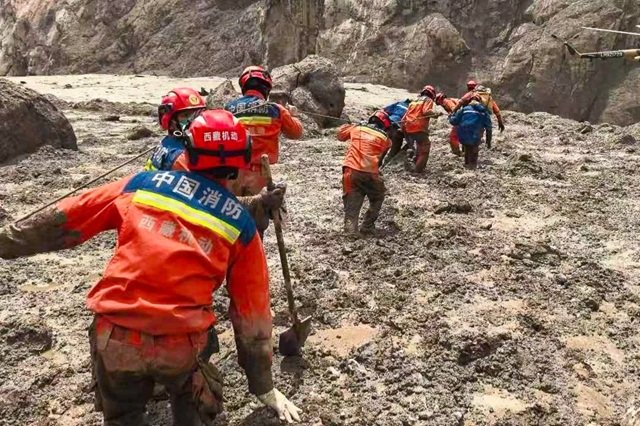
About 20 Chinese rescue workers in bright orange protective clothing operated excavators, shovels and ground-penetrating radar detectors on Sunday as recovery teams searched for hundreds of people still missing after a tsunami-like mudslide destroyed China’s main border crossing with Nepal.
The Gyirong border crossing, separating China’s Tibet and Nepal, has become a grim symbol of the devastation that followed the collapse of a glacier on the Nepal side of the border on August 26. The disaster swept through the narrow river gorge where the land port is located, destroying buildings and leaving large areas covered in deep mud and debris.
Reuters and other news agencies visited the land port on Sunday during the first trip organised for foreign media by China’s foreign ministry. Images and video from the site showed the scale of the destruction, including the complete disappearance of the five-storey Chinese customs building that had stood at the border before the disaster.
The only structure still visible from before the mudslide was part of a nearby water tower installation. Workers had placed a Chinese flag at the location where the border gate, which stood nearly 20 meters tall, once marked the crossing.
Behind hazard signs reading “Danger Area Pass Quickly”, three groups of about 20 rescue and recovery workers dug through the earth with shovels on Sunday afternoon, while several red excavators stood nearby. Officials said the rescue operation had divided the search area into seven zones. Searches had been completed in four zones, leaving three still to be examined.
The mudslide has killed more than 1,300 people on both sides of the border, while more than 5,000 remain missing. On Saturday, emergency crews in Nepal rescued a Chinese worker who had been trapped in a tunnel linked to a hydropower station.
On China’s side, 31 people had been confirmed dead and 531 others remained classified as missing as of Friday. Among those still unaccounted for are 261 foreigners from 23 countries, according to Chinese officials. The figures illustrate the international dimension of a disaster that struck a major route for movement between Nepal and Tibet.
Rescue efforts have been complicated by the geography and conditions of the area. Gyirong County sits at an average altitude of more than 4,000 meters, although the port itself is at around 1,800 meters. The continuing risk of landslides, poor weather and deep mud has made searches more difficult and increased the challenges facing recovery workers.
Access has nevertheless improved. The only land route into Gyirong was restored by Wednesday morning, enabling China to bring heavy equipment into the area for recovery operations and eventual rebuilding. State media has also shown workers restoring electricity by installing temporary electric poles to reconnect the area to the grid.
The destruction has hit a crossing that has become increasingly important over the past decade. Gyirong emerged as the main border route for travellers and trade between Nepal and Tibet after a 2015 earthquake in Nepal badly damaged an alternative crossing farther east.
The port had also faced disruption before the latest disaster, remaining closed between July last year and January because of an earlier glacial flood. Beyond serving as a shipment point for Chinese goods, including electric cars, it had become an important route for thousands of Hindu pilgrims travelling through Nepal towards Mount Kailash, a high-altitude site in Tibet revered by Hindus and Buddhists.
Many of the foreign nationals still missing in Tibet were pilgrims travelling with extended families in India, diplomats in Beijing have said. Among those missing are 49 Indian citizens, adding another international dimension to the continuing search at the devastated border crossing.