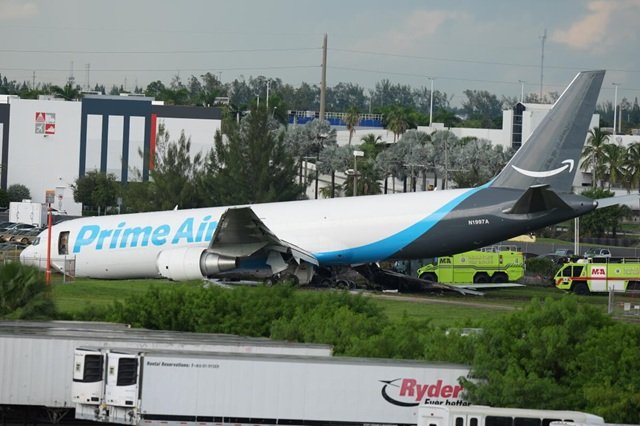
What Happened?
The aviation landscape is defined by the unrelenting pursuit of safety, a discipline where the margin for error is razor-thin and the consequences of failure are measured in human lives. On occasion, the veneer of systematic perfection is pierced by an event that compels us to look beyond the immediate mechanics of an accident and interrogate the fundamental philosophy of airport design, the resilience of infrastructure, and the iterative nature of global safety standards. The runway excursion involving an Amazon Air cargo aircraft at Miami International Airport (MIA) on 6 September 2026 stands as one such event—a tragic intersection of kinetic energy, infrastructure, and human operational complexity. While the immediate aftermath of such a catastrophe often prompts a clamour for simple solutions, a scholarly and analytical perspective demands we move past surface-level observations to engage with the complex regulatory frameworks, specifically those established by the International Civil Aviation Organization (ICAO), and the often-misunderstood engineering interventions like the Engineered Materials Arresting System (EMAS).
To frame this discourse, we must first revisit the physical reality of the incident. Though specific details regarding the precise timeline and meteorological conditions of the Miami event are subject to ongoing investigation by the National Transportation Safety Board (NTSB) and its international counterparts, the broad contours of the occurrence are clear: a heavy, wide-bodied transport aircraft, operating under the mantle of e-commerce logistics, traversed beyond the paved surface of the runway end. In the world of aviation, this is known as a runway excursion—a generic term that masks the sheer violence of the event. When a commercial airliner or heavy freighter exits the runway, it does not simply glide into the grass. It is a massive, high-velocity projectile interacting with terrain that was never designed to receive it. In the Miami incident, the aircraft’s failure to arrest its forward motion before traversing the airport boundary and encroaching upon adjacent infrastructure resulted in a catastrophic outcome, involving ground vehicles and resulting in fatalities. This tragedy is not merely an operational failure; it is a profound rupture in the “safety net” that modern aviation strives to weave around every takeoff and landing.
The public and media discourse following such events often fixates on the presence or absence of specific technologies, most notably, the Engineered Materials Arresting System (EMAS). EMAS, often colloquially misunderstood or idealized by the layperson, is a passive safety system designed to stop an overrunning aircraft by using crushable material beds located at the end of a runway. When an aircraft’s wheels sink into this cellular cement bed, the energy of the aircraft is dissipated through the deformation of the material. It is a deceptively simple and elegant solution to a problem that has plagued aviation since the dawn of the jet age: what happens when a plane runs out of runway? Yet, to argue that the absence of EMAS at Miami was the “cause” of the tragedy is to fundamentally misunderstand the architecture of aviation safety. Aviation is not built on a single pillar of defense but rather on a holistic, systemic approach—the “Swiss Cheese Model,” where multiple layers of protection, from pilot training and air traffic control to runway lighting and pavement friction, must fail simultaneously for a disaster to occur.
ICAO
To understand why MIA, an airport of global significance, might not be equipped with an EMAS installation on every runway end, we must look to the authoritative texts that guide international civil aviation: the ICAO Annex 14 (Aerodromes) and the associated guidance material, particularly the Airport Planning Manual (Doc 9184) and the Airport Services Manual (Doc 9137). ICAO, as the specialized agency of the United Nations, provides the Standards and Recommended Practices (SARPs) that signatory states incorporate into their own national regulations, such as those promulgated by the Federal Aviation Administration (FAA) in the United States.
According to ICAO Annex 14, the primary objective is to provide a Runway End Safety Area (RESA). The standard requires that a RESA be provided at each end of a runway, extending from the end of the runway strip to a distance of at least 240 meters (or 90 meters for shorter runways) for code 3 and 4 runways. The RESA is intended to be cleared, graded, and drained, ensuring that if an aircraft overruns, it encounters an environment that minimizes the risk of damage. However—and this is the crucial nuance often lost in public debate, the Airport Planning Manual acknowledges the reality of land use. Not every airport is blessed with vast, unencumbered tracts of land beyond its runway thresholds. Many airports, especially those in densely populated urban centers or regions with challenging geography like coastline or highway proximity, cannot meet the ideal RESA dimensions without immense societal and financial disruption.
In such instances, ICAO guidance provides for flexibility. When the standard RESA cannot be achieved due to physical constraints, the airport operator must perform a risk assessment. This is where EMAS enters the equation. EMAS is classified as an engineered alternative—a way to achieve an equivalent level of safety (ELS) even when the physical dimensions of a standard RESA are unattainable. It is not an arbitrary aesthetic choice nor a luxury; it is a mitigation measure specifically deployed to bridge the gap between “ideal design” and “geographic reality.” Therefore, the fact that a major international airport does not possess an EMAS bed at every runway end is not necessarily a violation of safety protocols. It suggests that the airport, in consultation with its regulatory body, has determined that the existing runway end environment may include extended safety areas, cleared buffer zones, or specific operational constraints, provides a level of protection deemed acceptable under current standards.
However, the tragedy in Miami compels us to re-examine the adequacy of these “acceptable” levels. The nature of global aviation is dynamic; the aircraft types, the frequency of operations, and the surrounding land use are in constant flux. An assessment that was deemed “safe” ten or twenty years ago may no longer reflect the risk profile of today’s operating environment. The Airport Services Manual emphasizes the importance of a continuous safety management system (SMS). This is not a static document but a living, breathing process. It requires that airports, in tandem with air navigation service providers, constantly monitor their risk registers. If a road that was once quiet now carries significant vehicular traffic, or if the mix of aircraft has shifted toward heavier, faster cargo jets, the risk assessment regarding runway end safety must be revisited.
Moral Obligations
This brings us to the core of the ethical and legal challenge in the aftermath of the Miami incident. If we accept the principle that aviation safety should be proactive rather than reactive, we must ask: at what point does the “flexibility” afforded by ICAO guidance become a liability? The Aerodromes Manual provides the technical specifications, but the moral imperative rests with the states and the airport operators. The disparity between airports like Chicago O’Hare or Ronald Reagan Washington National, which feature prominent EMAS installations, and airports that lack them, is often a reflection of the intense land-use pressure surrounding those specific sites. Reagan National, hemmed in by the Potomac River, had no choice but to adopt EMAS to operate safely within its constraints. Miami, with its different geographic configuration, may have relied on its runway geometry and safety areas, believing them sufficient until the event proved otherwise.
This observation is not an exoneration of any party, but an acknowledgment of the complexity of the “Safety Case.” When an accident occurs, the post-mortem investigation serves as a crucible. It must look at the “Three Pillars of Safety”: the human factor, the technological factor, and the organizational factor. Was the crew provided with the most accurate information on runway surface conditions? Was the aircraft’s braking performance optimal given the meteorological conditions? Was the “stability” of the approach maintained? And critically, did the runway-end environment, as currently configured, perform to the design intent?
If the investigation reveals that the accident occurred despite the flight crew operating within standard parameters, then the focus must inevitably shift to the infrastructure. Here, the doctrine of res ipsa loquitur—the thing speaks for itself—might be tempting, but it is insufficient in technical aviation investigation. We must instead apply the doctrine of “Reasonable Foreseeability.” Was it reasonably foreseeable that an aircraft might overrun this specific runway, given the frequency of operations and the external environment? If the answer is yes, then the question becomes one of cost-benefit analysis—a grim but necessary calculation that sits at the heart of civil aviation policy. The cost of installing EMAS, while high, is infinitesimal compared to the cost of human life and the systemic disruption of a major airport. Yet, we must be careful not to create a false binary where EMAS is the only solution.
True safety in the modern era requires a multi-layered approach that the Airport Planning Manual advocates for. This involves, first and foremost, the prevention of the excursion itself. The most effective EMAS is one that is never touched by an aircraft because the landing was stable, the weather information was accurate, and the runway friction was properly monitored. We must invest as much in the digital architecture of safety—the real-time dissemination of braking action reports, the integration of weather data into cockpit flight management systems—as we do in the physical infrastructure of crushable concrete.
The Airport
Furthermore, we must address the “externalities” of the airport. The encroaching urbanization of airports is a global phenomenon. Residential developments, warehouses, and critical highway infrastructure often press against the very boundaries of aerodromes. The ICAO standards regarding obstacle limitation surfaces (OLS) and runway end safety areas are designed to create a “no-man’s-land” that serves as a buffer. When this buffer is compromised by road or rail, the risk increases exponentially. The Miami incident highlights the danger of what happens when the airport boundary is not a true buffer but merely a line on a map. Public authorities and urban planners must recognize that an airport is not a static facility; it is an active, evolving zone of risk. Land use planning around airports must be integrated into the aviation safety strategy, not treated as a separate civic concern.
As we dissect the lessons of the Miami cargo overrun, we must do so with a spirit of humility. Aviation safety is an endless journey toward a horizon we can never quite reach. We cannot eliminate risk; we can only manage it. The ICAO Aerodromes Manual and the Airport Planning Manual provide the map, but it is the vigilance of the operator, the rigors of the regulator, and the commitment of the state that drive the vehicle.
The tragedy in Miami is a somber reminder that the “global village” is connected not just by the speed of our commerce, but by the shared fragility of our systems. When a cargo aircraft fails to stop, it is a failure of the collective safety apparatus. To prevent a recurrence, we must avoid the seductive simplicity of pointing to a missing piece of equipment as the sole culprit. Instead, we must undertake a rigorous, evidence-based review of the entire runway-end safety environment. This review should not be limited to the installation of EMAS, but should encompass the full spectrum of defensive layers: from the training of pilots to handle aborted landings, to the technological enhancement of runway monitoring, to the long-term, painful, but necessary redesign of land use around our most critical transport hubs.
In the final analysis, the pursuit of aviation safety is a liberal, humanitarian endeavor. It is rooted in the belief that every individual, whether on an aircraft or driving on a road near an airport, has the right to security and protection from the hazards of modernity. The technical documents issued by ICAO are not merely dry collections of engineering specifications; they are the codification of this humanitarian principle. By aligning our infrastructure with these global standards, and by treating every runway as a unique, high-stakes environment requiring constant reassessment, we honor the memory of those lost in Miami. We do not just build better airports; we build a more resilient, more equitable, and more secure future for global civil aviation. The path forward is not found in the blame game, but in the painstaking, analytical, and forward-looking application of those very standards that aim, above all else, to keep the sky safe and the ground secure.
Continuous Monitoring
In observing this, one cannot help but recall the evolution of air law and safety regulation over the past decades. The transition from the localized, fragmented safety practices of the early jet age to the harmonized, globally integrated standards we enjoy today is a testament to the power of international cooperation. Yet, the Miami incident serves as a stark reminder that this system is not a monolith; it is an ecosystem that requires constant nurturing and adaptation. The technical provisions in the Airport Planning Manual are intended to be interpreted through the prism of the specific risk profile of each airport. The challenge, therefore, is to ensure that the “flexibility” provided to states does not devolve into “laxity.” This requires a robust regulatory oversight mechanism, one that is willing to challenge the status quo and demand upgrades, even when the facility technically “meets the minimum.”
This perspective aligns with a more progressive, risk-based approach to safety management. We must move beyond “compliance-based” safety—which asks, “Does this meet the minimum requirement?”—to “performance-based” safety, which asks, “Is this the safest achievable outcome?” The difference is profound. A facility might be fully compliant with outdated standards while still harboring significant, unaddressed risks. The transition to performance-based oversight, as encouraged by ICAO, places the onus on the airport operator to justify their safety measures based on the specific threats they face. If an airport’s risk assessment identifies that the surrounding land use presents an unacceptable risk to the public in the event of an overrun, the operator should be required to implement advanced mitigation, whether that is EMAS, extended runway end safety areas, or restricted vehicular access to adjacent roads.
Challenges
This also touches upon the vital role of transparency. The findings of accident investigations should not be buried in dusty archives; they must be translated into actionable guidance for every airport in the world with similar characteristics. The global aviation community shares a common body of knowledge, and the lessons learned in Miami must be disseminated to every aerodrome manager globally. The sharing of safety data, the open reporting of near-misses, and the collaborative analysis of infrastructure limitations are the hallmarks of a mature safety culture.
Furthermore, we must address the role of the pilot in this equation. While the discussion often centers on engineering, the human element—the pilot’s decision-making process during the critical seconds of a touchdown—is paramount. Are we providing pilots with sufficient, real-time data to make informed decisions about whether to continue a landing or execute a go-around? The Airport Services Manual speaks to the importance of runway friction monitoring and the prompt reporting of conditions. If a runway is compromised by water, the ability of a pilot to make a go-around decision is contingent on the quality of the information they receive. The interface between the airport’s infrastructure and the cockpit is a critical, often neglected, dimension of safety.
As we look toward the future, the increasing automation of aircraft and the anticipated growth in cargo operations will only amplify the pressures on our airport infrastructure. The rapid expansion of e-commerce has led to a proliferation of cargo flights, often operating at odd hours, in various weather conditions, and with highly demanding schedules. This operational tempo requires an equally rigorous tempo in infrastructure maintenance and improvement. We cannot expect 20th-century runway designs to handle 21st-century logistics demands without significant investment and upgrading of our safety buffers.
The tragedy in Miami is a call to action. It is a reminder that in the high-stakes world of aviation, “good enough” is never sufficient. We must strive for excellence, not just in our machines, but in our design, our regulation, and our shared culture of safety. The ICAO documents are not merely suggestions; they are the bedrock upon which the entire edifice of international aviation rests. By holding ourselves to these high standards—and by constantly pushing the boundaries of what is possible in the name of safety—we can prevent such tragedies from recurring. We owe it to the passengers, the crews, and the communities that surround our airports to ensure that the skies remain a domain of safe and efficient movement, protected by a safety net that is as robust as it is comprehensive.
In the final reckoning, the Miami accident will be analyzed through many lenses—legal, technical, operational, and ethical. It will be studied in classrooms, debated in boardrooms, and scrutinized by regulators. But the ultimate value of this analysis will not be found in the assignment of fault. It will be found in the changes that are made, the standards that are updated, and the new safety measures that are implemented at airports across the world. It will be found in the quiet, painstaking work of engineers and planners who, inspired by this tragedy, look at their own runways and ask, “How can we make this safer?” That is the true legacy of aviation safety, and that is how we turn the darkness of a single, devastating event into the light of lasting progress.
The conversation must also move toward the concept of “Resilient Infrastructure.” It is not enough for an airport to be safe in normal operations; it must be resilient in the face of abnormal events. This means designing for the “edge cases”—the unexpected gusts of wind, the hydraulic failure, the rare coincidence of conditions that pushes an aircraft beyond its performance envelope. Resilience implies a system that can absorb the shock of an excursion and mitigate its impact. This is the promise of EMAS, but it is also the promise of proper land-use planning, effective barrier systems on adjacent roads, and rigorous emergency response protocols. It is a holistic view that recognizes that the runway is not an isolated island, but part of a larger, interconnected environment.
We must also recognize the global nature of this challenge. While local airport authorities hold the responsibility for day-to-day operations, the standards they follow are global. This is the beauty and the difficulty of the ICAO system. It allows for a unified approach to aviation safety across continents and cultures, but it also means that a failure at one airport resonates globally. The Miami incident is not an American story; it is a global aviation story. The lessons learned here belong to the international community. If we find that existing RESA standards are insufficient for the current fleet of heavy, long-range, high-speed cargo aircraft, then we must have the courage to advocate for a global update to the standards, even if it requires significant capital investment at airports worldwide.
The ethics of such a decision are clear. The aviation industry is built on the public’s trust. When people board a plane, or when they live near an airport, they place their trust in a system that they assume is managed with the utmost care and foresight. When that system fails, that trust is shaken. Restoring it requires more than just words; it requires action. It requires a willingness to confront hard truths, to admit when our designs are no longer sufficient for the tasks we demand of them, and to invest in the safety of our systems, not just for the sake of compliance, but for the sake of the people they serve.
In this context, the role of international aviation law becomes increasingly important. Treaties and agreements facilitate the movement of aircraft, but they also create a framework for shared responsibility. The ICAO Council, the Air Navigation Commission, and the various panels of experts that work tirelessly to update the SARPs are the guardians of this framework. They, too, are influenced by events like the Miami accident. They observe, they analyze, and they incorporate these lessons into the evolving global standards. This is the heartbeat of international aviation—a constant process of learning and improvement, fueled by the dedication of thousands of professionals worldwide.
As we conclude this reflection, let us reiterate the essential point: the Miami cargo overrun was a tragic failure, but it is not a signal that our entire safety system is broken. On the contrary, it is a reminder of why that system exists and why it must be constantly defended and improved. The aviation community has an extraordinary record of resilience and innovation. From the early days of aviation, we have learned from every mistake, analyzed every failure, and used that knowledge to build a safer future. This is the path we must continue to walk.
The tragedy of the Amazon cargo overrun in Miami is a heavy burden, one that will be felt by the families of those lost for years to come. But we must ensure that their loss is not in vain. We must use the knowledge gained from this event to strengthen the foundations of our safety system, to ensure that the “safety net” is stronger, more responsive, and more comprehensive than ever before. We must continue to interrogate our assumptions, to challenge our practices, and to commit ourselves, with unwavering dedication, to the principle that safety is the most important commodity in aviation. Only then, through the hard work of research, analysis, and implementation, can we hope to fulfill the promise of a truly safe and secure global aviation network.
This analysis, written in the spirit of the rigorous, human-centered approach championed by scholars and practitioners of international aviation law, underscores the necessity of moving beyond the immediate clamor for quick fixes. Instead, it invites us to engage in a deeper, more systematic examination of the structures that govern our skies. Whether it is the technical nuances of the Airport Planning Manual or the broader, philosophical implications of our commitment to safety, the message is clear: the journey toward perfection in aviation is an ongoing process of inquiry, adaptation, and unwavering vigilance. The lessons of Miami are waiting for us; it is our collective duty to learn them well, to act upon them with resolve, and to ensure that the skies remain a place of progress, protected by the wisdom of our shared experience.
The story of aviation safety is a story of human ingenuity pitted against the inherent risks of flight. It is a story that has no end, only chapters of growth and adaptation. The chapter currently being written, in the wake of the Miami incident, must be one of profound reflection and determined action. We must honor the complexity of the systems we have built, respect the power of the natural forces we navigate, and above all, hold fast to the principle that the protection of human life is the ultimate measure of our success. The road ahead is challenging, but it is a road we travel together, guided by the light of evidence, the weight of our shared experience, and the unyielding goal of making every landing as safe as the first. This is the true mandate of aviation safety, and this is the promise we must keep.
My Take
The tragic overrun of an Amazon Prime Air Boeing 767 at Miami International Airport raises a question that is larger than the immediate circumstances of one accident: have we done enough, internationally, to protect an aircraft when the runway is no longer sufficient to contain it? The aircraft, operated by 21 Air, overran the runway after arriving from San Juan, struck vehicles beyond the runway environment and caught fire. At least five people were killed and several others injured. The investigation by the United States National Transportation Safety Board is only beginning, and it would therefore be premature to attribute causation to pilot technique, touchdown point, braking performance, weather, runway condition or aircraft malfunction.
Yet an accident investigation and the broader question of aerodrome safety are not mutually exclusive. Indeed, the purpose of the latter is precisely to ensure that when human or mechanical performance falls short of perfection, the aerodrome itself provides a final layer of protection. This is the philosophy underlying the Runway End Safety Area (RESA) in ICAO Annex 14. RESA is intended to reduce the risk of damage to an aircraft undershooting or overrunning the runway. ICAO’s own material recognizes that arresting systems may constitute an appropriate mitigation where the conventional safety area cannot provide the necessary level of protection.
The conceptual importance of this principle is profound. A runway should not be regarded merely as a strip of pavement upon which an aircraft lands. It is part of a larger safety system comprising the runway, runway strip, RESA, visual aids, declared distances, obstacle limitation surfaces, drainage, friction characteristics, rescue and fire-fighting capability and, where appropriate, engineered arresting technology. The Airport Planning Manual and the Aerodrome Design Manual reflect this systems approach: airport planning is not simply an exercise in determining how much pavement an aircraft requires, but in creating an aerodrome environment capable of accommodating foreseeable operational contingencies.
The Engineered Material Arresting System, or EMAS, represents perhaps the most tangible expression of this philosophy. ICAO has acknowledged that arresting systems can provide safety performance equivalent to the prescribed RESA and has specifically recognised the successful use of EMAS in stopping aircraft that have overrun runways. The significance of EMAS is therefore not that it prevents an aircraft from leaving the runway; rather, it accepts that an overrun may occur and seeks to make the consequences survivable.
This distinction is important. Aviation safety has progressively moved from a philosophy of prevention alone towards one of containment and mitigation. The objective is no longer merely to ask, “How do we prevent the aircraft from overrunning?” but also, “What happens if it does?” ICAO’s Global Runway Safety Action Plan already identifies runway excursions as a safety priority and calls for RESA or appropriate mitigations such as arresting systems.
The Miami accident therefore invites ICAO to undertake further work, not necessarily because its existing provisions are deficient, but because aviation has changed considerably since many of the underlying concepts were formulated. Modern airports are increasingly constrained by urban development, surrounding roads, commercial facilities and other infrastructure. Cargo aircraft are operating with substantial weights and increasingly complex operational profiles. The question is whether a nominally compliant runway environment remains sufficiently resilient when viewed against the consequences of a high-energy overrun.
I would therefore suggest that ICAO examine, through its aerodrome and runway-safety machinery, whether the present international framework should move toward a more risk-based and consequence-oriented assessment of runway ends. Such an assessment could consider aircraft mass and energy, runway length, surrounding land use, traffic density beyond the runway end, terrain, meteorological conditions and the feasibility of EMAS or other arresting technologies. ICAO should also examine whether airport master planning should more explicitly integrate the protection of persons and property beyond the aerodrome boundary.
The lesson of Miami is consequently not simply that aircraft must stop before the end of a runway. That proposition is self-evident. The deeper lesson is that the end of the runway should not necessarily be the end of the safety system. An aerodrome worthy of the name must possess layers of protection extending beyond the pavement, so that when the extraordinary occurs, the consequences do not become catastrophic. ICAO has already established the intellectual and regulatory foundations for such an approach. The Miami tragedy provides an opportunity to ask whether those foundations should now be strengthened, modernized and made more universally responsive to the realities of twenty-first-century aviation.