


by Our Special Defence Correspondent
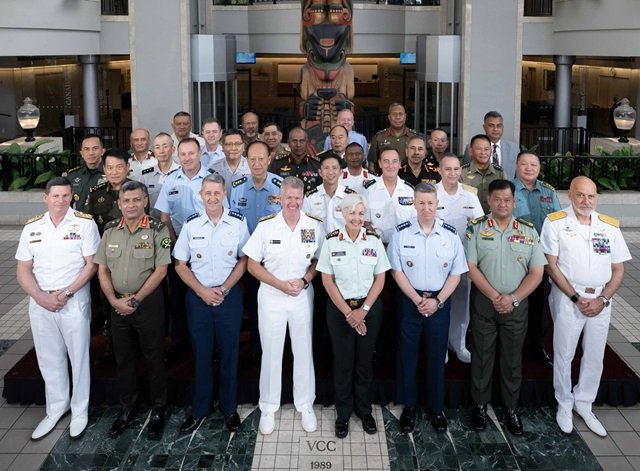
Sri Lanka has managed to turn a question of military representation into a question of institutional confusion. At the 28th Indo-Pacific Chiefs of Defence Conference in Victoria, Canada, from 31 August to 2 September, the country was represented by its Defence Secretary, Air Vice Marshal (Retd) Sampath Thuyacontha. The conference brought together defence chiefs and senior military leaders from around 30 countries and was co-hosted by Canada’s Chief of the Defence Staff, General Jennie Carignan, and the Commander of US Indo-Pacific Command, Admiral Samuel Paparo. The official US account describes it plainly as a Chiefs of Defence conference.
There is nothing inherently improper about a civilian defence official attending a military conference. Canada’s own Defence Minister addressed the gathering. Civilian control of the armed forces is a fundamental principle of democratic government. NATO itself maintains a clear distinction between civilian defence authorities and military command, and its institutional calendar separately identifies meetings of Defence Ministers and meetings held at Chiefs of Defence level. NATO’s Military Committee, for example, meets at CHOD level as the Alliance’s highest military authority.
That distinction is precisely why Sri Lanka’s decision deserves scrutiny.
A Defence Secretary is a civilian official responsible for the administration and implementation of government defence policy. A Chief of Defence Staff is a senior military institution designed to provide professional military coordination and advice across the Services. One does not become the other simply because the Defence Secretary happens to be a retired senior military officer.
The irony becomes difficult to ignore because the same Government is now attempting to abolish the statutory office of Chief of Defence Staff. The Chief of Defence Staff (Repeal) Bill has been approved at committee level and is scheduled for its second reading in Parliament on 9 September. Parliament’s own explanation says the 2009 Act established functions including coordination between the Armed Forces and the Ministry of Defence. The Government now argues that a separate CDS office is no longer necessary and that the functions can be handled through the Ministry of Defence.
And then, almost on cue, Sri Lanka arrives at a conference built around Chiefs of Defence without a serving CDS.
This is not a question of whether the Defence Secretary should have worn a uniform. He should not. He was attending in his civilian capacity, and the official US account correctly identifies him as Secretary to the Ministry of Defence. The uncomfortable question is much more fundamental: if Sri Lanka removes its senior tri-service military coordination institution, who exactly is supposed to perform that function when the country engages with the world’s senior military leadership?
The Government cannot have it both ways. It cannot argue that the CDS function is sufficiently important to be represented internationally while simultaneously arguing that the institutional position designed to perform that function is unnecessary. If the function has genuinely become redundant, the Government should explain what has replaced it. If the function remains necessary, abolishing the office does not make the function disappear.
There is also something profoundly revealing about the optics. The official Sri Lankan account proudly says the Defence Secretary represented Sri Lanka and participated in discussions with defence and military heads from around 30 countries. The US Pacific Command photograph goes further, showing him addressing fellow military leaders during a panel discussion. So this was not merely a ceremonial visit. He was actively representing Sri Lanka in substantive security discussions.
There have also been reports and social-media claims concerning the Defence Secretary travelling with his wife. I have not found sufficiently reliable public documentation to establish that independently, and therefore it would be irresponsible to turn it into an allegation of misuse of public funds. If the trip was privately accompanied and no public money was spent on the spouse, there may be no financial issue at all. But transparency is precisely why travel arrangements and expenditure should be clear when senior officials undertake overseas defence engagements.
The bigger embarrassment is not civilian clothing. It is institutional design. NATO understands the difference between political control and military command. Serious democracies do not confuse civilian authority with professional military leadership. Sri Lanka should not either.
If the Government wants to abolish the CDS, let it explain who replaces the function. If there is no replacement, then the country has not streamlined its defence structure. It has simply removed a piece of it and hoped nobody would notice. The world noticed in Victoria. The question now is whether Colombo will.










Government taking over Military function. Vibes of the OLD JVP ???????