C. discovered that he was being deported to Africa almost by accident.
The 36-year-old Venezuelan had spent five years living and working in the United States. He had a temporary residence permit, renewed annually, that allowed him to work legally. He sold vehicles during the day and delivered food at night. He says he obeyed the law and had built what he regarded as an ordinary life.
Then, after eight months in US immigration detention, he was put on a charter flight to Liberia — a country he had never heard of and with which he had no family, legal or personal connection.
“I found out I would be deported to Africa only a few hours before the flight,” C. says. Nobody formally informed him, he says. He happened to see his name on a list of people who were to be transferred to Liberia. There was no time, he says, to challenge the decision legally or say goodbye to his family. “I couldn’t do anything. Everything had already been decided.”
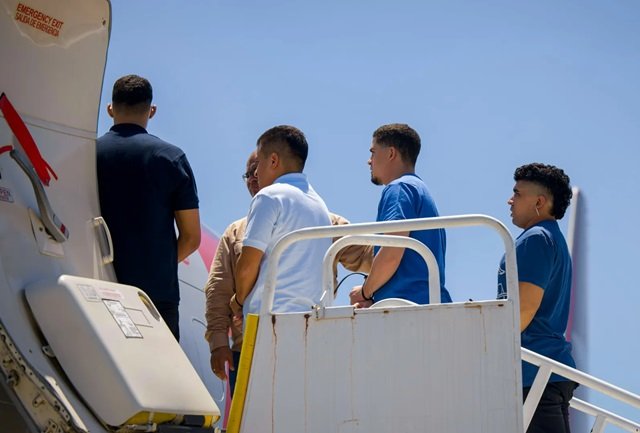
On 19 August, US Immigration and Customs Enforcement (ICE) placed C. and other migrants from Latin America, the Caribbean and sub-Saharan Africa on a charter flight departing Alexandria, Louisiana. They became the first group sent to Liberia under an agreement in which the government of President Joseph N. Boakai has agreed to receive about 1,200 people from the United States over the course of a year.
The arrangement is part of a much broader US policy of transferring migrants to countries other than those of which they are nationals. Between 20 January 2025 and 15 August 2026, the US government signed transfer agreements with more than 35 countries across Africa, Asia and the Americas. During the same period, more than 23,000 people were deported to 26 countries, according to Human Rights First and Refugees International, organisations monitoring the forced transfers.
More than 300 detainees have been sent to 14 African countries, including Liberia, the Central African Republic, the Democratic Republic of Congo, Eswatini and South Sudan.
Among the most contentious cases are people who already had legal protections against removal to their countries of origin. Such protections can prohibit forced repatriation where there is a genuine risk of persecution or torture, obligations recognised under the United Nations Refugee Convention and the Convention against Torture.
C. says his own protection arose from the danger he faced in Venezuela. He spent his life in the Venezuelan Andes before leaving in 2021 amid the country’s political and economic crisis. As an opposition supporter, he says he faced serious danger and eventually fled after believing he was close to being killed.
Instead of returning him to Venezuela, US authorities sent him to Liberia.
His initial two-week detention, which officials told him was necessary for a special investigation, eventually lasted eight months. During that time, he was transferred between nine different detention centres.
“They are places where nobody would want to be: dirty, full of rats,” he says. “There are also people there who have committed crimes, but I am innocent.”
For C., the most painful consequence has been the birth of his only child. His son was born while he was detained. The child is now five months old, and C. has never held him.
“I can only see him by video call,” he says. “There are things you would not wish on anyone.”
His situation in Liberia is, at least in one respect, different from that of some other migrants transferred to Africa. The Liberian government has said those sent there would be free to move around the country, apply for asylum or leave.
The 20 migrants sent to Liberia initially arrived in Monrovia. Six reportedly refused to leave the aircraft and were subsequently deported to Malabo, Equatorial Guinea. Fourteen others were taken to a hotel in Marshall, a coastal city about 50 kilometres from the capital, where they have remained for more than a week without knowing when they will leave.
A., a 45-year-old Venezuelan, says he was transferred between four detention centres in the United States within a few months. His lawyer was not informed of the transfers or his deportation, he says.
He had gone with his wife to an immigration office for a routine check. Both had protection against repatriation to Venezuela and neither had a criminal record. His wife was allowed to leave. A. was detained.
He says the months in detention brought severe anxiety and depression. When ICE officers took him towards the aircraft bound for Liberia, he feared they intended to kill him.
“I was in a panic,” he says. “The ICE agents have that power: they psychologically terrorise you with their silences, their vague answers and their mistreatment.”
When he tried to resist boarding, an officer stopped him.
“Either you get on voluntarily or we put you on by force,” A. recalls being told.
Once inside, he says, everyone began to cry.
“We were chained by our hands and feet throughout the entire journey,” he says. The flight lasted about 15 hours.
A. says that when authorities initially told him he would be returned to Venezuela, he objected because he feared persecution as an opposition supporter. The response, he says, was: “You are no longer at risk. Venezuela is now free.”
He rejects that assessment, saying opposition supporters he knows remain afraid for their safety.
The effects have extended far beyond the migrants themselves. A. says his daughter is receiving therapy and repeatedly asks why her father is in Liberia when he “did nothing”. His older son has considered leaving school to work and help support the family.
“We are a traumatised family,” A. says. “They are destroying entire families.”
W., a 40-year-old Honduran, describes another dimension of the uncertainty. He says staff from the International Organization for Migration visit the migrants daily and that he is receiving assistance with his diabetes. He also says the hotel is clean and that the deportees can enter and leave freely.
But he does not feel safe outside.
He says he rarely moves more than 10 metres from the hotel because he fears assault or robbery.
W. has already been deported twice under the Trump administration — first to Honduras and now to Liberia. He says he was intercepted by police in New Orleans while driving to collect his wife from work. He was eventually taken to Jackson Parish Correctional in Louisiana and then transported to Alexandria airport.
There, he says, some Cuban and Guatemalan passengers panicked and resisted. ICE agents restrained them.
“Seeing that scene, I started crying,” W. says. “I asked myself what had happened to the United States I knew, the country where I felt free and safe to live and go out with my children.”
The US system permits transfers to third countries under guidelines issued by the Department of Homeland Security in March 2025. Before a deportation, the United States is to determine whether the receiving country offers assurances that the person will not face expulsion or torture. If those assurances are considered credible by the State Department, the transfer can proceed without additional procedures or asking the person whether they feel unsafe there.
The legality and implications of the policy are increasingly contested.
The first US-Liberia agreement, signed in September 2025, is being challenged in litigation over asylum-cooperation arrangements. US law provides that an asylum seeker can be sent to a third country only if it is genuinely safe and offers a comprehensive and fair asylum system.
Savi Arvey, director of Refugee and Immigrant Policy and Rights at Human Rights First, says Liberia lacks the capacity to process asylum applications. She warns that migrants could remain in indefinite limbo or face “chain refoulement” — ultimately being returned to the same countries and conditions from which they fled.
The agreements have also raised questions about money and diplomatic pressure. According to a February report by Democratic members of the US Senate Foreign Relations Committee, the Trump administration has spent more than $40 million of US taxpayer money on third-country deportation arrangements.
The agreements are generally opaque, with documents often unavailable publicly and few details emerging about what receiving countries obtain in return.
In Liberia’s case, the relationship has involved a series of economic and diplomatic developments. After the Liberian government agreed to accept a Salvadoran deportee last year, Washington extended the validity of business and tourist visas for Liberian citizens from 12 to 36 months. In December, the United States committed $124 million to Liberia’s health sector. Around the same period, Ivanhoe Atlantic, backed by US interests, agreed to pay $1.8 billion for a five-year concession involving the transport of iron ore along Liberia’s railway corridor.
An investigation by The New York Times also reported that the US State Department agreed to provide Liberia with $5 million to manage third-country nationals transferred from the United States, despite previous Liberian government statements that it had received no compensation and that the arrangement was strictly humanitarian.
For the migrants now staying in Marshall, those diplomatic and financial calculations offer little comfort.
They are free to leave the hotel, but none of the three interviewed wants to remain in Liberia. Through a Liberian lawyer, they are in contact with US law firms working on their cases.
For C., the immediate reality is a country he did not know existed until his deportation was already decided.
For A., it is a family divided across continents and children struggling to understand why their father is gone.
For W., it is the memory of a United States where he once believed he was safe.
The question raised by their stories is no longer simply where migrants are deported. It is whether a person can be removed to a country with which they have no connection, without meaningful opportunity to challenge the decision, and still be regarded as having received a safe and lawful destination.
For those waiting in a hotel near Monrovia, that question is not theoretical. It is where their lives now stand.