by Durga Velayudham
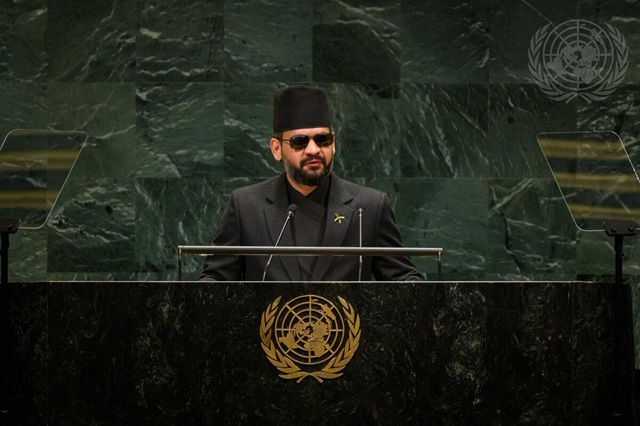
Nepal’s Prime Minister Balendra Shah arrived at the United Nations with an image almost impossible to ignore. A young prime minister in black glasses, speaking for a landlocked country wedged between two giants, standing before the representatives of the world’s most powerful states and telling them that the international system has failed the people least responsible for its failures. His speech was deliberately constructed for the age of climate catastrophe. It had mountains, dead and missing citizens, melting glaciers, angry questions, clever metaphors, China and India, war and food, climate justice and finally Buddha. It was also, in places, very good politics. But precisely because it was so carefully designed, it deserves to be examined more severely than the applause it is likely to receive.
Shah’s central argument is difficult to dismiss. Nepal contributes less than 0.1 per cent of global greenhouse-gas emissions, yet it faces severe consequences from a changing Himalayan environment. His speech placed the recent Bhotekoshi-Trishuli disaster at the centre of that argument, citing at least 1,400 confirmed deaths, more than 6,000 missing people and recovery needs estimated at about 10 per cent of GDP. Those figures are also reflected in contemporary reporting and in the published transcript of his address. The devastating floods and landslides were not invented for diplomatic theatre. They exposed genuine vulnerability in a country where geography itself makes infrastructure, communications and rescue extraordinarily difficult. Shah was therefore on firm political ground when he asked why a country that contributes so little to global emissions should repeatedly be forced to spend scarce resources repairing climate-related destruction. But the speech becomes less convincing when it moves from a powerful moral argument to the implication that climate change alone provides the complete explanation for Nepal’s vulnerability.
The most effective line in the speech may also be its most theatrical. “We have built a world with flawless logistics for war and broken logistics for food,” Shah declared, contrasting missiles and ammunition that cross borders with the inability of a Nepali farmer to obtain fertiliser or fuel when needed. It is an extraordinary sentence because it compresses an enormous international political economy into one image. It is also an exaggeration. The world does not possess flawless military logistics, nor are civilian supply chains simply broken. Wars, sanctions, shipping disruptions, commodity prices, infrastructure shortages, domestic regulation and political decisions produce highly uneven systems of distribution. Yet the exaggeration contains a serious question. Why can states mobilise extraordinary resources when strategic interests are involved while basic economic security remains painfully difficult for poorer populations? Shah does not really answer that question. He turns it into a moral indictment, which is rhetorically effective but analytically incomplete.
His demand for grant-based climate finance is similarly compelling but politically convenient. Shah argues that poor countries should not be forced to borrow their way out of disasters they did not create. That position deserves serious attention, particularly when reconstruction itself can increase debt burdens. He is also right to criticise complicated financing procedures that can delay assistance. But there is an uncomfortable question beneath the appeal for grants. Who determines responsibility, how is historical responsibility calculated, and how should limited international resources be distributed among dozens of vulnerable states making similar claims? The speech invokes “common but differentiated responsibilities and respective capabilities”, but does not confront the hardest problem of all. Climate finance is not merely a moral contest between innocent victims and guilty polluters. It is an increasingly complicated struggle over definitions, eligibility, historical emissions, present emissions, national capacity and competing claims on finite funds.
The speech is also striking for what it does not say about Nepal itself. Shah speaks eloquently about global failure, but national vulnerability is not created exclusively in foreign capitals. Building roads on unstable slopes, locating settlements and infrastructure in hazardous areas, regulating construction, maintaining hydropower projects, protecting river corridors, managing forests and developing credible early-warning systems are domestic responsibilities as well as international ones. His proposed Himalayan Climate Resilience Mechanism involving Nepal, India and China is potentially significant because the Himalayas do not conform to national borders. The proposal includes satellite-data sharing, glacial-lake monitoring, early-warning systems and coordinated disaster response. But regional cooperation cannot become a substitute for domestic accountability. It would be remarkably convenient if every future failure could be attributed to global warming, geopolitical rivalry or inadequate foreign assistance.
There is another contradiction hiding inside Shah’s rhetoric. He condemns an international order in which military and economic power determines whose voice is heard, while simultaneously asking that international institutions deliver more money, technology, infrastructure and political attention to Nepal. That is not hypocrisy. A small state has every right to use the institutions of an unequal international system to demand greater equality. But it reveals the limits of the speech’s revolutionary language. Shah is not proposing to abandon the international order. He wants the order to work better for countries like Nepal. He wants a more generous multilateralism, not the end of multilateralism. That distinction matters.
His invocation of democracy and a new political generation is perhaps the most politically sensitive portion of the address. Shah presented Nepal’s recent political change as part of a wider youth revolt against corruption, inequality and lack of opportunity. Contemporary reports describe his UN address as extending beyond climate change into questions of global inequality and the international order. Yet a speech at the United Nations can easily convert domestic political aspirations into international moral capital. Saying that young people have demanded integrity and accountability is inspiring. Demonstrating that institutions have actually become more accountable is much harder. The test of a new generation of politics is not the eloquence of its leaders abroad but what happens to procurement, public administration, infrastructure standards, corruption investigations, local government and public services at home.
This is ultimately the weakness of Shah’s performance. He is exceptionally good at identifying the moral asymmetry of the climate crisis, but less interested in the uncomfortable complexity behind it. Nepal is a victim of global warming, but it is also a sovereign state with policies, institutions, development choices and responsibilities of its own. Rich countries have historical responsibilities, but developing countries also have present emissions and development choices. International finance is inadequate, but money alone cannot manufacture resilient institutions. Regional cooperation is essential, but it cannot eliminate geopolitical distrust between Nepal’s two enormous neighbours.
Still, Shah understood something many leaders at the UN forget. Small countries rarely possess the military or economic power to force the world to listen. They must make their vulnerability impossible to ignore. His speech attempted precisely that. The man in black glasses from a landlocked Himalayan country transformed mountains, floods and missing people into an argument about the architecture of global power.
That is the speech’s achievement. Its weakness is that it sometimes confuses a compelling indictment with a complete explanation. Nepal deserves climate justice. It also deserves something harder and less glamorous — institutions capable of converting warnings into preparation, money into infrastructure, international solidarity into measurable results and political rhetoric into protection for the farmer Shah invoked so effectively. The world should listen to Nepal’s warning from the rooftop of the world. But Nepal, too, will eventually have to answer what it did with the warning.