


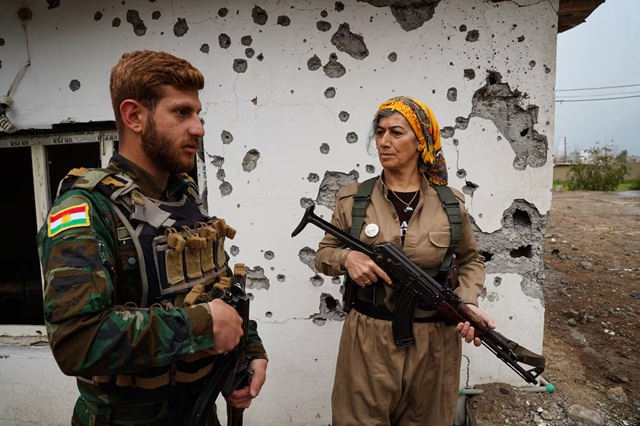
The planned withdrawal of nearly all remaining US troops from Iraq by the end of September is leaving Washington’s Kurdish allies facing what the prime minister of Iraq’s semi-autonomous Kurdistan region describes as a serious and immediate security threat from Iran.
Masrour Barzani, prime minister of the Kurdistan Regional Government (KRG), said the departure of American forces was particularly concerning because Iraqi Kurdistan had been repeatedly targeted by Iranian missiles and drones during the US war against Iran that began in February. The local government estimates that at least 1,000 Iranian drones and missiles have struck the region since the start of the conflict.
Most of the attacks were directed at training camps belonging to Iranian Kurdish opposition groups and US military targets, according to the KRG. But Barzani’s own office in Erbil was attacked in the middle of August. The prime minister said the region remained exposed because it lacked its own aerial defence systems.
“The threat is real — we are vulnerable, we are being attacked,” Barzani, 57, said in an interview. “Now, to be left alone without any, let’s say, appropriate defensive system, it’s shameful.”
The United States has used sophisticated defences at its main military base attached to Erbil airport to intercept some missiles and drones. But the KRG cannot independently purchase comparable aerial defence systems, Barzani said, because such weapons must be acquired through Iraq’s federal government in Baghdad.
“When we are prevented from purchasing adequate weapons that are needed against these incoming missiles and drones and sophisticated systems, then of course, we are deliberately becoming vulnerable, becoming weaker,” he said.
The US withdrawal is scheduled to be completed by September 30 under an agreement negotiated between Washington and Baghdad. The remaining few hundred American military personnel, most of them based in the Kurdistan region, are due to leave as the international coalition fighting Isis winds down its operations. The departure fulfils President Donald Trump’s pledge to end what he describes as America’s “forever wars”, bringing Washington’s military presence in Iraq to an end 23 years after the US invasion that removed Saddam Hussein.
The US State Department said Iraqi security forces, including the Kurdish Peshmerga, had demonstrated “increased capabilities”. It described the withdrawal as a sign that Iraq and the United States had “turned an important page in our bilateral relationship”.
For Iraqi Kurds, however, the end of the American military presence carries particular significance. Their initial autonomy was established under a largely US-enforced no-fly zone that protected the region from Saddam Hussein’s forces from 1991. Washington’s continuing role has remained an important element of the region’s security relationship with the United States.
Last year, the US opened an $800 million consulate in Erbil, described in the source as the largest in the world. Many Kurds had expected the facility to support a continuing American presence. But after the US withdrew non-essential personnel during hostilities with Iran, the building appeared largely deserted, contrasting with the nearby Iranian consulate.
Toby Dodge, an Iraq expert at the London School of Economics, said the reduced US military presence would leave Barzani with limited options in dealing with Tehran. “The message it sends to long-term US allies in the region is clear: do your own deal with Tehran because Washington cannot be relied upon,” Dodge said.
Iran’s principal grievances with Iraqi Kurdistan include the presence of Iranian Kurdish opposition groups, some of which have hundreds of fighters and have roots dating to the Iran-Iraq war of the 1980s. Barzani said discussions with Tehran had repeatedly focused on the presence of coalition forces and those opposition groups. He has said the KRG is not a threat to Iran.
Barzani also faces tensions with Baghdad, where relations have deteriorated over the past decade. Kurdish autonomy was weakened after the KRG’s 2017 independence referendum was rejected by Baghdad and the international community. Baghdad subsequently regained control of the major oil-producing hub of Kirkuk, reducing Kurdish oil revenues. The KRG now relies on funding from the federal budget and is supposed to receive just under 13 per cent to run its affairs, including paying government salaries.
Political divisions within Iraqi Kurdistan remain unresolved. Government formation talks have been deadlocked for nearly two years amid rivalry between the two main Kurdish parties, following an election won by Barzani’s Kurdistan Democratic Party, led by his father Masoud.
Barzani warned that the US could repeat what he described as the mistake of 2011, when Washington withdrew combat troops and a security vacuum subsequently contributed to the rise of Isis. The US returned in 2014 to lead the international coalition that defeated the group in 2018.
“If the security situation deteriorates, it might call on the international community to come back to this region to assist and stabilise the region,” Barzani said. “But they could do it now — without really waiting for things to get worse before they get better.”










