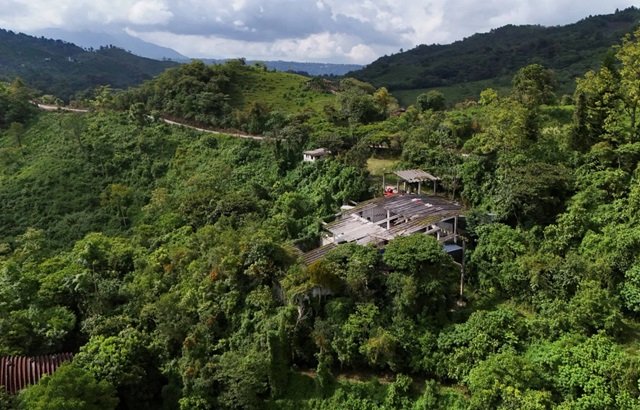
Hidden among the lush green mountains of central Mexico, beside a rarely travelled gravel road, a ramshackle building operated in near secrecy. But the loud mechanical whirring of hundreds of specialised computers, combined with unusually high electricity consumption, helped lead police to what authorities suspect was a cryptocurrency mining operation linked to the laundering of illicit funds.
The discovery in Puebla state’s Sierra Norte region has drawn attention to the growing use of cryptocurrency by organised criminal groups in Mexico. Crypto mining uses powerful computers to generate virtual assets such as bitcoin, requiring substantial amounts of electricity to operate and cool the equipment.
Authorities discovered 300 graphics processing units, 80 medium-voltage terminals and eight satellite antennae at the site. The equipment was being used to compete with millions of other machines in solving the computational puzzles required to create new cryptocurrency. Although the operation was relatively modest by international commercial standards, it was the fourth crypto farm uncovered in the area since early last year.
“Drug cartels appear to have reached a new level of sophistication,” said David Saucedo, a Mexico-based security analyst. He said establishing such an operation would have required technical expertise and financial backing from a well-funded organisation, such as one of Mexico’s most powerful cartels. Mexico’s federal attorney’s office declined to comment, citing an active investigation.
The case comes as cryptocurrency becomes increasingly significant in global illicit finance. Illicit cryptocurrency transactions more than doubled in 2025, with addresses linked to criminal activity receiving an estimated $154 billion, compared with $59 billion a year earlier, according to blockchain analytics firm Chainalysis. The company attributed much of the increase to a surge in transactions associated with sanctions evasion, including payments involving sanctioned governments.
As cryptocurrency adoption expands among individuals and institutions, most of it within legal activity, organised criminal groups in Latin America are also increasingly using crypto transfers and mining operations as tools for moving or laundering money, said Caio Motta, Chainalysis’ Latin American specialist.
“These locations will have very cheap electricity, or be in an area under the influence of organized crime so they’re able to steal electricity and establish a large infrastructure to mine cryptocurrency,” Motta said.
Electricity represents the largest cost of cryptocurrency mining, while rising energy prices and the increasing resources required to generate individual units of virtual currency have made mining more expensive. The University of Cambridge’s Bitcoin Electricity Consumption Index estimates that producing one bitcoin costs nearly $45,000. At current prices of around $78,000, that can still leave a substantial margin.
The economics become even more favourable if electricity is obtained illegally. “If they were stealing the electricity, the main costs of the operation would be, well — nothing,” said Samuel Leon, an expert in energy theft at Mexico’s Iberoamericana University.
Mexican authorities are investigating whether the Puebla operation was stealing electricity from a nearby hydroelectric dam. The remote geography of the Sierra Norte, with dense vegetation and scattered communities, provided a natural environment for concealing the facility.
Two residents of neighbouring communities, who requested anonymity because of fears of reprisals, said the machinery could be heard from as far as a kilometer away. The facility itself was approximately twice that distance from the nearest village.
Three other similar crypto farms were discovered last year near the hydroelectric dam in northern Puebla. Local authorities said they were working with neighbouring states to investigate whether additional hidden operations exist.
The Mexican discoveries form part of a wider pattern. Similar raids have taken place in Brazil, the United States and Southeast Asia, including a major bitcoin mining operation in Thailand that extended across five provinces.
Motta said the continued global expansion of cryptocurrency would probably push crypto-related crime to new records in the years ahead as virtual currencies become more accessible. At the same time, investigators are becoming increasingly capable of tracing transactions and pursuing organised crime through blockchain activity.
“Law enforcement agencies are becoming far more equipped to fight organized crime using cryptocurrency,” he said.