India and Russia are seeking to deepen one of Asia’s oldest defence relationships by expanding cooperation from arms purchases into technology-driven industrial partnerships, with the modernisation of BrahMos missiles and a Russian offer to transfer technology for Su-57 stealth fighter jets emerging as key areas of discussion.
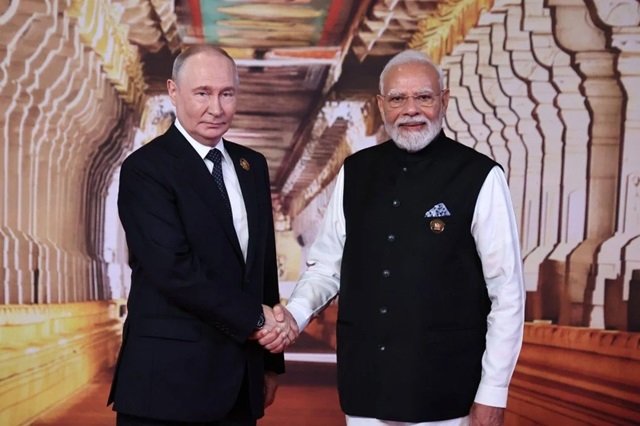
Russian President Vladimir Putin and Indian Prime Minister Narendra Modi shook hands and embraced on Friday ahead of last weekend’s Brics summit in New Delhi, prompting Indian Commerce Minister Piyush Goyal to post on social media: “A bond that keeps growing stronger!” Analysts said the meeting reflected a broader recalibration of defence ties centred on joint production, technology transfer and weapons development aimed partly at export markets.
Srikumar Menon, a former Indian diplomat, said discussions on modernising BrahMos missiles and Moscow’s offer of Su-57 technology demonstrated “the growing maturity, depth and strategic sophistication” of India-Russia defence cooperation.
India has traditionally depended heavily on Russian military equipment, including tanks and fighter jets. In recent years, however, New Delhi has expanded defence purchases from France, the United States and Israel in an effort to obtain more advanced technology and reduce exposure to uncertainties surrounding Russian supplies during the war in Ukraine.
“Russia has been hampered by Western sanctions since 2022 in accessing advanced components and technology, which in turn affected defence supplies to India,” Menon said. The pressures have encouraged both countries to move towards joint production, technology transfer and localisation under India’s “Make in India” programme, launched in 2014.
BrahMos has become a prominent example of that approach. The cruise missile travels at three times the speed of sound and can be launched from land, sea, air or underwater. The Philippines, Indonesia and Vietnam have reached agreements to acquire the system, while Malaysian Prime Minister Anwar Ibrahim said Kuala Lumpur was engaged in exploratory discussions.
No contract for an advanced BrahMos variant was announced following the Putin-Modi meeting, but Srinivaasan Balakrishnan, director of strategic engagements and partnerships at the Indic Researchers Forum, said the meeting raised “the political priority of the next generation BrahMos work that was already under way”.
Kremlin spokesman Dmitry Peskov said last week: “We are jointly producing the BrahMos missiles. It is time to think about improving those missiles, adding some additional characteristics, making them more competitive in the market and more effective.”
Proposals cited by Balakrishnan include a lighter and smaller BrahMos variant for India’s Tejas jets, a submarine-launched version and a hypersonic variant capable of travelling at five times the speed of sound. “The next step should be to move from jointly producing an existing weapon to jointly developing the next generation of weapons,” he said.
The future of India’s fighter fleet is another major area of interest. Discussions include an US$11 billion programme to upgrade the ageing Su-30MKI fleet, which remains the backbone of India’s air force, alongside a Russian proposal for joint development of the Su-57 stealth fighter.
India is developing its own fifth-generation Advanced Medium Combat Aircraft, but faces difficulties securing an engine. Ravi Gopal Krishna Kapoor, a former Indian Air Force air marshal, said General Electric had reportedly raised the price of the GE-414 engine almost threefold, while delays affecting the GE-404 engine used by the Tejas Mk-1A had raised “a serious question on achieving first flight [for the AMCA] within a 2028-29 time frame”.
“With both China and Pakistan strengthening their air forces with fifth-generation fighters and strong air defence, India is in dire need of a fifth-generation fighter,” Kapoor said. He argued that the Su-57 could partly address what he described as India’s current stealth gap before 2030–31, amid indications that Delhi might not opt for US-made F-35s.
Talks with France over 114 Rafale jets have also stalled, reportedly over Paris’ refusal to provide core software source codes, creating an opening for Moscow. Kapoor nevertheless cautioned against overstating the Su-57’s capabilities, noting that only around 30 had been built and that the aircraft had yet to make a “visible impact” in Russia’s war with Ukraine.
He said a limited Indian purchase could be considered if Moscow agreed to share the aircraft’s source code, highlighting the broader issue at the heart of the evolving partnership: whether Russia and India can turn decades of arms cooperation into deeper technological and industrial collaboration.