When Austrian electronics manufacturer AT&S began considering Malaysia for its next-generation substrate plant in 2020, Penang appeared the obvious destination. But there was one problem: there was not enough land.
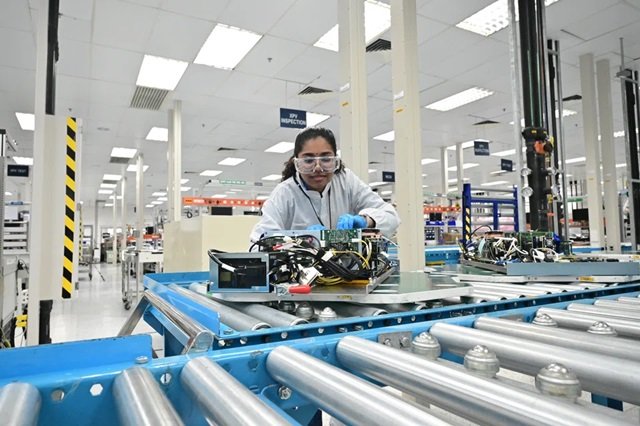
The company crossed the state border to Kulim, about 40 km away, where it found the space, infrastructure and utilities required for a major new facility. Today, the site produces integrated circuit substrates for AMD’s high-performance computing products.
AT&S Malaysia managing director Ingolf Schroeder said the decision reflected a broader reality facing Malaysia’s semiconductor industry. Kulim offered ample industrial land while remaining close enough to Penang for companies to draw on its workforce, with engineers able to commute in less than an hour.
Penang remains Malaysia’s established semiconductor powerhouse, but the scale and technological complexity of the country’s ambitions are increasingly extending beyond a single state. Its own five-decade evolution demonstrates the change. What began with assembly and testing has expanded into advanced design, validation, advanced packaging, automation and next-generation product development.
“It’s not possible for Penang to absorb all this investment by itself,” said InvestPenang chief executive Loo Lee Lian. But she stressed that investment spreading elsewhere is “not at the expense of shrinking” Penang’s role. Instead, the state is becoming more selective, focusing on higher-value activities such as IC design, advanced packaging and automated test equipment.
Kearney Malaysia country head Keat Yap described Penang as the semiconductor industry’s “gravitational centre”, but not its only meaningful one. He sees an increasingly specialised national ecosystem taking shape: Kedah handling front-end manufacturing and substrates, Selangor concentrating on IC design and research and development, Melaka on assembly and testing, and Johor on digital infrastructure and logistics.
The Penang-Kulim corridor offers the clearest example of this division of labour. Schroeder described the relationship as “symbiotic”. Kulim initially benefited as manufacturers crossed the state border in search of larger industrial sites, while continuing to draw on Penang’s engineers, suppliers and accumulated industry expertise.
“Penang laid the foundation, but investment is increasingly moving towards Kulim,” Schroeder said, noting that even industrial land within Kulim Hi-Tech Park has become scarce. AT&S now operates more than 230,000 sq m at its Malaysian site, with two mega-factories operating, a third under expansion and additional land leased for future growth.
AMD Penang site lead Khoo Chuang-Li said distributing capabilities across different locations gives companies greater scale and resilience as Malaysia’s semiconductor industry develops into a “multi-node, complementary network”. AMD operates across Penang and Cyberjaya, combining advanced engineering, research and development and laboratories in Penang with finance and IT functions in Cyberjaya.
Selangor is pushing further upstream. The two-year-old Malaysia Semiconductor IC Design Park is preparing to unveil up to eight commercialised chip products in October, covering data centres, autonomous driving, drones, power management and transportation. The park has 17 companies and more than 400 engineers, up from 15 companies and 302 engineers in April, with its chief executive Yong Kai Pin targeting 500 engineers by the end of the year and 1,000 by 2030.
Yong said Selangor’s proximity to data centres, automotive manufacturers, Port Klang, airports and Subang’s aerospace cluster provides opportunities to turn locally developed technologies into commercial products. Penang-linked firms including SkyeChip and Oppstar are also expanding into Selangor, although Yong argues this should not be viewed as a contest between states. More local chip design, he said, could ultimately create greater demand for fabrication, packaging and testing across Malaysia.
That broader approach is also emerging among Malaysian technology companies. ViTrox group chief executive Chu Jenn Weng said greater cooperation among domestic firms is necessary if Malaysia is to reduce dependence on overseas equipment and capture more value locally.
“We operate on the philosophy that while one company can go fast, a group of aligned companies can go far,” Chu said.
Groups such as the Penang Automation Cluster and Advanced Technology Equipment Cluster are seeking to strengthen capabilities in robotics, artificial intelligence and advanced packaging. Yet Chu identified a difficult obstacle: persuading competitors to collaborate rather than protect their individual interests. The challenge, he said, is moving from “zero-sum” thinking to “positive-sum” thinking.
Capital and talent remain equally important. Cambrian Fund, managed by Southern Capital Group with ViTrox’s co-founders, has made three investments in Industry 4.0 businesses spanning robotics, AI software and machine vision, with a fourth expected soon. Southern Capital chief executive Kenneth Tan said Malaysia has “some of the most exciting startups anywhere in the region”, but that companies need both capital and opportunities to grow.
Intel Malaysia managing director Lee Wei Chern said the next phase will require more specialised talent and deeper supplier capabilities in advanced materials, high-density packaging and AI-enabled manufacturing. In Selangor, Yong is seeking to bring 20 to 40 senior Malaysian engineers working overseas back to the country by the end of the year, arguing that challenging work may matter as much as salary.
The semiconductor expansion is also reshaping Malaysia’s business-services economy. Penang now has about 90 companies operating global business services, employing more than 20,000 people. Functions that once centred on payroll and accounts payable have expanded into human resources, procurement, supply-chain management, data analytics and AI-enabled services.
The growth has also created demand for specialised offices, laboratories and testing facilities. CBRE | WTW senior director Peh Seng Yee said global business services have become embedded throughout Penang’s semiconductor ecosystem, while private developers have increasingly entered the market after strong occupancy demonstrated sustained demand.
A similar ecosystem could eventually emerge around Kulim, although replicating Penang’s depth will take time. For Malaysia, the challenge is no longer simply attracting semiconductor factories. It is building enough land, talent, capital, suppliers, technology and collaboration across multiple states to support the next generation of the industry.