Mohamed Kassen, an Egyptian entrepreneur, believes Africa could become the new promised land of the global textile industry. For decades, he has pursued that idea with what can sometimes appear to be almost quixotic determination, trying to convince the world that vast spinning mills and mass garment factories could flourish across the continent.
In 2005, Kassen created a now-defunct federation intended to bring together producers from across Africa. In 2016, he founded Destination Africa, a trade fair designed to connect local suppliers, foreign investors and multinational companies in the sector. Its tenth edition will take place in Cairo next November, where Kassen will once again promote the proposition that Africa’s moment may be approaching.
“There is a growing movement for the major production hubs to shift from Asia to other regions such as Africa. It is not happening as quickly as I would have liked, but I do not lose hope,” he says in a video call.
His optimism is not entirely isolated. “Many people think Africa is the future,” says Behnam Gashemi, editor of Kohan, a publication specialising in the textile industry in Africa and the Middle East. Kassen draws on a classical theory of development to argue that textiles and garment manufacturing could provide the industrial push Africa needs. “Since the 19th century in Europe, the textile sector, with its relative simplicity, has usually been the first step guiding the path towards industrialisation.”
Yet the figures remain modest. According to calculations based on data from the Observatory of Economic Complexity, just over 2% of global textile exports originate from African ports and airports. The category is dominated by clothing, although the statistics also include textiles for homes, automobiles and medical materials. The continent’s total amounts to roughly €15.5 billion a year, with more than 80% coming from North African countries such as Egypt, Morocco and Tunisia. In sub-Saharan Africa, only South Africa exceeds €1 billion annually, followed by Madagascar and Kenya.
Eric Trachtenberg, director-general of the International Cotton Advisory Committee, places those figures in perspective. Bangladesh, the world’s second-largest textile power by a considerable distance behind China, “exports what all of Africa does multiplied by two and a half”. France and Spain, despite their high production costs, generate figures broadly comparable with the African total.
For now, therefore, Africa remains a marginal participant in a fiercely competitive global market. But there is one encouraging sign: growth. Since 2021, textile exports have risen by an average of 6.6% across the continent, according to a Destination Africa report based on World Trade Organization data.
The obstacles, however, are substantial and varied. Experts point to a mixture of material constraints and historical patterns, organisational difficulties and geopolitical developments. Energy shortages exist alongside the particular dynamics of global trade. Internal conflicts can coincide with geopolitical storms, while inadequate infrastructure can be compounded by a lack of state commitment. Not every factor applies everywhere, and the continent’s extraordinary diversity makes simple generalisations difficult.
Some problems are nevertheless widespread. Recurring power cuts are among the most obvious. Without a reliable electricity system, industrial ambitions can be severely constrained, particularly in fabric manufacturing, which occurs before cutting and sewing. “Where even a micro-outage has a tremendous impact on quality,” explains Juan Parés, president of the International Textile Manufacturers Federation, or ITMF.
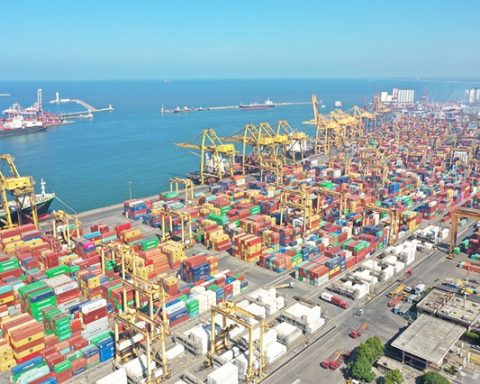
Infrastructure creates another barrier. Parés describes, with exceptions, a continent of “bad roads and congested ports”, affecting both the reliability of delivery and costs in an industry where margins are limited. According to a Mordor Intelligence report, transporting a truck from Kampala in Uganda to Mombasa in Kenya, a journey of just over 1,000 kilometres, costs more than €1,700. Customs procedures in Ethiopia take an average of 44 days.
Trachtenberg also points to the shortage of specific government policies and effective public-private partnerships capable of facilitating investment. Tobias Alando, chief executive of the Kenya Association of Manufacturers, identifies another complication: the widespread presence of second-hand clothing from Europe and the United States. In his view, restricting those imports could create an incentive to manufacture for domestic markets, which could in turn improve production capacity for exports.
The challenge is not simply to establish factories. The experience of Ethiopia demonstrates how fragile an emerging textile hub can be when its international circumstances change.
The Kenya Association of Manufacturers leads Make it East Africa, an initiative designed to promote textiles in Tanzania, Rwanda, Kenya and Uganda. Ethiopia is notably excluded. Lindsay Whitfield, a researcher who has closely studied clothing exports from the Global South, describes Ethiopia as an exceptional African case because it made a determined effort to develop a textile industry.
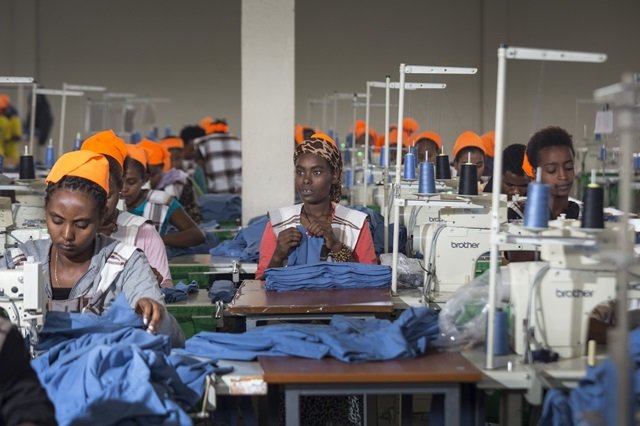
Around a decade ago, government support converged with investment from the international giant PVH, whose brands include Calvin Klein and Tommy Hilfiger. Together, they persuaded Chinese suppliers to move production to Ethiopia. Specialised industrial parks were established, including Hawassa, which became a frequently cited symbol of a possible new era.
For a time, Ethiopia appeared to be producing a continental model: a textile industry capable of helping transform extreme poverty into industrial growth, offering the possibility of an African Bangladesh or Vietnam. Then, in 2022, Ethiopia lost AGOA, a preferential trade agreement with the United States, partly because of human rights violations in the Tigray region. The loss abruptly removed a crucial source of support for the country’s textile ambitions.
Whitfield cites Ethiopia to demonstrate how many variables determine the fortunes of textile production. These include “structural movements in global trade”. The question, she argues, cannot simply be reduced to Africa being poor and therefore having low wages. “Things are not as simple as Africa is poor, wages must be low, so why is more clothing not manufactured there?”
Bangladesh offers another lesson. Its emergence as a textile giant resulted from an unusual combination of government facilitation, chance and exploitative practices. Whitfield traces part of its rise to the Multi-Fibre Arrangement, or MFA, a quota system imposed by the United States in the 1970s to prevent East Asian states such as South Korea from capturing more of the market. The system helped send large quantities of South Korean capital and technology to Bangladesh, where they could be used to expand production.
The country’s ability to maintain its position after the quota system ended in 2005, Whitfield argues, was closely connected to “a very repressive labour system that ensures wages do not rise”. Bangladesh’s success was therefore the product of a particular combination of internal and external circumstances, rather than simply the result of being a poor country.
That distinction is central to Africa’s prospects. Parés argues that the continent’s textile future would require substantial investment and a holistic approach, creating ecosystems that cover the entire production process, from natural or synthetic fibre to finished garments.
The emphasis is increasingly on integrated value chains. “It is what multinationals prioritise today; it is no longer enough to have enormous factories with sewing machines, now they are looking for an entirely local supply,” Whitfield says.
That requirement may also create an opportunity. Rising costs in China and the trade war between China and the United States have opened space for production to move elsewhere. But capturing that opportunity requires far more than attracting individual factories.
Benin is one country being watched closely. The small West African state produces abundant cotton and is developing a textile industrial park designed to be self-sufficient through clean energy. The ambition is straightforward: trucks would arrive carrying raw cotton and leave carrying trousers and T-shirts ready for sale.
The vision is of a complete production chain operating within Africa, turning locally grown fibre into finished garments and, eventually, establishing a model capable of being replicated elsewhere.
For Kassen, that possibility remains compelling. His decade-spanning campaign has yet to produce the continental transformation he envisaged. The numbers remain small, and the obstacles are formidable. But Africa’s textile industry is growing, and investors looking for new production hubs are increasingly looking beyond Asia.
As EL PAÍS reports, the question is no longer whether Africa has the raw materials, labour and potential to participate more substantially in global textiles. The harder question is whether the continent can build the infrastructure, energy systems, policies, investment networks and integrated supply chains required to turn that potential into sustained industrial power.
Kassen will return to Cairo in November to make the case once again. The promised land he has imagined for Africa’s textile industry has not yet arrived. But the search for it has begun.