In 2020 a National Action Plan for Human-Elephant Conflict Management (NAPHEC) was drafted, and the committee responsible for the draft of the NAPHEC conducted a review of all human-elephant conflict mitigation methods. Activities to be adopted for the NAPHEC were selected based on their proven effectiveness, ability to be implemented at an appropriate geographic and time scale, and cost effectiveness. Stakeholder consultations were conducted with the public and relevant agencies, and expressed views were incorporated in the Action Plan as appropriate. So as a result, it became the most comprehensive human-elephant conflict mitigation strategy in the world. However, there was a lapse in implementation of the NAPHEC fully. In the meantime, a new NAPHEC is being drafted.
Considering the 2020 NAPHEC, there seems to be some lack of strategies related to mitigation on issues related to elephants and transport routes. Therefore, adding those strategies would make the new NAPHEC more comprehensive and would tremendously help in safeguarding the lives of both elephants and humans.
For more than a decade I have been studying the behavior of the elephants found on the roads, and I do find one of the most feasible strategies to mitigate elephant-vehicle collisions in the meantime is deploying special patrols. This approach has a useful precedent in India: along National Highway 37 near Kaziranga National Park, forest personnel patrol the highway during periods when seasonal flooding forces wildlife to move between habitats. Their duties include monitoring vehicle speeds, observing motorists, and assisting animals in crossing the highway.
Patrols on roads: improving motorists’ anticipation and response
The effectiveness of road patrols lies primarily in their ability to influence driver behaviour. Patrols stationed at random locations along roads used frequently by elephants can create an expectation among motorists that they may encounter a monitoring point at any time. This can encourage drivers to remain more attentive, reduce their speed and respond more quickly when an elephant appears on or near the road.
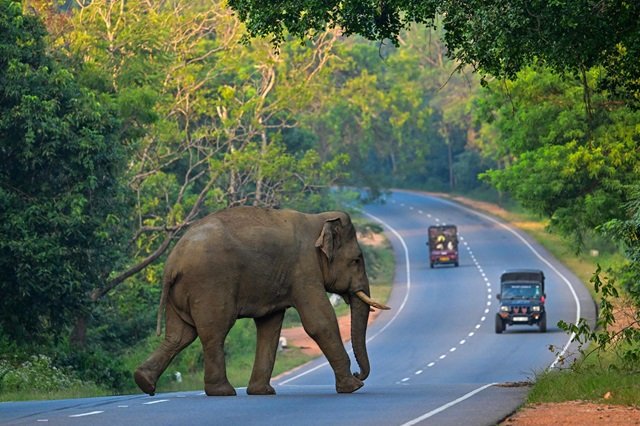
This is proven by data gathered from Buttala–Kataragama Road (B035) and the Habarana section of the A11 road. Though there are no patrols deployed on those two roads, a different phenomenon gives evidence: Elephants along the B035 are more likely to approach vehicles and remain on the roadway in the aim of soliciting food from motorists, often becoming familiar to motorists as “begging elephants”. Consequently, motorists travelling along this route may be more prepared for the possibility of encountering an elephant, and as a result, they respond more quickly when they do see an elephant. In contrast, elephants along the A11 are less likely to solicit food from motorists and less likely to stand in the middle of the road, yet the A11 route has recorded a higher elephant-mortality rate from vehicle collisions. The reason for this is because motorists moving in the A11 don’t expect elephants in the middle of the road to solicit food, and as a result, their preparedness is weak. This difference suggests that motorists’ expectations and attentional preparedness may have influenced their ability to detect and respond to elephants quickly as early as possible.
Even more, it is a scientific fact that “stopping distances increase with speed, and it takes a longer distance to stop a moving vehicle than most people think”. So, if motorists know that their speed may be monitored at unpredictable locations, they may drive more cautiously and maintain greater visual attention. Such increased attentional concentration could shorten reaction times when an elephant unexpectedly enters the roadway.
Besides, there are locations such as Kasikote, between Galgamuwa and Ambanpola, where large numbers of elephants—sometimes more than a hundred—cross through a narrow, approximately 30 m (98.4 ft) wide gap during the morning and evening. It is at this location that Sri Lanka’s first experimental wildlife underpass tunnel is being constructed beneath a railway line to reduce elephant–train collisions. The A28 road, which leads towards Anuradhapura, also runs alongside this railway line. Typically, large female herds and male elephants gather along the roadside before crossing, after which they move across the road together. In recent years, this location has gained considerable attention among the public, attracting visitors who come specifically to observe the elephants. Unfortunately, however, some visitors behave irresponsibly and, at times, disturb the elephants while they are attempting to cross the road. Wildlife officials recently arrested a drone operator in the area for illegally flying a drone and disturbing wild elephants. I have also observed vehicles being parked directly along the elephants’ crossing route, obstructing their movement.
Such irresponsible behaviour can pose serious risks to both people and elephants. Under circumstances such as these, the deployment of patrols could play an important role in regulating human activity, preventing disturbances, keeping the crossing route clear and ensuring that visitors and motorists do not obstruct the elephants during their movements. Patrols could therefore provide not only a means of mitigating collision risks but also an effective mechanism for managing human behaviour at important wildlife-crossing sites.
Patrols on railways: Monitoring speed limits
The same principle can be applied to railway lines. In areas where elephants regularly cross railway tracks, recommended speed limits of 20 km/h are already indicated by warning signs. This is particularly important because train speed directly affects the amount of time available for a driver to detect an elephant, respond to its presence and stop the train. A train travelling at a lower speed requires less distance to stop and provides a greater opportunity to avoid a collision. Conversely, excessive speed substantially reduces the time available for a response. But signs alone do not guarantee that drivers will reduce their speed or maintain sufficient attention. Because a speed limit is only effective if it is consistently observed and enforced. Deploying patrols equipped with speed guns at wildlife-sensitive railway sections would provide a direct mechanism for monitoring whether trains comply with these limits. Patrols add an element of accountability that passive warning systems cannot provide.
The most comprehensive long-term solution would be to construct underground or elevated railway systems in areas where railway lines intersect important wildlife habitats and movement corridors. However, given Sri Lanka’s present economic circumstances, the implementation of such large-scale infrastructure projects is unlikely in the near future. So, patrols can be an interim solution.
In the final note
The value of patrols extends beyond preventing wildlife–vehicle collisions. Their presence can serve multiple purposes by strengthening surveillance and vigilance in ecologically sensitive areas and helping to address wildlife-related offences, including activities such as biopiracy. Furthermore, many areas with high concentrations of wildlife are located away from urban centres and generally experience lower traffic volumes. This relatively low traffic may encourage some motorists to drive in a reckless manner, increasing the risk to both wildlife and human road users. The deployment of patrols can therefore act as a deterrent against reckless driving, encouraging motorists to adhere to safe road rules and thereby reducing the risk of accidents involving both humans and animals. Most importantly, patrols do not require major infrastructure projects before they can begin. They can be deployed rapidly, targeted towards known elephant-crossing areas and intensified during periods of seasonal elephant movement.
On routes, strategically positioned patrols could also assist in identifying periods and locations of particularly high elephant activity. Such information could eventually contribute to more targeted management, allowing patrols to be concentrated at times when elephants are most likely to cross.
If Sri Lanka is serious about reducing the repeated loss of elephants on its roads and railway lines, the emphasis should move beyond reacting to individual accidents. Preventive enforcement must become a continuous process. Strategic patrol deployment provides one of the most immediately actionable ways of achieving that objective.