For centuries, the evidence for how Indigenous communities of the Canary Islands treated their dead has been fragmented, leaving archaeologists to reconstruct practices from skeletal remains, artefacts and historical accounts. Now, an unlikely source — thousands of preserved insect remains — is providing a new account of life and death inside one of Gran Canaria’s ancient caves.
Archaeologists analysing the seventh–ninth century AD funerary cave of Cruz de la Esquina have found evidence that the space was used for food storage before it became a burial site. More significantly, the insects associated with human decomposition indicate that bodies were placed inside the cave shortly after death, challenging previous interpretations that corpses may have been exposed to sunlight for an extended period before burial.
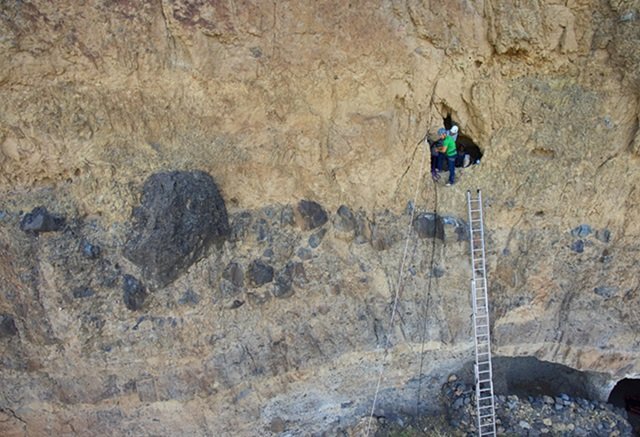
The findings come from an archaeoentomological study of Cruz de la Esquina, located at 990m above sea level on the south-eastern ridge of the Acusa plateau, in the Tejeda Basin, Artenara, on Gran Canaria. The archaeological complex contains approximately twenty artificial caves, which were used by the Indigenous population for domestic, storage and funerary purposes. Cruz de la Esquina is the only documented funerary cave within the complex.
“It was already known that Indigenous communities in Gran Canaria used caves for funerary purposes, including the deposition of wrapped bodies”, says lead author Pedro Henríquez-Valido from the University of Alcalá. What remained uncertain was how soon after death those burials occurred and whether the cave had served another function before becoming a place for the dead.
Cruz de la Esquina offered unusually favourable conditions for answering those questions. When the cave was discovered during survey work in 2001, most of the skeletal remains were exposed on the ground, while a few vertebrae and ribs from one individual remained associated because of pathological fusion. A series of wooden planks formed a platform on which corpses had been deposited. Fragments of rope, rush fabrics, leather and other plant materials had also survived in the cave’s dry conditions.
Those conditions preserved something rarely available to archaeologists: insects connected to both storage and decomposition.
The research team recovered 8173 arthropod remains, of which 8082 could be taxonomically identified, representing a minimum number of 5792 individuals. The remains included species associated with human decomposition as well as insects commonly found in stored grain. Together, they provided evidence for two different phases in the cave’s history.
The first was a period of storage. Twenty-one per cent of the identified insects were classified as storage pests, and such insects were found in 76 per cent of the sediment samples. Among the most significant was Sitophilus granarius, commonly known as the granary weevil, a flightless species specialised in storage environments and dependent on human transport for its spread.
Other storage pests included Mezium americanum, Stegobium paniceum, Oryzaephilus surinamensis and Tenebroides mauritanicus/latens. Their diversity, combined with the absence of direct archaeological evidence for cereal offerings accompanying the burials, led the researchers to conclude that the cave had originally functioned as a granary rather than simply containing grains brought into a funerary space.
The evidence suggests the change in function was relatively rapid. Bayesian modelling of the radiocarbon dates supports a sequence in which storage preceded funerary use, while the calibrated ranges indicate substantial chronological overlap. A radiocarbon date obtained from Sitophilus granarius on the wooden planks falls between AD 772–974, supporting the interpretation that storage pests remained active after the burial space had been established, probably because cereals remained beneath the wooden platform.
The cave therefore preserves an unusual archaeological transition: a space designed for storing food was subsequently transformed into a place for depositing the dead.
The insects also speak to what happened after death. Flies from the families Calliphoridae and Sarcophagidae, which colonise corpses during the initial stages of decomposition, were particularly significant. More than 1000 individuals represented by puparia from these groups accounted for 47 per cent of all identified specimens. Their abundance is consistent with decomposition taking place inside the cave rather than after prolonged exposure elsewhere.
The presence of Phoridae, which can reach corpses during early decomposition in indoor or underground environments, supports the same interpretation. Later-arriving insects, including Muscidae, Fanniidae, Dermestidae and Cleridae, provide evidence that decomposition continued inside the cave. Dermestes maculatus and other dermestid beetles are associated with active decay, while Necrobia rufipes is linked to the dry and skeletonisation phases.
Taken together, the evidence indicates that the bodies were deposited shortly after death and that decomposition proceeded in situ. The findings therefore challenge the interpretation that corpses were deliberately left exposed to sunlight before being transferred into caves.
The distinction matters because the archaeological record of Indigenous Canarian funerary practices is already incomplete. Before Spanish conquest in the 15th century AD, the Canary Islands were occupied by Indigenous people whose cultural practices were subsequently affected by colonial destruction. The researchers argue that insect evidence can recover aspects of those practices that may otherwise remain invisible.
The remains also suggest that the bodies were originally wrapped in bundles, based on preserved textile fragments made from plant fibres and hides, together with burial patterns documented at other sites on the island. Yet the condition of the skeletal material made the original sequence of deposition difficult to reconstruct. Archaeoentomology provided another line of evidence, complementing anthropological studies that are still underway.
The implications extend beyond a single cave. If similar insect assemblages are found in other funerary caves, Cruz de la Esquina may represent part of a wider pattern in the Canary Islands. If not, its unusual history may prove to be an isolated example of how Indigenous communities adapted existing spaces to changing needs.
“The archaeoentomological remains have revealed the hidden biography of Cruz de la Esquina: before it became a burial cave, where bodies were deposited shortly after death, it was a granary where food was stored”, Henríquez-Valido states.
The research thus turns some of the smallest surviving traces of the past into evidence for two of the most consequential questions in archaeology: how people lived and how they treated their dead. In Cruz de la Esquina, grain pests and carrion insects have together transformed a cave from a seemingly static burial site into a record of changing human use — first as a place for food, and later as a place for the dead.