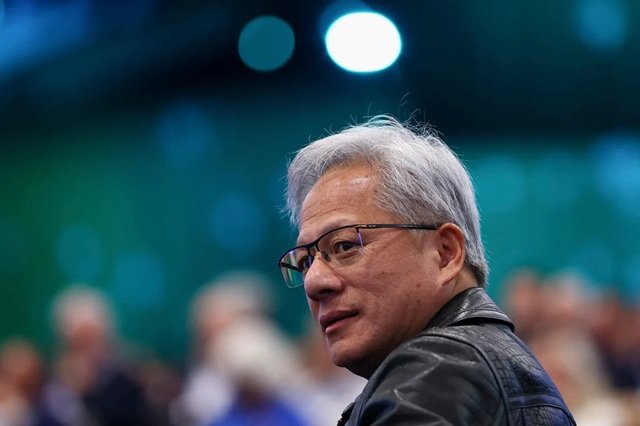
Jensen Huang, the chief executive of Nvidia, has become one of Donald Trump’s closest allies in promoting rapid artificial-intelligence development, placing the head of the world’s most valuable company at the centre of a growing dispute over how the technology should be regulated.
The closeness was on display when Trump recently called Huang while the Nvidia chief was appearing on stage in Los Angeles to discuss AI data centres. Huang took the call, arranged a microphone and put the president on speaker. “Mr. President, you are now talking to the Planet,” he told him. Trump joked that Huang could build AI chips ten years ahead of the competition but could not make his own microphone work. He then attacked warnings about AI catastrophe and demands for regulation as “a conspiracy” and a huge “scam”. Data centres, Trump said, would make people and countries wealthy. AI was “the oil of the next 20, 25 years”, he said, adding that China could also benefit from the debate over the dangers of the technology.
“You are right, we’re not gonna let that happen, Sir,” Huang replied.
The exchange reflected a partnership that has grown substantially since Trump began his second term. While other technology executives, including Tim Cook of Apple, Sundar Pichai of Google, Jeff Bezos of Amazon and Mark Zuckerberg of Meta, have cultivated relationships with the president, Huang has appeared alongside Trump publicly six times since his inauguration and has travelled abroad with him. He has also spoken openly about their private conversations, saying: “He calls me in the middle of the night.”
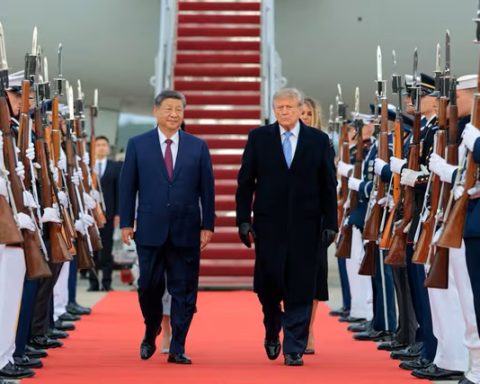
Huang is reportedly expected to attend a state dinner for Chinese President Xi Jinping hosted by Trump, alongside other technology executives. US Treasury Secretary Scott Bessent has described Huang and Trump as “completely aligned” in testimony to Congress.
For Huang, the relationship carries major commercial interests. Nvidia produces some of the most powerful chips available and supplies hardware essential to data centres used to train advanced AI systems. Under an exemption granted by Trump, Nvidia can now sell certain, less powerful versions of its chips to China in limited quantities. Huang has presented the policy not as a concession to Beijing but as part of the US competition with China, arguing that American technology can prevail only if American chips are used around the world, including in China.
Nvidia’s financial performance illustrates the stakes. In its 2026 financial year, the company’s revenue rose 66 per cent, from $130 billion to $216 billion. Almost $194 billion came from supplying data centres. Huang, who co-founded Nvidia in 1993 and remains its chief executive, is estimated to have a personal fortune of about $190 billion.
A significant slowdown in AI development could therefore affect the demand for Nvidia’s hardware. Proposals for an AI development moratorium, including those advanced by experts such as Nate Soares and politicians such as Bernie Sanders, would potentially reduce demand for the company’s chips. Huang has instead argued that AI risks can be managed through engineering and greater computing resources. A superintelligence, in his view, is primarily a technical problem that can be addressed through “good old-fashioned engineering”.
That position has made Huang one of Silicon Valley’s most prominent “Anti-Doomers”, a group that considers fears of human extinction from AI exaggerated. He has said that claims about catastrophic AI scenarios lack a “scientific basis”. He has also argued for a centrally determined US approach to AI regulation, warning that state-by-state rules would create a patchwork that could slow the technology industry.
The partnership with Trump took shape during the controversy surrounding the Chinese AI model DeepSeek R1 in January 2025. The system caused alarm in Silicon Valley after Chinese developers appeared to have produced a powerful AI programme at substantially lower claimed costs. Trump called the development a “wake-up call” and moved to remove obstacles facing US AI laboratories. Huang, already dissatisfied with export controls introduced under Joe Biden, became a natural partner in that strategy. In December 2025, the two announced an arrangement allowing Nvidia to sell chips to China under limited conditions, with the stated objective of strengthening the US position in the competition for advanced AI.
But the political debate is becoming less accommodating to their approach. The source reports that fewer than one-third of Americans approve of Trump’s performance, while two-thirds regard AI as dangerous. Several US states are pursuing or have introduced AI legislation. California has established an expert group to examine how a “kill switch” could operate, allowing an AI system to be stopped or isolated if necessary.
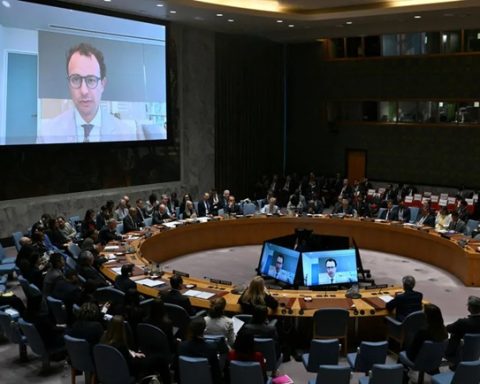
Calls for national regulation are also gaining support in Washington. Rahm Emanuel, the Democratic strategist and former chief of staff to Barack Obama, criticised the prospect of technology companies themselves seeking regulation while the federal government remains reluctant to act. At the United Nations General Assembly in New York, AI regulation is also a major issue. German Chancellor Friedrich Merz and 17 other heads of government have signed an appeal for binding safety rules covering particularly powerful AI models, warning that inadequate controls could create “serious risks for security and protection”.
Within the technology industry, the divide is increasingly visible. Chris Lehane, OpenAI’s chief lobbyist, said he had developed a “very good and constructive working relationship” with the US administration and had recently spent considerable time with members of both parties and both chambers of Congress. He said a “growing consensus” was emerging around the need for binding national safety standards and described the position as fundamentally bipartisan.
“I actually have the impression that such a dynamic has emerged,” Lehane said. “That opens, in my view, a real opportunity.”