by Durga Velayudham
Sri Lanka’s Easter Sunday investigation has become an ugly political operation in which the word “mastermind” is endlessly recycled because an unanswered question has become more politically useful than an answered one. Seven years after the massacre, the High Court has convicted 15 of the 24 accused in the main Easter case, with sentences ranging from 200 to 260 years and the confiscation of their property. Nine were acquitted. The trial involved 23,270 charges and 2,309 prosecution witnesses. Yet the verdict has not stopped the machinery surrounding the “mastermind”. It has simply moved the argument somewhere else. The bombers and their network are apparently not enough. The convictions are not enough. The evidence tested through years of criminal proceedings is not enough. The public is again being asked to look for another invisible hand. At some point, this stops being a search for truth and becomes a method of keeping a political narrative alive.
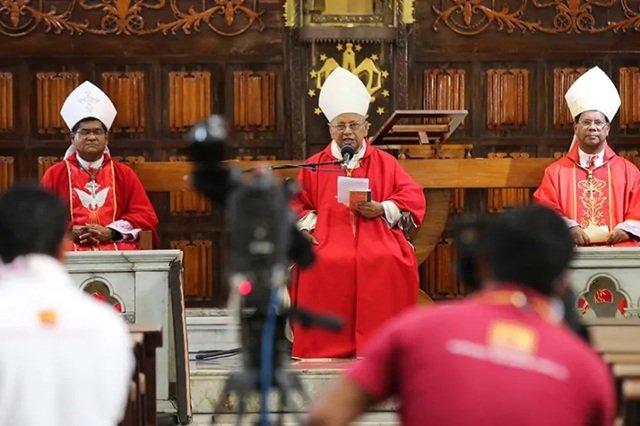
Cardinal Malcolm Ranjith has been at the centre of that narrative for years. He built enormous public authority around the demand for Easter justice and repeatedly insisted that the attacks could not be understood simply as the work of the Islamic State-inspired extremists who carried them out. In 2022, he told the UN Human Rights Council that the attacks had become, in his words, a “grand political plot” according to subsequent investigations. That was an extraordinary allegation and it carried an extraordinary burden of proof. Where is that proof? Where are the documents, communications, financial records, witnesses and operational links establishing the alleged political conspiracy? Where is the evidence connecting the people repeatedly named in public debate to the planning and execution of the massacre? The public has been hearing the accusation for years, but an accusation does not become evidence because a Cardinal repeats it, because a priest discusses it on television or because politicians repeat it in Parliament.
The same standard must now be applied to Father Cyril Gamini Fernando, Jude Krishantha and every other person who has continued to advance allegations about hidden actors behind Easter. If they have evidence, produce it. If they have witnesses, bring them before investigators. If they have documents, submit them to forensic examination. If they know that a particular person planned, facilitated or knowingly enabled the attacks, then establish that connection through evidence. Sri Lanka has had enough of allegations being turned into accepted public facts through repetition. A press conference is not proof. A television programme is not proof. A documentary is not proof. A parliamentary statement is not proof. An allegation repeated for seven years is still an allegation if nobody can produce the evidence necessary to establish it.
The Suresh Sallay case has exposed the absurdity of this entire process. Sallay is now himself being investigated over allegations concerning the Easter attacks and remains detained under the Prevention of Terrorism Act. At the same time, the CID has moved to obtain statements from ten Opposition MPs, including Opposition Leader Sajith Premadasa, who made allegations in Parliament linking Sallay to the attacks. The Attorney General’s Department authorised the CID to request their statements, and investigators want to know the sources on which those parliamentary allegations were based. Because the statements were made under parliamentary privilege, the MPs must cooperate voluntarily. This is one of the most revealing developments in the entire saga. For years, allegations have travelled from Parliament to television, from television to social media and from social media back into political debate as though the repetition itself constituted corroboration. Now the investigators are finally asking the basic question that should have been asked at the beginning. What is the source of the allegation?
That question should be asked of everyone, not merely opposition politicians. If an opposition MP says Sallay was involved, produce the source. If a priest says there was a political conspiracy, produce the source. If a Cardinal says subsequent investigations revealed a grand political plot, produce the investigations. If investigators accuse someone of prior knowledge, produce the evidence establishing what that person knew and when. The standard cannot change according to political convenience. It cannot be evidence when it supports one side and speculation when it damages another.
The most serious issue may therefore be sitting somewhere else entirely. The country has spent years searching for a hidden mastermind while the record continues to raise questions about what government investigators and security agencies knew before the attacks and what they did with that information. The Supreme Court has already dealt with the failure of senior officials to act on intelligence warnings, and the wider investigative record has repeatedly raised questions about the handling of information concerning Zahran Hashim and his network before 21 April 2019. The recent criminal proceedings have added further material concerning information available before the massacre. The obvious questions are not mysterious. What did the authorities know? When did they receive it? Who received it? What investigation followed? What operational action was taken? Who made the decisions? Why were the warnings and investigative leads not converted into effective action before hundreds of people were killed?
Those questions inevitably place the conduct of Ravi Seneviratne and Shani Abeysekara under scrutiny. That does not establish that either man participated in a conspiracy, and there is no justification for turning an allegation into a fact without evidence. But their roles in the investigative machinery deserve examination against the record. If information about Zahran and his network reached investigators before Easter, the public has a right to know what followed. If investigative leads were available and were not pursued, why not? If investigators assessed the threat and concluded that immediate action was unnecessary, who made that decision? If everything possible was done, where is the documentary record demonstrating it? These are not unfair questions. They are precisely the questions that any serious investigation should ask.
Instead, Sri Lanka has repeatedly been offered the more convenient spectacle of the mastermind. That story has served almost everyone who needs the Easter case to remain politically unfinished. It gives politicians another allegation to make. It gives campaigners another demand to repeat. It gives television programmes another mystery. It gives investigators another theory to pursue. It gives institutions another reason to claim that the real truth is still somewhere beyond the reach of the public. And it distracts attention from the less dramatic but far more concrete possibility that catastrophic institutional failures, delays, failures of coordination and failures to act on available information were sufficient to allow the terrorists to proceed.
The Catholic Church has a particular responsibility here because it has made justice and truth central to its public campaign since Easter. That makes the question of its own transparency unavoidable. If Church institutions received substantial financial assistance connected with Easter victims, legal action, investigations, international advocacy or campaigns for justice, the public deserves a clear account of those funds. From whom did the money come? Through which organisations? How much was received? How much was spent on victims? How much was spent on legal proceedings, investigations, advocacy, travel, communications and media activity? What independent audits exist? Where are the accounts? This is not an accusation of financial wrongdoing. It is a straightforward demand for the same transparency that the Church has demanded from the state. An institution that repeatedly asks others to open their files cannot reasonably object when the public asks it to open its financial books.
Cardinal Ranjith’s continuing political influence makes that accountability even more important. He has become one of the most powerful public voices surrounding Easter, and that influence has been built substantially around the unresolved demand for the “real truth”. But public influence brings public responsibility. If the Cardinal has evidence of a political conspiracy, he should put it before the appropriate investigators and courts. If Cyril Gamini has evidence against Sallay, produce it. If Jude Krishantha has evidence, produce it. If the Opposition MPs have credible sources for their allegations, the CID is now asking them to identify those sources. The same demand should apply to everyone else who has made serious public accusations.
The recent verdict should therefore be treated as a test of honesty. It does not establish that every question surrounding Easter has been answered. It does not prevent further investigation of any person against whom credible evidence emerges. But it does establish that a substantial criminal case has now been judicially tested and that 15 accused have been convicted while nine were acquitted. Any new claim about a mastermind must therefore bring new evidence, not merely another name, another television appearance or another political speech.
Sri Lanka cannot continue treating suspicion as evidence and repetition as corroboration. People who have no demonstrated connection to the attacks must not be dragged into a permanent cycle of accusation simply because their names fit somebody’s political theory. If there is a connection, prove it. If there is a conspiracy, prove it. If there was prior knowledge, prove who knew and when. If investigators failed, establish exactly how and why. If officials deliberately obstructed justice, prosecute them. If allegations against Sallay are true, establish them in court. If they are not, the same legal system must clear him.
The Easter victims deserve something better than an endless political industry built around their deaths. They deserve the truth, whatever that truth turns out to be. That truth may expose terrorists, investigators, officials, politicians, intelligence failures or something else entirely. It cannot be selected in advance to fit a political narrative.
For seven years Sri Lanka has been told that the real mastermind is still somewhere in the shadows. Now the country should stop chasing shadows and examine the evidence. The CID is already asking opposition politicians where their allegations came from. It should ask the same question of everyone. The Church should answer questions about its claims and its finances. Investigators should answer questions about their decisions. Politicians should answer for what they have alleged. And every person accused should be judged by evidence rather than propaganda. Nobody demanding justice should be above scrutiny. Not a politician. Not an investigator. Not a television commentator. Not a priest. And not a Cardinal.