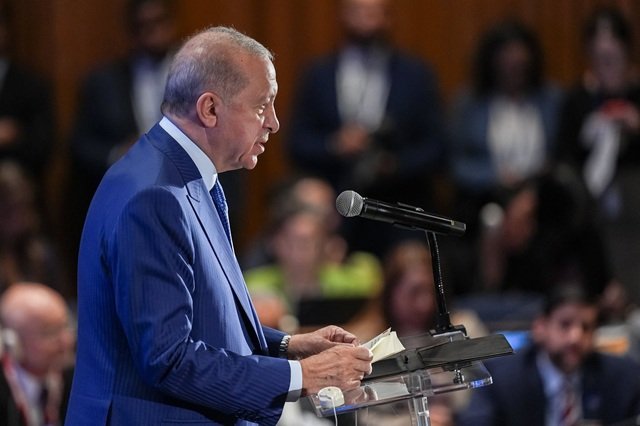
The Kashmir dispute has once again found its way onto the floor of the United Nations General Assembly, and with it, the familiar diplomatic triangle of India, Pakistan and Türkiye has resumed its well-worn choreography. President Recep Tayyip Erdoğan’s remarks touching on the status of Jammu and Kashmir drew a swift reaction from New Delhi, with segments of the Indian press framing the comments as unwarranted interference in what India considers a strictly bilateral matter. The episode is less a new development than a recurrence, the latest instance of a disagreement that has simmered at the UN, on and off, for more than seven decades.
Kashmir’s presence at the United Nations is not a recent invention. The dispute was formally brought before the Security Council in January 1948, shortly after the first India-Pakistan war over the former princely state, and it produced a series of resolutions, most notably UNSCR 47, calling for a plebiscite to determine the region’s future. Those resolutions were never implemented, and both India and Pakistan have since offered starkly different accounts of why. Islamabad maintains that New Delhi reneged on a commitment to let Kashmiris decide their own status, while India argues that Pakistan’s own troop withdrawal precondition was never met and that subsequent bilateral agreements, chiefly the 1972 Simla Agreement, superseded the UN framework by committing both countries to resolve outstanding issues bilaterally. That legal and political disagreement, over which framework actually governs the dispute today, is the substance beneath every fresh round of rhetoric.
Erdoğan has been one of the more consistent international voices to invoke Kashmir on the global stage. Over the past several years, he has raised the issue at UNGA sessions, in joint statements with Pakistani leaders, and in bilateral forums, generally couching his remarks in calls for dialogue “within the framework of the UN Charter and relevant Security Council resolutions”, rather than in explicit backing for any specific outcome. Ankara has paired this with repeated expressions of solidarity with Kashmiris, language that Turkish officials describe as consistent with their broader foreign-policy emphasis on self-determination and humanitarian concern, but which Indian officials read as one-sided, given Türkiye’s close alignment with Pakistan on nearly every other regional question.
That alignment was on vivid display during the India-Pakistan military confrontation in May 2025, when hostilities flared following a terror attack and subsequent cross-border strikes. Erdoğan publicly voiced solidarity with Pakistan during the crisis, a gesture Islamabad welcomed and Indian commentators seized upon as evidence of Ankara’s partisanship. At the same time, Turkish statements during that period also urged restraint and de-escalation, a dual-messaging pattern — solidarity with Pakistan alongside calls for calm — that has become something of a signature of Turkish diplomacy on the subcontinent. Türkiye’s relationship with Pakistan runs deep and predates the current dispute cycle: the two countries cooperate closely on defence procurement, including Turkish drone technology used by Pakistan’s military, and both governments frequently describe their ties using the phrase “one nation, two states.” That closeness gives Ankara’s Kashmir statements added weight in Indian eyes, and added irritation.
The reaction in the Indian media to Erdoğan’s UNGA remarks followed a pattern that has become familiar. Rather than engaging primarily with the substance of what Ankara said, a significant share of coverage pivoted to broader criticism of Türkiye’s foreign-policy choices, its ties with Pakistan, and Erdoğan personally — alongside calls, echoed periodically by segments of India’s political and commercial establishment, for consumer boycotts of Turkish goods and tourism. This is not a new phenomenon; it has recurred after nearly every prior instance of Turkish commentary on Kashmir, and it reflects a broader dynamic in Indian public discourse, where foreign statements on Kashmir are frequently treated as a bellwether of a country’s overall relationship with India rather than assessed in isolation. Indian officials, for their part, have historically pushed back through more conventional diplomatic channels, summoning ambassadors or issuing formal statements characterising outside commentary on Kashmir as an internal matter of India and reiterating that the region is an integral part of the country.
New Delhi’s core objection is not merely to Erdoğan individually but to the broader pattern in which some Muslim-majority states, along with the Organisation of Islamic Cooperation, periodically issue statements on Kashmir at multilateral forums. India’s position — that these interventions ignore ground realities, including elections held in the region and its integration into India’s constitutional and administrative structure — has remained largely unchanged since the abrogation of Jammu and Kashmir’s special status in August 2019, an event that considerably sharpened international attention on the region. Pakistan and its allies, conversely, argue that the 2019 changes altered the region’s status unilaterally and that this makes international attention more, not less, warranted.
What makes this recurring cycle notable is less the novelty of any single statement than its durability. Erdoğan’s comments at this year’s UNGA session changed no positions on either side; they restated views that both governments have held for years. Indian media’s response, likewise, followed a script rehearsed in previous years. The dispute persists not because either side has introduced new arguments, but because the underlying disagreement — over whether Kashmir is a matter properly addressed at the United Nations and by third countries, or one confined to bilateral India-Pakistan negotiations — remains genuinely unresolved. Absent a shift in that fundamental question, Kashmir seems likely to resurface at the UN General Assembly again, drawing familiar statements from Ankara and familiar rebuttals from New Delhi, with each side operating from a framework of legitimacy that the other does not accept.