by Eric
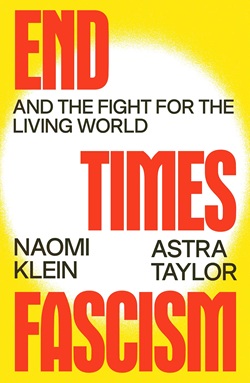
What if the people preparing for the apocalypse are not trying to prevent it? That is the unnerving question at the centre of Naomi Klein and Astra Taylor’s End Times Fascism. Their most provocative claim is not that fascism is returning, but that a new political sensibility is emerging among people who have already decided that the future is effectively lost. “The most powerful people in the world are preparing for the end of the world, an end they themselves are frenetically accelerating” (p. 27). That sentence contains the book’s central wager: catastrophe is no longer necessarily a failure to be avoided; for some of the world’s most powerful actors, it has become an environment to be monetised, militarised and escaped. The wealthy build bunkers, technology billionaires pursue artificial intelligence and extraterrestrial futures, religious movements anticipate messianic rupture, states harden their borders, and private corporations discover markets in surveillance, detention and security. What supposedly binds these phenomena is not a single ideology but a common answer to a frightening question: who deserves to survive when the old world begins to break apart?
Klein and Taylor call that answer “end times fascism”, defining it as “a fascism embedded in an understanding that something immense is ending, and it responds to this discomfiting truth with unabashed cruelty” (p. 27). The phrase is deliberately inflammatory—and therefore demands unusually careful scrutiny. Fascism has become one of the most overused political words of the present, capable of functioning simultaneously as historical diagnosis, moral condemnation and rhetorical alarm bell. The authors deliberately push the term beyond its conventional twentieth-century boundaries. “If we are waiting for soldiers goosestepping in formation, we’ll miss the venture capitalists and their autonomous weapons. If we are looking for yellow stars, we’ll miss the facial-recognition databases and the algorithmic threat ratings” (p. 31). This is an intelligent provocation. But it also establishes the book’s fundamental problem. If fascism can include venture capital, artificial intelligence, religious apocalypse, border politics, oligarchy and private prisons, what precisely distinguishes fascism from the wider family of authoritarian, exclusionary or plutocratic politics? The book is at its most compelling when it answers that question; at its weakest, it appears to assume the answer.
Its historical argument provides some of its strongest ammunition. “History isn’t linear but it also doesn’t repeat on a loop, circling back to the same place over and over again. Rather, it moves in more of a spiral” (p. 30). That formulation permits Klein and Taylor to reject both historical complacency and crude analogy. Contemporary authoritarianism need not reproduce the 1930s literally. It may operate through algorithms, databases, private contractors, financial networks and autonomous weapons rather than uniforms and mass rallies. The authors reinforce this argument through Jawaharlal Nehru’s 1938 observation that “Fascism is a mirror to the past, and to a certain extent the present, of imperialism” (p. 29), and W.E.B. Du Bois’s observation that European civilisation had already practised many of the atrocities associated with Nazism against colonised peoples (p. 29). Their point is consequential: fascism cannot be understood solely as an aberration within European history while ignoring the colonial systems of racial domination that preceded and accompanied it.
Yet the historical analogy also needs discipline. “Fascism is capitalism’s most ferocious threat response,” the authors declare, “a way of making sure that the public anger that wells up during times of deep crisis is directed downward at the vulnerable rather than upward at the system itself” (p. 32). The formulation is memorable, and their accompanying phrase—“Fascism is capitalism with bared teeth” (p. 33)—is even more memorable. But rhetoric is not theory. Capitalism has operated alongside liberal democracy, social democracy, authoritarianism and fascism. To say that capitalism can generate conditions favourable to fascist politics is different from saying that fascism is capitalism’s essential political form. The distinction matters because otherwise the category becomes dangerously elastic. Klein and Taylor are right to ask how economic crisis, inequality and concentrated wealth can nourish authoritarian politics; they are less convincing when the causal chain is compressed into a slogan.
The chapter on religious apocalypticism is both fascinating and perilous. The authors assemble a disturbing collection of statements in which war, Israel, the Temple Mount and messianic expectation become entangled. “We are approaching the end of the road,” declares one Church of God publication (p. 43); a red-heifer rancher says, “We need the Messiah to come” (p. 56); Pastor Doug Wilson announces, “We’re supposed to be arsonists” rather than firefighters (p. 59). Pete Hegseth’s assertion that the rebuilding of the Temple on the Temple Mount is possible, despite his admission that he does not know how it could happen, becomes another piece of the authors’ case (p. 60). The cumulative effect is unmistakable: eschatology can become politically consequential when catastrophe is interpreted not as something to avert but as evidence that prophecy is unfolding.
But here the book needs to be read against its own evidence. Apocalyptic religion is not inherently fascist, nor does belief in an end time necessarily produce political violence. Indeed, Klein and Taylor concede that “There is no passage in the Bible, Old Testament or New, or in the Quran, that lays out the world-ending story in unambiguous terms” (p. 50). Their strongest argument therefore concerns the political appropriation of religious narratives, not religion itself. The distinction is essential. Otherwise the book risks reproducing the very simplification it seeks to expose: replacing complex religious traditions with the most extreme statements of their political interpreters.
The book becomes considerably more original when it moves from the supernatural to Silicon Valley. Here apocalypse acquires a technological vocabulary. Sam Altman is quoted saying, “AI will probably most likely lead to the end of the world, but in the meantime, there’ll be great companies” (p. 97). Peter Thiel’s statement that “I no longer believe that freedom and democracy are compatible” (p. 101) is even more politically revealing. The authors identify a strange fusion of existential fear, technological transcendence and commercial opportunity. “Building AGI will bring about a rapture. Literally a rapture” (p. 108), while Thiel is quoted saying that Altman should be treated “as more of a messiah figure” (p. 107). The book’s underlying question is therefore not whether artificial intelligence is dangerous. It is who gets to determine the acceptable level of danger when the people developing the technology possess enormous capital and political influence.
The Memphis chapter gives this argument its physical consequences. KeShaun Pearson calls AI infrastructure “the energy vampire” (p. 145), while Justin J. Pearson declares, “Our lives and our lungs are being sacrificed on the altar of their capitalistic exploitation” (p. 145). The authors juxtapose these complaints with the extraordinary contradiction contained in Microsoft’s sustainability argument: its environmental goals have moved further away, yet AI is presented as the technology that will eventually build the “rocket” capable of reaching them (p. 149). This is perhaps the book’s sharpest recurring insight: the same system can produce the crisis and sell the technology supposedly capable of rescuing us from it. But once again, the authors occasionally move too quickly from contradiction to fascism. Environmental hypocrisy, technological hubris and corporate power may be serious political problems without automatically constituting fascism.
Their discussion of borders and ecological nationalism is more difficult to dismiss. “Borders are the environment’s greatest ally,” says Jordan Bardella (p. 194), while Renaud Camus describes his opposition to “global replacism” as ecological (p. 195). The Christchurch shooter’s grotesque formulation—“Kill the invaders, kill the overpopulation and by doing so save the environment” (p. 195)—shows what happens when ecological anxiety is fused with racial extermination. Yet the important distinction is between environmentalism and eco-fascism. Concern about population, resources, migration or ecological limits is not itself authoritarian. The danger arises when ecological scarcity becomes an argument for deciding which populations are disposable. Here End Times Fascism offers a genuinely useful conceptual warning.
The chapter on “for-profit fascism” extends the argument into private security, detention, propaganda and digital influence. Mike Davis’s observation that “Greed has become radicalized” (p. 206) captures the authors’ economic thesis, while John Ganz describes an alliance between reactionary technology, private capital, ICE and online influencers as the class composition of “actually-existing American fascism” (p. 217). The analysis is strongest when it demonstrates how profit can acquire political consequences. Private detention, surveillance technologies and media ecosystems do not merely respond to authoritarian politics; they can acquire economic incentives to reproduce it. But again the distinction between enabling infrastructure and fascist political organisation deserves greater precision.
The book’s answer to this darkness is “hereness”: staying rather than escaping. Against bunkers, Mars colonies and elite fantasies of technological transcendence, the authors offer the insistence that “this time no one will be left to drown / and all of us must be chosen” (p. 239). Feleecia Guillen expresses the principle more simply: “We are in heaven right now. We’re here and we have to take care of these things while we’re here” (p. 254). This is where the book becomes less a diagnosis of fascism than a philosophy of democratic survival. Its alternative to the apocalypse mentality is not another grand promise of salvation but an ethic of responsibility to place, neighbours and institutions.

That argument reaches its political expression in the book’s treatment of Zohran Mamdani and local organising. “We want to stay in our city! We want to stay on our planet! We love it here!” (p. 284) could almost serve as the book’s manifesto. The political alternative is deliberately earthly: housing, community, public provision, environmental repair and democratic participation. Martin Luther King Jr.’s insistence that politics must address not merely the “new Jerusalem” but “the new New York, the new Atlanta, the new Philadelphia, the new Los Angeles, the new Memphis, Tennessee” (p. 267) provides the book with its clearest moral principle. Salvation that exists only in another world is politically useless if people cannot survive in this one.
The conclusion extends the argument towards international law, nuclear weapons and institutional reform. Antonio Guterres’s warning that machines capable of taking human life without human control “should be prohibited by international law” (p. 299) connects technological power with the older problem of militarism. Bertrand Russell and Albert Einstein’s question—“Shall we put an end to the human race; or shall mankind renounce war?” (p. 308)—then gives the book its final scale. The argument is ultimately about political imagination. What happens when powerful people stop believing that collective institutions can shape the future and begin preparing privately for catastrophe? The danger is not simply that they might survive while others perish. It is that their expectation of collapse could itself become a reason to dismantle the restraints that might prevent it.
End Times Fascism is therefore most valuable not when it proves that every phenomenon it examines is fascist, but when it forces the reader to examine the political consequences of an increasingly influential survivalist mentality. Its language can be excessive: “capitalism with bared teeth”, “technofascists”, “energy vampire” and “arsonist coming back and being the fireman” are formulations designed to provoke. At times, the provocation outruns the historical precision required to sustain the book’s central category. Yet dismissing the argument on that basis would miss its deeper achievement. Klein and Taylor identify a frightening possibility: that the most consequential political divide of the coming era may not be between optimists and pessimists, left and right, or even democracy and authoritarianism, but between those who imagine themselves escaping a damaged world and those who believe there is still a collective obligation to repair it. Their final proposition is both simpler and harder than the language of apocalypse: survival cannot be privatised. If “some versions of this world need to end” for planetary survival to become possible (p. 311), the unresolved question is which versions—and who gets to decide. That is where the book leaves its reader, not with a prophecy, but with a political argument that cannot be settled by prophecy.