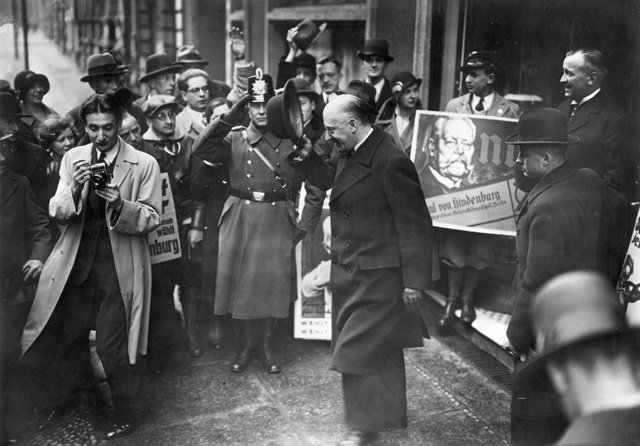
provides the first warning. Established after the November Revolution of 1918, it possessed constitutional and legal mechanisms for dealing with political violence and anti-democratic organisations. After the assassination of Foreign Minister Walther Rathenau in 1922, the Republic introduced the Law for the Protection of the Republic. It permitted restrictions on anti-republican organisations and publications and strengthened criminal measures against political violence.
Yet the existence of legal powers did not guarantee their effective use.
Paramilitary formations associated with the nationalist right were sometimes incorporated into the defence of the Republic itself. The judiciary, police and other state institutions retained large numbers of officials who had served under the Imperial regime, and the absence of a comprehensive personnel transformation after 1918 left anti-republican attitudes embedded inside parts of the state.
The contradiction became particularly stark in the final years of Weimar. In 1932, the central government intervened against the elected Prussian government under the pretext of restoring order. In 1933, the Reichstag Fire Decree suspended fundamental rights and became one of the principal instruments through which Adolf Hitler’s dictatorship consolidated power.
The lesson, therefore, was not simply that democracy needs more legal weapons. It was that democratic safeguards are only as effective as the institutions and officials willing to use them.
After 1945, the circumstances changed dramatically because Germany’s democratic reconstruction did not initially depend exclusively on Germans themselves.
The western Allies occupied Germany, retained extensive powers and intervened directly in political reconstruction. MERKUR describes this as an “Allied liberalization dictatorship”: democratic institutions were being established under an occupying authority that simultaneously restricted political forces considered dangerous to the new order.
The scale of this intervention is easily underestimated. The postwar process included denazification, restrictions on nationalist organisations and the internment of large numbers of people regarded as potential threats to the new political order. The Allied occupation authorities also reconstructed Germany’s judicial and political institutions; denazification and the rebuilding of the courts formed part of the wider effort to establish a new legal order.
This creates an uncomfortable complication in the conventional success story. West German democracy was not simply born from the Basic Law. It emerged within an environment in which the Allies had already removed, restricted or disrupted important elements of the political networks that might have challenged the new order.
At the same time, the occupation itself contained contradictions. The western powers also made use of personnel with backgrounds in the former German military and security apparatus, particularly because of the emerging Cold War. The new democratic order was therefore being constructed through a mixture of repression, rehabilitation, institutional reform and political compromise.
The Basic Law nevertheless introduced powerful safeguards. Article 21 provides that political parties seeking to undermine or abolish the free democratic basic order can be declared unconstitutional, with the Federal Constitutional Court—not the government—responsible for determining whether a party is unconstitutional.
That provision was not merely theoretical. The Socialist Reich Party, widely regarded as a successor to the Nazi movement, was banned in 1952. The Federal Constitutional Court subsequently banned the Communist Party of Germany in 1956. These were extraordinary interventions into democratic political competition, but they were explicitly justified through the constitutional framework created after Nazism.
The system nevertheless developed another contradiction. While extremist organisations could be prohibited, their supporters did not simply disappear. During the Bonn Republic, parts of the nationalist right were gradually integrated into conventional conservative and liberal political structures, while sections of the radical left were subjected to surveillance and restrictions on public employment.
The result was not necessarily the elimination of political extremism but its containment and transformation.
The later history of the Federal Republic further complicated the idea of permanent democratic immunity. After reunification, the political environment changed again. Communism ceased to be the central perceived threat, while Islamist terrorism and right-wing extremism became increasingly important security concerns. The rise of right-wing violence in the 1980s and 1990s was initially treated by many institutions as a marginal phenomenon rather than as a fundamental challenge to the political order.
The Federal Constitutional Court’s 2017 ruling on the National Democratic Party demonstrated another important distinction in Germany’s constitutional system. The court found that the NPD pursued objectives directed against the free democratic basic order, but did not ban the party because there was insufficient evidence that it could successfully achieve those objectives.
That distinction is crucial. Germany’s postwar system was never based simply on banning every anti-democratic organisation. It developed a legal threshold that attempted to balance political freedom against constitutional self-defence.
The historical question raised by MERKUR is therefore larger than any individual party or contemporary controversy. If Weimar possessed defensive instruments but failed to use them consistently, and if Bonn’s stability was partly made possible by extraordinary Allied intervention, then the Federal Republic cannot simply assume that constitutional safeguards will automatically reproduce the stability of the past.
Democratic resilience is not a permanent institutional possession. It depends on political institutions, courts, civil society, social conditions and the willingness of democratic actors to defend constitutional principles.
That may be the more uncomfortable lesson from Germany’s twentieth-century history. The survival of democracy was never the product of one constitutional formula. It resulted from a succession of political decisions, external interventions, institutional reforms, compromises and, at times, coercive measures.
The history of Weimar and Bonn therefore offers no simple recipe. It offers something more unsettling: evidence that democratic systems can possess the formal means of self-defence and still fail to use them effectively—and that institutions celebrated as naturally resilient may owe part of their stability to historical circumstances that cannot simply be recreated.