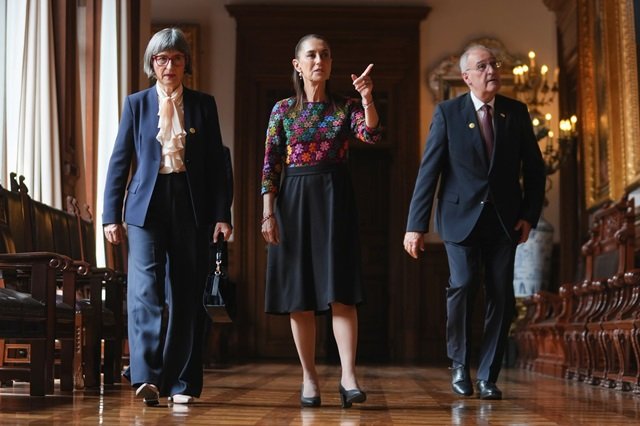
More than 70,000 people gathered in Mexico City’s Plaza de la Constitución on Sunday, September 27, as President Claudia Sheinbaum concluded a nationwide accountability tour launched after she presented her constitutional Second Government Report on September 1. The Zócalo assembly brought together the final stage of a tour during which Sheinbaum visited all 32 federal entities to present regional assessments of her administration and maintain direct contact with citizens.
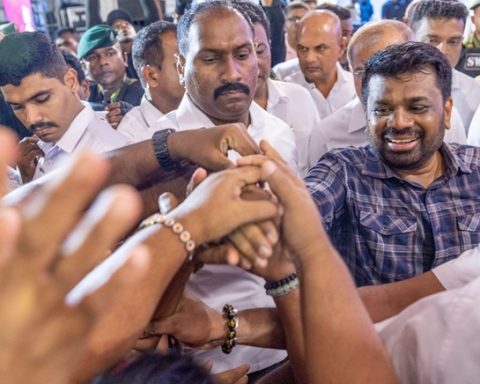
The event was formally presented as an accountability exercise rather than a national political mobilisation, with Sheinbaum focusing on government programmes and projects in Mexico City. The Zócalo began filling from early morning, while roads leading into the Historic Centre became crowded with supporters carrying flags, banners and symbols associated with the government and Morena. Local authorities reported that more than 70,000 people were in the square by 8.30am. The gathering included Mexico City residents, social-programme beneficiaries, Morena activists, public-sector workers and visitors from elsewhere in the country.
The president used the occasion to outline reforms that she said had strengthened the constitutional recognition of social rights and established new national priorities. Education, universal scholarships, public healthcare, housing and a 40-hour working week were among the areas she identified. She also highlighted constitutional changes prohibiting political nepotism and consecutive re-election beginning in 2030, as well as a proposal requiring public officials and candidates for elected office to hold Mexican citizenship.
Judicial reform featured prominently in the presentation. Sheinbaum defended the popular election of members of the judiciary as part of the transformation of Mexico’s political institutions. Supporters argue that elected judges can be more accountable to the public, while critics warn that popular voting could expose the judiciary to greater political pressure and weaken judicial independence. The competing interpretations form part of a wider debate over how institutional reform should be balanced with checks and balances.
Energy and natural resources were also central to the president’s account of her government’s priorities. She highlighted the recovery of Petróleos Mexicanos, or Pemex, and the Federal Electricity Commission, known as CFE, as public companies. Sheinbaum said public ownership was essential to national sovereignty and energy security. She also referred to constitutional changes recognising water as a national asset, with the government seeking greater federal control over water resources and opposing what it describes as excessive privatisation or unequal access.
That emphasis was linked directly to the president’s broader argument about sovereignty. Referring to Article 40 of the Constitution, Sheinbaum said: “National sovereignty is a fundamental pillar of our democracy.” She added that “no foreign power or economic elite has the right to dictate Mexico’s destiny.” The position comes as Mexico manages relations with the United States and Canada over trade, migration, security, energy and industrial policy while seeking to preserve economic integration through the USMCA agreement.
In Mexico City, Sheinbaum reviewed social programmes implemented with Clara Brugada Molina, the head of government. The administration allocated 70.258 billion pesos for 2026 to support more than three million beneficiaries and pensioners in the capital. The figures presented included 1,377,198 older adults receiving universal pensions, 321,684 women aged 60 to 64 enrolled in Mujeres Bienestar, 389,305 public high-school students receiving scholarships, 312,885 secondary-school students receiving the Rita Cetina scholarship, 387,867 children supported through Beca para Empezar and 255,000 people with disabilities incorporated into pension programmes.
The government presented these programmes as measures to reduce inequality, strengthen household incomes and guarantee access to education and basic services. Critics question the cost, sustainability and long-term effectiveness of some transfers, arguing that they need to be accompanied by higher productivity, formal employment, stronger schools and improved health services. The government maintains that welfare programmes are rights rather than temporary charity.
Healthcare and infrastructure formed another major part of the capital’s assessment. Sheinbaum cited the completion of IMSS Regional Hospital No. 25 in Iztapalapa, construction of a Women’s Oncology Hospital in Gustavo A. Madero, the Gonzalo Castañeda General Hospital operated by ISSSTE and the remodelling of Ignacio Zaragoza Hospital. The administration also reported the expansion of IMSS-Bienestar through 804 clinics with their own pharmacies.
Nearly 60 billion pesos was highlighted for mobility and water infrastructure. Projects included the completion of Metro Line 12 to Observatorio and rehabilitation of Line 2, Cablebús Line 4, the Tren Insurgente to Observatorio and rail connections with Felipe Ángeles International Airport. The government also cited the Mexico City-Pachuca and Mexico City-Querétaro railway routes, saying they would improve regional mobility and reduce road congestion. Water projects are intended to reduce flooding and improve supplies, particularly in eastern Mexico City, where shortages, sinking ground, leaking pipelines and severe flooding remain challenges.
The government presented the infrastructure programme as evidence of delivery, although major projects face issues involving financing, construction delays, environmental impacts, land acquisition and public oversight. Metro Line 12 remains politically sensitive after its deadly structural collapse in 2021, making technical transparency and safety inspections particularly important in its rehabilitation.
The Zócalo event concluded the tour with Sheinbaum affirming her commitment to unity between government and people. “Long live freedom and democracy; long live Mexico!” she declared, closing a nationwide exercise that combined institutional reporting with a demonstration of support for the Fourth Transformation and its political project associated with Morena and the governments of Andrés Manuel López Obrador and Sheinbaum.