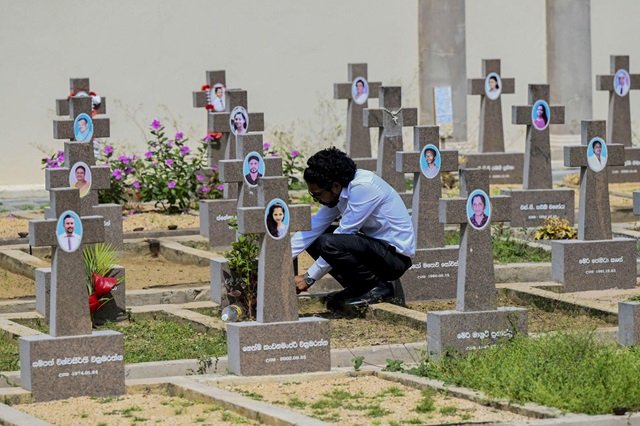
The Special Tripartite High Court judgment ( Read the Full Judgment) on Sri Lanka’s Easter Sunday attacks places Mohamed Ibrahim Mohamed Naufer, known as Naufar Moulavi, at the centre of an alleged network that prosecutors say connected ideological indoctrination with recruitment, training, logistics and the suicide bombings that killed 267 people and injured 574. The case, heard before High Court Judges Navaratne Marasinghe, Sujeewa Nijameddin and Ramanathan Kannan, was instituted under provisions of the Judicature Act, the Prevention of Terrorism (Temporary Provisions) Act and the Code of Criminal Procedure Act. The trial began with an indictment running to nine volumes and containing 23,270 charges against 25 named defendants.
The scale of the case is reflected in the court record. Transcripts and translated indictments supplied to defendants totalled 8,980 pages, with Tamil translations provided for 17 defendants and an English translation for the 25th defendant. During the proceedings, the 17th accused, Yasam Bawa Abdul Rauf, also known as Yasin Bawa Abdul Rauf, died on 5 February 2023. The court subsequently ordered the deletion of 932 charges directly relating to him, while 312 duplicated charges were withdrawn following prosecutorial review. The proceedings therefore continued against 24 living defendants.
At the heart of the indictment was a conspiracy charge under Section 3(b), read with Section 2(1)(h) of the PTA. The prosecution alleged that the defendants participated in a criminal conspiracy connected to violence, religious and racial disaffection and communal disharmony. The first defendant, Naufar Moulavi, faced the principal conspiracy allegation as well as a separate charge concerning indoctrination and a series of charges alleging that he aided and abetted the suicide bombers. The source material portrays him as the ideological figure who promoted extremist ideas and influenced members of the network, including those who later carried out the attacks.
The judgment’s treatment of indoctrination is one of its most consequential elements. Drawing on the Oxford Advanced Learner’s Dictionary and the Advanced Law Lexicon, the document defines indoctrination as teaching that establishes a particular set of beliefs while excluding alternative points of view. The prosecution’s case was that extremist ideology was deliberately propagated to create religious, racial and communal hatred and facilitate terrorist acts. The allegations extended beyond the bombings themselves to lectures, recruitment, training and other preparatory activities. The source material states that the network operated across locations including Anuradhapura-Rambewa, Malwana, Kandy, Nuwara Eliya and Hambantota.
The alleged operational structure was extensive. Mohamed Saribu Adam Lebbe, known as Gafoor Mama, was accused of providing logistical assistance and shelter, including allegedly concealing Zahran Hashim to prevent his arrest. Hayatu Mohamedu Ahamedu Milhan, known as Abu Sila, was accused of operational coordination, weapons handling and explosives-related activities. Other defendants faced allegations involving recruitment, communications, transport, safe houses, weapons training and the movement or possession of explosives. The source material refers specifically to RDX, TNT and a detonator identified as “WP-BCQ 0304”, with alleged activity in places including Kattankudy, Ollikulam, Katuwapitiya and Narummalai.
The court record connects those allegations to the seven locations attacked on Easter Sunday, 21 April 2019. Alawdeen Ahammad Muath was identified as the bomber who attacked St Anthony’s Church, Kochchikade; Achchi Mohammadu Hastun attacked St Sebastian’s Church, Katuwapitiya; and Muhammadu Nasar Muhammadu Ashath attacked Zion Church in Batticaloa. At the Kingsbury Hotel, Mohammad Azam Mohammad Mubarak was identified as the bomber. The Shangri-La operation involved Zahran Hashim, also known as Mohammad Cassim Mohammad Zahran, Abu Muharib and Abu Ubaida, together with Mohammad Ibrahim Ilham Mohammad, known as Abu Bara. Mohammad Ibrahim Inshaf Ahamed attacked the Cinnamon Grand Hotel, while Abdul Latheef Jameel Muhammad carried out the attack at the New Tropical Inn in Dehiwala after an earlier or secondary detonation plan was abandoned.
The indictment also recorded individual victims and injured persons in detail, including foreign nationals. Among those killed was Chelsea Decaminada, an official of the United States Department of Commerce. The source states that the prosecution relied on the nationality of specified victims in invoking provisions concerning specified persons under Section 31(1) of the PTA. The casualty record was organised by attack location and incorporated into the extensive series of abetment, murder and attempted-murder charges.
The case also sought to establish a political and ideological objective: the creation of an “Islamic State” in Sri Lanka. The source material says the prosecution linked that objective to the statutory definition of a terrorist act, including conduct intended to cause death or serious bodily injury or to create terror. It also records allegations concerning religious and racial hatred and the use of coordinated attacks on churches and internationally recognised hotels to produce mass casualties and communal tension.
The judgment was delivered after a trial involving an enormous evidentiary record. Its treatment of the defendants cannot, however, be reduced to the allegations contained in the indictment. The source material itself distinguishes charges from judicial findings, and notes that the proceedings resulted in convictions of some defendants and acquittals of others. That distinction is central to understanding the judgment: the court was required to determine individual criminal responsibility rather than simply reproduce the prosecution’s theory of the Easter Sunday conspiracy. The record therefore contains not only the alleged chain from indoctrination and preparation to bombing, but also the judicial determination of which allegations were established against individual defendants and which were not.