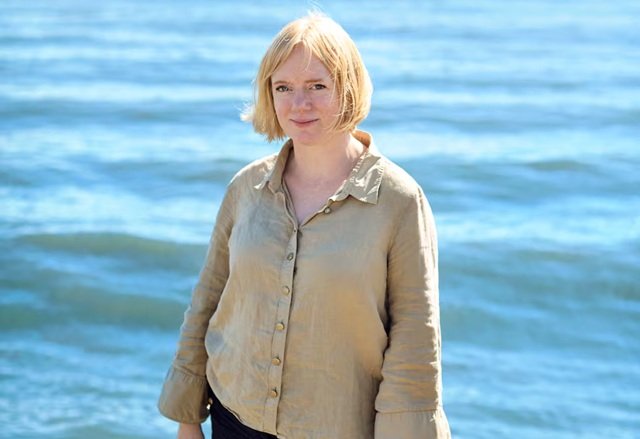
Norwegian anthropologist and travel writer Erika Fatland has completed a book about Ukraine, drawing on journeys through Kraków, Kharkiv, Odesa and Kyiv to document how people attempt to preserve ordinary life during a war that has disrupted their routines since the winter of 2022. Her reporting examines not only those who have become heroes through their actions, but also men who refuse to fight, people who avoid politics and civilians whose lives have been reorganised by the conflict.
“I am deeply moved by seeing people risk their lives to save dogs and cats on the front line,” Fatland said in an interview with the Spanish newspaper El País, which published the original account. In Kharkiv, she met a young woman who refused to leave because she was caring for bats. “War brings out the worst in people, but also the best,” she said.
The book marks another stage in Fatland’s investigation of countries shaped by their proximity to Russia. Her earlier work, The Border, explored the histories, tensions and political experiences of the 14 countries that share a border with the world’s largest country. Only her native Norway, she observed, has avoided going to war against Russia. The project began as an imagined peaceful journey from North Korea to Norway, travelling around Russia to understand what it means to live beside such a powerful neighbour. Within weeks of her original plan, Russia annexed Crimea and war began in eastern Ukraine in 2014, changing the circumstances of her journey.
Fatland has not yet written a book about Russia itself. She said she approached her former Russian publisher to ask for help obtaining a visa, but was told that if she intended to produce a critical account of the Russian government, as she had with The Border, the publisher would be the last organisation to assist her. She interpreted the response as a warning not to visit. “I think, statistically, I will outlive Putin, so I will wait,” she said. Russia would still be there, she added, whereas Ukraine required attention now.
Her approach to the Ukrainian war differs from her earlier travel books. Rather than concentrating exclusively on dramatic events or heroic figures, she seeks to capture the range of experiences within a society at war. Her account combines personal testimony with historical context, recording the choices people make, the limits of their willingness to participate in the conflict and the efforts to maintain relationships and responsibilities under extraordinary pressure.
The project continues a career in which Fatland has used travel to examine how political systems, historical violence and cultural identities shape individual lives. Her early books addressed the Beslan school siege in Russia’s North Ossetia region and the 2011 attacks on Utøya in Norway. Researching Beslan initially formed part of her anthropology thesis, which she undertook while learning Russian. She entered the region as a volunteer with the local Red Cross and was told shortly before travelling that she would need two bodyguards. The men assigned to accompany her were retired police officers and relatives of a local Red Cross official. Their reluctance to leave the car proved useful because it allowed her to conduct interviews without interference.
The subsequent book became personally significant when her cousin Lars was shot during the Utøya massacre. He survived, although Fatland said he might not have done so had the police taken another 30 minutes to find him. Comparing the two tragedies, she concluded that the psychological consequences of trauma were similar, but that the responses of the societies and governments differed substantially.
In Beslan, she said, families received reports containing lies and manipulation, leaving victims to expend enormous energy trying to establish what had happened. Conspiracy theories proliferated, and families fought among themselves. In Norway, by contrast, the government’s mistakes following Utøya were identified and openly discussed in a subsequent report. Fatland said that transparency was important to victims and helped distinguish the Norwegian experience from the unresolved grievances surrounding Beslan.
Writing about such events eventually became emotionally exhausting. Fatland turned to travel writing with Sovietistan, exploring former Soviet republics in Central Asia. She found the genre offered greater freedom to combine politics, history and culture without restricting herself to academic interpretation. Although the countries shared legacies of Soviet rule, including borders drawn in the 1920s under Stalin and political leadership inherited from the Soviet system, she cautioned against treating them as a single cultural entity. Their populations retained distinct identities, and describing them collectively as Sovietistan could obscure their differences.
Fatland has also investigated the restrictions imposed by authoritarian governments. In North Korea, she was permitted to walk alone only in the hotel car park. Comparing the country with Turkmenistan, she said both systems tightly controlled political opposition and elevated their leaders, but Turkmenistan remained more exposed to outside information through satellite television and limited internet access. North Korea, she argued, had achieved a much more comprehensive isolation of its population, with education shaped by state propaganda and punishment potentially extending to an offender’s entire family.
She also warned that North Korea was becoming more dangerous through its involvement in the war in Ukraine. Pyongyang was not only sending soldiers to assist Russia, she said, but also learning modern warfare techniques involving drones.
Fatland’s latest Spanish-language publication, Los navegantes, examines the legacy of the Portuguese empire across Africa, Asia and the Americas. The book became Norway’s best-selling title in 2024, according to the interview. Her research examined Portugal’s role in the Atlantic slave trade, estimating that Portuguese traders were responsible for the trafficking of six million enslaved Africans, including five million transported to Brazil and 400,000 to the United States. She argued that Portuguese public understanding of imperial history remained unbalanced, with national pride in maritime discoveries receiving greater attention than slavery and colonial violence.
For Fatland, the same investigative principle connects her work on empires, authoritarian states and contemporary warfare: travel provides access to people whose experiences complicate official narratives. Having grown up in the small Norwegian community of Ølen, she left for Lyon at 16 through an exchange programme with France, an experience she credits with making her more independent. She later studied anthropology before pursuing writing full-time. Now 43, she continues to plan journeys well into the future, describing the freedom to investigate unfamiliar places and encounter different lives as central to her work.