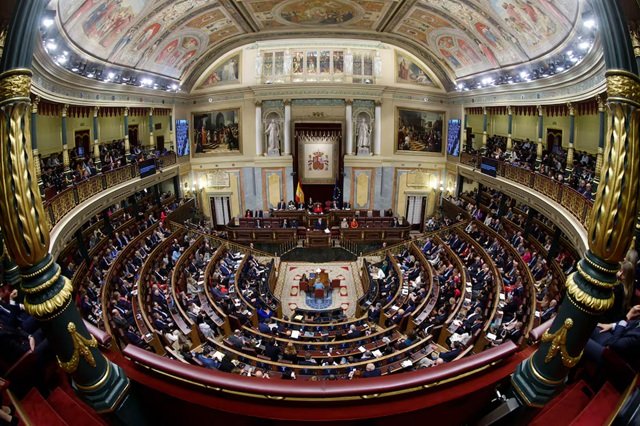
Political debate in Spain’s parliament has become increasingly confrontational, with negative rhetoric rising sharply in plenary sessions since 2017, according to a study analysing 48,191 parliamentary speeches and interventions between 1996 and 2023. Researchers from the University of Valencia and the Spanish National Research Council (CSIC) say the findings point to a growing theatricalisation of parliamentary politics, in which public confrontation increasingly takes precedence over the more practical work of reaching agreements.
The research, published in the academic journal Parliamentary Affairs by Oxford University Press, used natural language processing tools alongside measures of anger and negative sentiment to examine changes in parliamentary discourse over nearly three decades. Its findings reveal a growing contrast between plenary sessions, which attract substantial public attention, and parliamentary committees, where much of the detailed work of negotiating and developing agreements takes place.
Berta Chulvi, a social psychology professor at the University of Valencia and one of the study’s authors, said committees traditionally provided the setting in which political differences were worked through to produce agreements. Between 1996 and 2008, negative criticism was more prevalent in committees than in plenary sessions, reflecting the detailed scrutiny and negotiation involved in committee work. The two settings became more evenly matched between 2008 and 2017, before negative criticism in plenary sessions increased sharply and declined in committees.
The researchers interpret this reversal as evidence of the growing theatricalisation of parliamentary debate. Their findings are consistent with work by Xavier Coller, a professor of political science and public administration at Spain’s National University of Distance Education, who examined the phenomenon in his book La teatralización de la política en España. Coller conducted more than 500 surveys and over 50 interviews with politicians from different parties, most of whom acknowledged that political theatricalisation was a real phenomenon.
The shift in parliamentary rhetoric since 2017 coincided with the emergence of new political parties in Spain’s Congress, including Podemos and Ciudadanos, followed by Vox in 2019, as well as the rapid expansion of political content on social media. The year before the change became apparent, the United Kingdom voted to leave the European Union and Donald Trump won his first US presidential election. Both political developments subsequently became associated with controversies over social media use and disinformation.
The Spanish study does not establish a direct causal relationship between the growth of political content online and the increasingly confrontational tone of parliamentary speeches. However, its authors point to research suggesting that the pursuit of viral content and the operation of social media algorithms can encourage polarisation and the spread of misleading information.
David Arroyo, a CSIC researcher specialising in cybersecurity and data, said social media environments with limited content moderation allowed simple, rapid promises to spread widely. Such messages could capture attention without requiring extensive explanation or reflection, potentially translating that attention into votes.
“Social media have elevated conflict as a communication strategy,” Chulvi said, arguing that the confrontational style associated with online political debate had increasingly entered parliament and changed how politicians understood their own roles.
The expansion of political content online has also brought political discussion to audiences who previously had less exposure to it. Whereas people once relied largely on television news, newspapers and scheduled radio programmes for political information, social media now circulate political material to a much broader public. Chulvi said politicians seeking to capture this enlarged audience increasingly emphasised conflict between opposing sides.
Researchers also examined the use of personal pronouns, particularly the distinction between “us” and “them”, as an indicator of polarising language. Chulvi said this division was common in disinformation and hate speech, where political or social disagreements could be framed as conflicts between opposing groups.
The researchers warned that the implications extended beyond the language used in parliamentary debates. If politicians increasingly perceive confrontation as electorally beneficial, the incentive to seek compromise may weaken. Arroyo said the communication dynamics of social networks and newer online media had become connected to the construction of political discourse, potentially making consensus more difficult to achieve.
Chulvi argued that when parliamentarians adopt narratives built around social conflict, they can reinforce the same communication strategies that help disinformation spread. The change may affect not only how politicians conduct their work, but also how the public perceives political representatives and the institutions in which they operate.