The United States and the Soviet Union came remarkably close to an agreement that could have transformed global security by eliminating nuclear weapons, according to previously secret documents released by the National Security Archive on 10 October 2026. The records, published to mark the 40th anniversary of the Reykjavik summit, reveal how Ronald Reagan and Mikhail Gorbachev pursued their shared vision of nuclear abolition in October 1986, only to be divided by a fundamental dispute over American missile defence and the future of strategic competition.
The documents include the leaders’ correspondence, internal Soviet Politburo discussions, American briefing papers, complete United States and Soviet transcripts of the summit meetings, and subsequent assessments of why the negotiations failed. Together, they provide an unusually detailed account of a diplomatic encounter that ended without a comprehensive agreement but helped open the way for major arms-control breakthroughs in the final years of the Cold War.
The central finding is that Washington substantially underestimated Gorbachev’s ambitions before the summit. American officials expected Reykjavik to prepare the ground for a future meeting rather than produce a dramatic agreement on nuclear reductions. Gorbachev, however, arrived determined to advance a programme aimed ultimately at the complete elimination of nuclear weapons, building on the Soviet proposal announced in January 1986.
Gorbachev’s initiative began with a letter to Reagan dated 15 September 1986, carried to Washington by Soviet Foreign Minister Eduard Shevardnadze. Seeking to break the cycle of inconclusive negotiations and escalating diplomatic tensions, he proposed “a quick one-on-one meeting, let us say in Iceland or in London.” The letter reflected his frustration that, despite the Geneva summit in November 1985, the two countries had made little progress towards meaningful arms reductions.
In his preparations for Reykjavik, Gorbachev repeatedly emphasised that the Soviet Union needed to take American security interests seriously if negotiations were to succeed. His objective was not simply to extract concessions from Washington but to create what he described as a position with “breakthrough potential”. He placed strategic nuclear weapons at the centre of the proposed discussions and reiterated that his ultimate goal was the “total liquidation of nuclear weapons”.
The contrast with American preparations was striking. A sensitive briefing memorandum prepared by Secretary of State George Shultz on 2 October 1986 did not anticipate an agreement of such magnitude. Another National Security Council assessment, prepared by Stephen Sestanovich two days later, misjudged Gorbachev’s intentions, portraying the Soviet leader as more hesitant about future negotiations than the subsequent discussions would demonstrate.
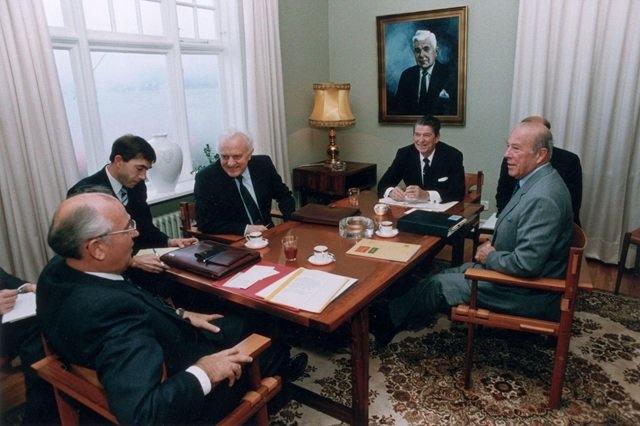
When the leaders met at Hofdi House in Reykjavik on 11 and 12 October, their conversations moved far beyond the limited expectations of their advisers. The two men discussed radical reductions in strategic arsenals and the possibility of eliminating ballistic missiles, approaching the prospect of abolishing nuclear weapons altogether.
Yet the negotiations encountered a formidable obstacle: Reagan’s Strategic Defense Initiative, or SDI, the proposed American missile-defence programme that became popularly known as “Star Wars”. Reagan regarded the development of defensive systems as essential insurance against a future nuclear attack. Even in a world without offensive nuclear weapons, he argued, a country would need protection against a leader who might secretly retain or rebuild missiles.
To explain his position, Reagan repeatedly invoked the analogy of retaining gas masks even after an international ban on chemical weapons. Gorbachev, increasingly frustrated by the repetition, reportedly responded: “that’s the 10th time you talked about gas masks.”
For the Soviet leader, SDI represented a potentially dangerous expansion of the arms race into space. He feared that American missile defences could undermine the strategic balance and create the possibility of a first-strike advantage. Soviet scientists had also argued that missile defences could be countered relatively cheaply through multiple warheads and decoys, even if the technology proved effective.
The disagreement was therefore about more than the technical feasibility of missile interception. It concerned the conditions under which nuclear abolition could be made credible. Reagan wanted to preserve the freedom to develop SDI while pursuing deep offensive reductions; Gorbachev insisted that restrictions on missile defence were essential to prevent a new strategic imbalance.
The Soviet and American transcripts illuminate the intensity of the exchanges. Although the two versions differ in wording and detail, the National Security Archive says they contain no direct contradictions. Their comparison captures both leaders expressing a shared aspiration for nuclear abolition while struggling to reconcile incompatible security assumptions.
The dispute was equally evident in negotiations between the military and diplomatic delegations. During overnight discussions led by Soviet Marshal Sergei Akhromeyev and American negotiator Paul Nitze, the Soviet side proposed broad strategic reductions, eliminating intermediate-range missiles in Europe and maintaining a ten-year period of non-withdrawal from the Anti-Ballistic Missile Treaty.
The American delegation continued to negotiate largely from earlier proposals that had been overtaken by the leaders’ discussions. Soviet aide Georgy Arbatov warned that the American position demanded a degree of confidence that had not been established. “What you are offering requires an exceptional level of trust. We cannot accept your position,” he told Nitze.
That assessment captured the summit’s central contradiction: both leaders appeared willing to contemplate extraordinary reductions, but neither could fully trust the other’s approach to the security arrangements that would follow.
The final meeting on 12 October ended without agreement. The American transcript records Reagan preparing to leave after asking Gorbachev for a personal favour concerning SDI and the ABM Treaty. Gorbachev responded that the issue was not a favour but a matter of principle. The Soviet transcript preserves additional closing remarks absent from the American version, including Reagan’s observation: “I don’t know when we’ll ever have another chance like this and whether we will meet soon.”
The missed opportunity was followed by political developments that further narrowed the prospects for a sweeping settlement. Soviet Politburo notes from 30 October indicate that Gorbachev had largely accepted Reagan’s formulation for continued SDI research, but the possibility of a deal had already weakened. The impending Iran-Contra scandal damaged Reagan politically, while the departure of National Security Adviser John Poindexter removed an official associated with the summit’s ambitious disarmament agenda. The documents also describe opposition within the American military establishment to abolishing ballistic missiles, partly because of estimates of the additional conventional military expenditure that would be required.
Reykjavik thus became a turning point without becoming the historic disarmament settlement its participants had contemplated. The summit exposed the scale of what was possible when political leaders moved beyond established negotiating positions, but it also demonstrated how technological ambitions, institutional resistance and strategic mistrust could obstruct even a shared objective.
The National Security Archive’s newly released records suggest that the failure was neither simply a clash of personalities nor a straightforward rejection of nuclear abolition. It was a collision between two different conceptions of security in a world both leaders hoped to make safer. Although they left Iceland without a comprehensive agreement, their negotiations helped establish the momentum for the major arms-control advances that followed, including the Intermediate-Range Nuclear Forces Treaty signed in December 1987.