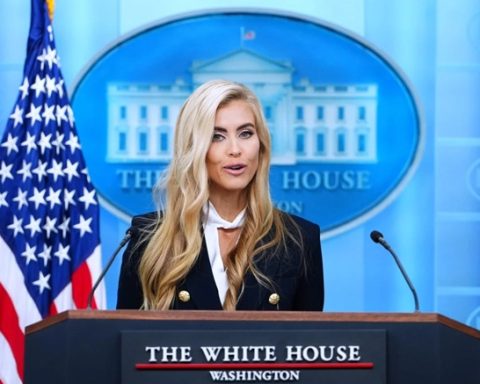
Katie Zacharia, the new White House press secretary under US President Donald Trump, attracted widespread attention during her first briefing after accidentally referring to the president as “my husband” when she intended to say “my president”. The brief verbal mistake quickly became the defining moment of her debut, provoking speculation about political loyalty, professional identity and the psychological significance of slips of the tongue. In a commentary published by German newspaper Die Zeit, the incident is examined through the competing interpretations offered by Freudian psychoanalysis and contemporary psychology.
Zacharia, a lawyer and former Fox News presenter, took over the role after the departure of her predecessor, Karoline Leavitt, who reportedly resigned in August 2026 to spend more time with her family. Leavitt had become a familiar defender of Trump, regularly presenting his decisions in a favourable light despite criticism of his unpredictable conduct. Her departure provides the context for Zacharia’s arrival in a position that requires its occupant to explain and defend the president’s actions to journalists while maintaining a public appearance of confidence and control.
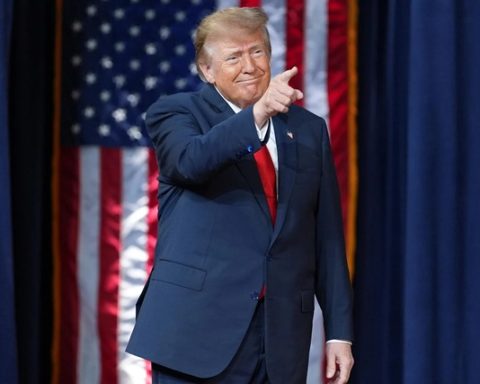
The challenges of the job are considerable, according to Die Zeit’s commentary. Trump’s recent decisions include a billion-dollar diesel agreement with Russia that the article says could help finance the war against Ukraine and sustain its consequences for Ukrainian soldiers and civilians. The president also blamed Ukrainian attacks on Russian oil refineries for the global oil-price crisis, a position the commentary contrasts with his own actions concerning Iran. Such developments illustrate the difficulty facing a press secretary expected to present the president’s decisions as coherent and deliberate, even when they appear inconsistent to critics.
Zacharia’s first appearance also exposed the conflicting expectations placed on women in senior political positions. She was asked how she intended to reconcile the demands of her new job with her responsibilities as a mother of four, a question that Die Zeit notes is not routinely posed to fathers in comparable positions. Cheerful and quick to respond, Zacharia said her family would naturally remain her highest priority. The commentary characterises this reassurance as an expedient response to an awkward question, arguing that the demands of such a high-profile position inevitably require substantial professional commitment.
The incident that attracted the greatest attention, however, came when Zacharia attempted to praise her husband. Instead of saying “my husband”, she said “my president”. She immediately recognised the mistake and remarked, “That’s a good one”, acknowledging the humour of the slip. The moment was recorded and circulated widely, turning an otherwise brief introductory appearance into an episode of public amusement and scrutiny.
The mistake also revived a familiar psychological question: do verbal slips reveal thoughts that a speaker would otherwise keep hidden? Sigmund Freud, the founder of psychoanalysis, popularised the interpretation that seemingly accidental errors of speech can expose unconscious desires, associations or thoughts. Under this reading, Zacharia’s substitution of “my president” for “my husband” could be interpreted as an inadvertent disclosure of the relationship between her professional allegiance and her private life.
Die Zeit’s commentary extends that interpretation to the competing priorities Zacharia had just discussed. Her words could be read as blurring the boundaries between husband and president, family and career, or personal commitments and professional obligations. Such an interpretation might suggest that the president occupies an unusually prominent place in her thinking, or that her assurances about putting family first sit uneasily alongside the demands of her new position. These are possible readings of the episode, rather than established conclusions about Zacharia’s private thoughts or motivations.
A less speculative explanation comes from contemporary psychology, which is generally less committed to Freud’s original account of slips of the tongue. From this perspective, the mistake need not reveal anything significant about the speaker’s unconscious life. It could instead be a simple cognitive error: a momentary failure in word selection caused by haste, in which the brain takes the wrong semantic route while producing speech.
The commentary describes this possibility as a cognitive “glitch”, comparable to a momentary processing error rather than a hidden psychological confession. The fact that “husband” and “president” share some phonetic similarities may also help explain how one word could replace the other in rapid speech. The resemblance offers a plausible linguistic explanation without requiring the assumption that Zacharia unconsciously regards Trump as equivalent to her spouse.
Neither interpretation can be conclusively established from the verbal slip alone. Freud’s approach invites audiences to search for concealed meanings, while contemporary cognitive explanations caution against treating every mistake as evidence of suppressed thoughts. The incident therefore reveals as much about the interpretative frameworks brought to public behaviour as it does about the words themselves.
The episode resembles a Rorschach test, in which an ambiguous image invites different interpretations depending on the observer. Zacharia’s verbal slip can be understood as an ordinary cognitive error or interpreted as a glimpse into the unconscious loyalties of a political spokesperson. Whether it reveals anything about her private thoughts, however, cannot be established from the mistake alone.