Mitoe Matsumoto was three years and four months old when an atomic bomb exploded over Nagasaki at 11.02am on 9 August 1945. Eighty-one years later, the 84-year-old Japanese survivor says the experience has shaped her entire life, even though her memories of the explosion are fragmentary. Her warning is direct: “Humanity has not learned the lesson of the bomb.” She believes the world continues to underestimate nuclear weapons and their long-term effects, including consequences that remain insufficiently understood by doctors and researchers.
“I am 84 years old, and my whole life has been defined by the bomb,” Matsumoto told El País during an interview at the Nagasaki Atomic Bomb Museum. She has made it her responsibility to recount what happened to her family and the people around her, aware that the generation of survivors, known in Japan as hibakusha, is disappearing. Her testimony comes as the number of people able to describe the atomic bombings of Hiroshima and Nagasaki from personal experience continues to decline.
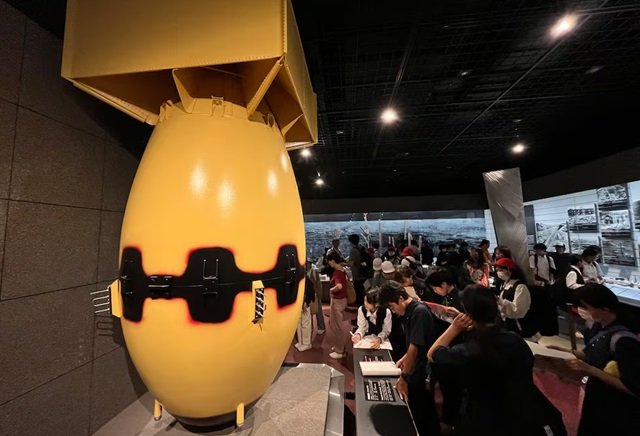
The bomb dropped on Nagasaki was a plutonium weapon, more powerful than the uranium bomb that had devastated Hiroshima three days earlier. Nagasaki was not the intended target, nor was the neighbourhood where the bomb ultimately exploded. The crew of the American B-29 bomber Bockscar spotted a break in the clouds and released the weapon, codenamed Fat Man, over the Urakami Valley, about four kilometres north of the city centre. The area was home to a substantial Christian population.
The two attacks killed an estimated 140,000 people in Hiroshima and 74,000 in Nagasaki. According to a census published by Japan’s Ministry of Health, Labour and Welfare, 91,105 hibakusha remain alive, with an average age of 86. Many were very young children when the bombs fell, leaving them with incomplete personal memories of the destruction but lifelong experiences of its consequences.
Matsumoto remembers the flash more clearly than the precise sequence of events. Before the bombing, her family had moved from a house near Nagasaki railway station to a small home in an agricultural area because they feared further American air raids. Her father, who worked at a Mitsubishi arms factory, had returned home after his department was bombed earlier that month.
The family consisted of Matsumoto, her parents, her maternal grandmother and her maternal aunt, Shimenko, who was 22 and worked as a nurse. On the morning of 9 August, they set out early for their new home and stopped to visit Shimenko at the hospital where she worked. She warned them to be careful because nobody knew what might happen in those dangerous days.
“It was the last word of hers that we heard,” Matsumoto recalled.
The family never found Shimenko’s body. They believed the explosion had probably reduced it to ashes and buried a lunchbox and a burnt hair, neither of which they could be certain belonged to her, in the family grave. Another aunt died several months later, in what Matsumoto believes was a consequence of radiation exposure.
The family had just reached their neighbourhood when the bomb exploded. “I remember that at that moment there was a gigantic flash of light, as if hundreds of camera flashes had gone off at once,” she said. Her mother seized her and ran towards the nearest house, while her father, who had been working in the garden, was thrown by the blast wave. He survived without serious injury. Her grandmother also survived because a mound of earth protected her from the force of the explosion.
Matsumoto remembers feeling relieved that her family members had survived, but says fear dominated the rest of her childhood. Although the family understood that the explosion was far more powerful than the conventional bombs that had previously struck Nagasaki, they did not know what a nuclear weapon was or understand the effects of radiation.
“We knew nothing about what had happened in Hiroshima,” she said. The family did not begin to hear about the effects of atomic radiation until 1954, when the Japanese fishing vessel Daigo Fukuryu Maru was accidentally exposed to a nuclear test in the Pacific. By then, her aunt had already died after a prolonged deterioration in health that the family associated with the bombing, without having access to clear medical information.
The uncertainty extended beyond Matsumoto’s family. In her book Nagasaki: Life After the Bomb, historian Susan Southard describes how American authorities denied that the weapon had effects beyond the immediate explosion, even as Japanese doctors increasingly suspected widespread radiation-related illness. Southard recounts how General Groves, the senior military official responsible for the Manhattan Project, dismissed reports of mysterious illnesses in Hiroshima and Nagasaki as propaganda.
Survivors also faced social discrimination. Some avoided discussing their experiences because they feared being treated as unhealthy or unsuitable marriage partners, particularly women, whose prospects could be affected by concerns about the health of their future children. Matsumoto says she escaped the worst of this treatment because everyone in her neighbourhood had survived the bombing. Nevertheless, she knows of women who experienced severe discrimination when they wanted to marry.
Japan provides hibakusha with medical coverage, a monthly allowance of between 30,000 and 40,000 yen, equivalent to approximately €170 to €225, and 200,000 yen towards funeral expenses. Matsumoto says some people criticise survivors for receiving these benefits, accusing them of living comfortably.
The discrimination and the continuing medical uncertainties reinforce her determination to speak publicly. “Everyone who was there received radiation, and every day we discover a new effect, a new illness related to the explosion,” she said. “We still do not know the effects of an atomic bomb. My message is that it must never be used again. We do not know what it is, and we do not know how it affects subsequent generations.”
Matsumoto is married to another survivor and has no children. She has long believed that she must pass on her experience, and now participates in efforts to train younger people to become custodians of survivors’ testimonies. At the museum, where schoolchildren from across Japan visit on educational trips, a medal commemorates the 2024 Nobel Peace Prize awarded to Nihon Hidankyo, the organisation founded by hibakusha in 1956.
Her own group once had 26 survivors, but only 20 remain active, she said. Programmes are recruiting younger people to carry their messages forward as the witnesses grow older.
“Many people think it is like an ordinary bomb, only much more powerful,” Matsumoto said. “Even doctors do not truly know its effects.”