Editorial
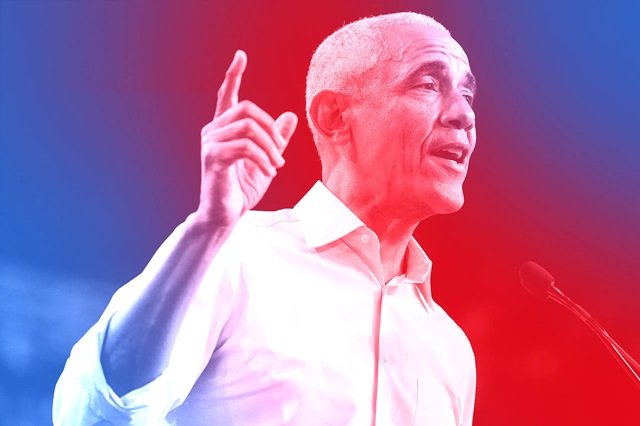
Donald Trump may have succeeded in making himself the centre of American politics, but Barack Obama has just demonstrated that he remains one of the few Democrats capable of challenging him on equal political and rhetorical terms. The former president’s return to the campaign trail has exposed something the Democratic Party has struggled to produce since his departure from the White House — a political figure who can command a crowd, dominate a news cycle, ridicule Trump’s excesses and, crucially, offer an alternative vision of America. If Trump continues entertaining the prospect of extending his political dominance beyond his present presidential term, the Democrats should recognise that Obama is still their most formidable political counterweight. He cannot constitutionally seek a third presidential term, but he can lead the political resistance that a serious challenge to Trump requires.
Obama’s recent appearances in Ohio, Michigan and Georgia have offered a striking reminder of the political electricity he can still generate. Thousands have gathered to hear him speak, with crowds in Georgia overwhelming the arrangements at a campaign event supporting Democratic Senator Jon Ossoff. In Cleveland, his intervention on behalf of Democratic candidates Sherrod Brown and Amy Acton produced an immediate political sensation. This is not merely nostalgia for a former president. It is evidence of a political connection that has survived years outside the White House. At a time when the Democratic Party is searching for a recognisable voice and a convincing message, Obama can still command attention in a way few of its current leaders can. His speeches combine humour, confidence, political intelligence and an ability to translate complicated national problems into language that ordinary voters understand.
His now widely circulated comparison of Trump’s White House renovations to a place where Saddam Hussein had opened a Cheesecake Factory was more than a clever insult. It was a calculated political attack on the president’s priorities and his understanding of public office. Obama mocked the ballroom, the gold decorations, the changes to the Rose Garden and the helicopter pad, suggesting that Trump appeared more interested in decorating the presidential residence than addressing the economic pressures confronting American families. The joke worked because it carried a political argument beneath its humour. A president presiding over a country concerned with living costs, inflation and economic uncertainty should be judged by what he does about those problems, not by the extravagance of his surroundings.
Trump’s irritated response only amplified Obama’s point. When the former president returned to the subject in Georgia, he observed that the administration had found time to respond to his Cheesecake Factory joke but had not adequately addressed his criticisms concerning rising prices, tariffs and alleged corruption. Obama remarked that the administration had effectively mobilised a government response to a joke rather than to inflation. His observation was devastating precisely because it turned Trump’s reaction into evidence for the original criticism. A political leader who allows personal ridicule to consume his attention while substantive questions remain unanswered is displaying a troubling confusion between personal prestige and public responsibility. Obama understood the political opportunity and exploited it with the confidence of someone who knows how to control an audience.
But the significance of Obama’s return extends beyond the entertainment value of his exchanges with Trump. His most important message was delivered when he reminded Americans that opposition alone was insufficient. “We can’t just be against this administration’s behaviour,” he argued. Democrats must demonstrate what the country could look like after Trump’s presidency, with concrete proposals to reduce living costs, make healthcare and housing more affordable and bring utility bills under control. He also described the midterm elections as the system’s “circuit breaker”, calling on voters to activate a mechanism of accountability. These are not simply campaign slogans. They represent an understanding of democratic politics that the opposition party desperately needs. A political movement cannot survive indefinitely by defining itself through the personality it opposes. It must offer a credible destination.
That is where Obama remains particularly valuable. His political strength lies in his ability to connect institutional concerns with the everyday anxieties of citizens. He can move from international conflict and economic consequences to the price of fuel at an American petrol station without losing his audience. He can condemn political cruelty, question presidential priorities and invoke the country’s democratic traditions while retaining the rhetorical discipline to explain why these matters affect ordinary people. His reference to Martin Luther King Jr.’s argument that progress sometimes requires rediscovering values left behind is particularly relevant to a country struggling with political division and institutional distrust. Obama’s appeal is not that he can restore an imagined golden age of American politics. It is that he can remind Americans that public office demands something more substantial than personal loyalty, spectacle and permanent confrontation.
The Democratic Party, however, must not mistake Obama’s popularity for an automatic political solution. His presidency was not without failures, controversies or unfulfilled promises, and nostalgia cannot substitute for a programme capable of addressing present-day inequalities, economic insecurity and public distrust. Nor can one gifted speaker repair the institutional weaknesses of an entire political party. The Democrats need new leaders, a coherent economic agenda and the courage to confront their own political shortcomings. Obama himself appears to recognise this when he insists that the party must explain what comes after Trump rather than merely denounce what is happening under him.
Nevertheless, if Trump continues to test the constitutional and political boundaries surrounding presidential power, Obama should be at the forefront of the Democratic response. The Twenty-Second Amendment prevents either Obama or Trump from being elected to a third presidential term under the present Constitution. That legal reality does not diminish the political significance of the question. Obama can be the Democrats’ principal campaigner, strategist, public voice and moral counterweight in a struggle over the future direction of the republic. Trump has demonstrated an extraordinary ability to dominate political attention. Obama has just demonstrated that he can still take that attention away from him.
America does not need another political personality cult to defeat the existing one. It needs a democratic movement capable of restoring seriousness to government, accountability to public office and substance to political debate. Obama’s return has shown that the energy, discipline and rhetorical force to help lead such a movement still exist. If Trump wants to make his presidency a permanent political project, the Democrats should put Obama at the centre of the fight against that ambition. He cannot occupy the Oval Office again, but he can help determine what kind of America occupies it next.