

The government serves as the primary governing institution responsible for providing public goods, enforcing law and order, ensuring economic stability, and advancing national development goals. To carry out these wide-ranging economic and social functions, the sovereign state must systematically raise revenue through taxation, duties, and non-tax channels, and strategically deploy these financial resources across public institutions. The execution of these fiscal responsibilities is governed through public finance frameworks, which dictate how public money is collected, prioritized, managed, and audited.
At the center of public finance lies the legislative instrument known as the Appropriation Bill. Under constitutional standards, such as Article 148 of Sri Lanka’s Constitution, Parliament retains ultimate authority over all public funds, stipulating that no tax may be levied and no revenue withdrawn from the Consolidated Fund without explicit legislative approval.
The Appropriation Bill represents the formal legislative proposal that authorizes the government to withdraw funds from the Consolidated Fund to meet service expenditures, administrative overheads, and development projects for a specific financial year.
Government Budget
The national budget is the central policy document through which a government translates its economic strategy, policy promises, and development objectives into binding financial commitments. Beyond being a mere accounting ledger of projected receipts and outlays, the budget functions as an instrument for macroeconomic stabilization, resource reallocation, and wealth redistribution. It directly impacts inflation targets, employment figures, national debt levels, private sector investment incentives, and overall economic growth trajectories.
A sound government budget typically exhibits several key characteristics that reflect strong public financial management. First, comprehensiveness requires that the budget capture all government revenues, expenditures, off-budget funds, and contingent liabilities to ensure complete financial transparency. Second, fiscal transparency and clarity ensure budget documents clearly delineate between recurrent operational expenses, such as wages and interest payments, and productive capital investments. Third, predictability and multi-year alignment align annual operational spending allocations with medium-term expenditure frameworks and long-term economic strategy. Fourth, allocative and operational efficiency directs resources toward high-multiplier sectors—such as education, digital infrastructure, and renewable energy—while keeping administrative wastage minimal. Finally, fiscal sustainability demands that expenditure commitments be balanced against realistic revenue projections to prevent unmanageable debt accumulation.
Deficit Government Budgets
A deficit government budget occurs when total state expenditure exceeds total government revenues during a fiscal period, requiring the state to bridge the gap through domestic or foreign borrowing. Most modern developing nations, including Sri Lanka, operate under persistent budget deficits to finance national development obligations and bridge infrastructural shortfalls.
Budget deficits offer clear advantages when managed strategically. In accordance with Keynesian economic policy, targeted deficit spending stimulates aggregate demand by increasing national employment, boosting consumer purchasing power, and encouraging overall economic activity during downturns. Deficits are particularly beneficial for funding productive capital expenditure, allowing governments to execute large-scale, high-multiplier capital projects—such as ports, energy grids, and digital networks—that generate long-term economic returns far exceeding their initial borrowing cost. Moreover, deficit financing supports crisis response and social protection, enabling states to maintain social safety nets, healthcare systems, and economic relief programs during crises without making sudden, damaging cuts to public services.
Conversely, persistent budget deficits introduce significant structural disadvantages. Uncontrolled spending leads to mounting public debt accumulation, forcing future generations to bear heavy debt-servicing burdens that consume large portions of the annual budget. Deficit spending financed through excessive central bank liquidity expansion or heavy domestic borrowing generates severe inflationary risks, eroding real household purchasing power. Large government borrowing requirements also cause a crowding-out effect in financial markets by absorbing domestic banking liquidity, pushing up market interest rates and restricting credit access for private sector enterprises. Finally, relying on foreign debt to cover fiscal shortfalls heightens external vulnerability, exposing the nation to foreign exchange volatility, sovereign rating downgrades, and debt sustainability crises.
As Sri Lanka navigates its post-recovery macroeconomic stabilization trajectory, fiscal policy remains the ultimate litmus test of state priorities. The presentation of the 2027 Appropriation Bill—outlining an estimated state expenditure framework of LKR 4,992.8 billion—offers a critical empirical window into how the nation balances short-term institutional stabilization with medium-term growth objectives. While the headline figure of nearly LKR 5 trillion underscores an expanding state financial footprint, a granular analysis of spending allocations reveals a classic structural duality. On one side stands the ongoing effort to maintain core administrative and social obligations, while on the other lie strategic capital investments aimed at expanding national productive capacity.
A central theme in modern Sri Lankan public finance is the trade-off between recurrent consumption and capital formation. Out of the total LKR 4,992.8 billion outlay for 2027, Recurrent Expenditure absorbs LKR 3,240.2 billion, representing 64.9 percent of total spending. This substantial commitment covers state sector wage bills, operational administrative overheads, debt service interest obligations, and social safety net transfers. In contrast, Capital Expenditure commands LKR 1,752.5 billion, or 35.1 percent of the national budget envelope. While a 35.1 percent capital expenditure allocation represents a significant improvement compared to the severely constrained capital budgets during peak crisis years, the structural distribution across line ministries highlights where fiscal rigidity remains firmly entrenched versus where dynamic development is actively prioritized.
The allocation of state funds across functional line ministries exhibits extreme concentration, following an aggressive Pareto distribution pattern. The top five portfolios absorb fully 65 percent of the entire budget envelope, while the top nine portfolios control 90 percent, accounting for LKR 4,492.0 billion of total expenditure. Consequently, the remaining 18 ministries and agencies are left to share the residual 10 percent, totaling LKR 500.8 billion. This heavy fiscal concentration means that critical future-facing sectors—such as the Digital Economy, Energy, Science and Technology, and Trade—operate within a tight nominal fiscal envelope, necessitating exceptionally high capital efficiency and aggressive private-sector synergies to achieve meaningful economic impact.
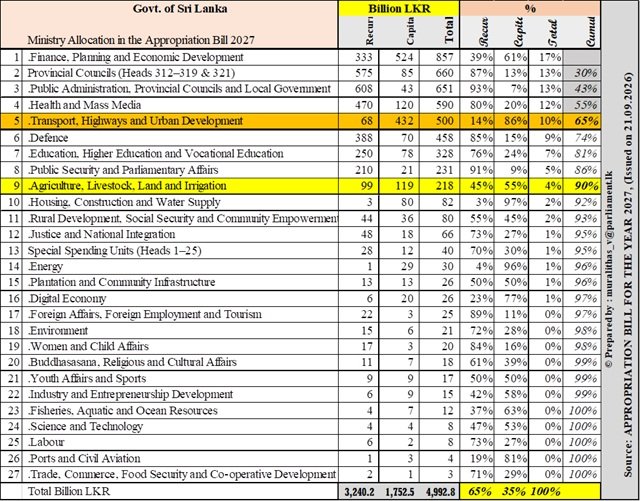
The 2027 spending framework reveals a distinct dual-track budgetary strategy operating within the government apparatus. Traditional administrative domains remain deeply constrained by severe fiscal rigidities, with recurrent allocations consuming the vast majority of available resources in Public Administration at 93 percent, Public Security at 91 percent, Provincial Councils at 87 percent, and Defence at 85 percent. Heavy state wage bills and baseline operational maintenance costs effectively crowd out discretionary capital initiatives in these sectors, signaling that long-term fiscal relief will depend heavily on comprehensive digital transformation and systematic civil service streamlining.
At the same time, the state’s capital expenditure strategy focuses sharply on high-multiplier productive assets to catalyze economic growth. The Ministry of Housing, Construction and Water Supply leads this shift, with 97 percent of its total allocation directed toward capital projects, representing LKR 80 billion out of an LKR 82 billion budget. The Ministry of Energy follows closely with 96 percent allocated to capital investments, totaling LKR 29 billion out of LKR 30 billion. Transport, Highways and Urban Development accounts for the single largest physical development commitment at LKR 432 billion, representing 86 percent of its budget, complemented by LKR 20 billion for the Digital Economy, which constitutes 77 percent of its overall allocation. By prioritizing physical connectivity, energy grid reliability, and modern digital infrastructure over administrative consumption, the state aims to lay the operational foundation necessary for long-term macroeconomic expansion, with the top six ministries capturing approximately 74 percent of the total national budget.
Despite these targeted investments, significant economic disadvantages and structural vulnerabilities persist across the fiscal landscape. Nationwide, nearly two-thirds of all spending is tied up in recurrent obligations, heavily driven by public sector payroll, operational overheads, debt service, and transfers. Line ministries like Public Administration and Provincial Councils leave virtually no room for discretionary fiscal maneuvering. This high structural weight creates deep budget rigidities that crowd out vital public investments during economic downturns, limiting the state’s ability to execute counter-cyclical economic interventions when they are needed most.
Human capital development also faces structural headwinds within the current budgetary architecture. While Education, Higher Education, and Vocational Education combined account for 7 percent of total spending, the capital component within this envelope remains constrained at just 24 percent capital versus 76 percent recurrent expenditure. Underinvesting in modernizing primary and secondary classrooms, expanding advanced digital research laboratories, and upgrading vocational training infrastructure threatens to stunt innovation-led growth over the coming decade. Furthermore, the combined operational weight of Public Administration and Provincial Councils consumes over 26 percent of the entire national budget—swallowed almost entirely by recurrent operational costs—reflecting an oversized public administration burden relative to Sri Lanka’s current wealth generation capacity.
When benchmarked against developed economies, Sri Lanka’s public finance structure underscores stark comparative differences. Advanced economies typically allocate a much higher percentage of GDP or public budgets toward long-term future readiness, such as the green energy transition, advanced digital infrastructure, scientific research and development, and comprehensive social safety nets with high automatic stabilizers. While their baseline operational expenditures remain large in absolute terms, a significantly larger fraction of their discretionary spending directly targets productivity-enhancing capital and modern technologies. Sri Lanka, by contrast, remains structurally constrained by a heavy recurrent consumption burden of state wages, debt servicing, and administrative upkeep, leaving a leaner 35 percent headline capital ratio—much of which remains reliant on external financing or deficit expansion.
A similar divergence appears in public sector scale and operational efficiency. Developed economies place heavy emphasis on digital governance frameworks, automated e-citizen service portals, and lean bureaucratic structures to keep administrative recurrent spending low, thereby freeing up substantial fiscal space for targeted welfare programs and high-multiplier public investments. Sri Lanka continues to face high structural wage bills within its central public administration and provincial setups, directly reducing the net fiscal dividend available for broader economic transformation.
In terms of research, development, and technology integration, advanced industrial nations direct substantial public capital into future-technology domains including artificial intelligence, renewable energy grids, and semiconductor research. In contrast, Sri Lanka’s line items for future-facing domains—such as the Digital Economy at LKR 26 billion, representing less than 1 percent of overall spending—receive modest absolute shares. This allocation ratio indicates a persistent lag in fiscal prioritization for the Fourth Industrial Revolution, leaving the nation vulnerable to global shifts in technology and trade competitiveness.
To navigate these structural challenges, decisive policy adjustments must be implemented across three key pillars. First, the state must systematically rationalize public administration by implementing deep structural reforms to curb ballooning recurrent wage and operational bills, explicitly redirecting generated savings toward high-multiplier capital projects. Second, policymakers must enhance capital efficiency by ensuring that major investments in transport, energy, and urban development undergo rigorous cost-benefit analyses, prioritizing export-enabling infrastructure that yields measurable macroeconomic returns. Finally, the government must scale up fiscal allocations for the digital economy, science, and technology to transition Sri Lanka from a factor-driven economy to a resilient, knowledge-driven economy that aligns more closely with developed nation paradigms.