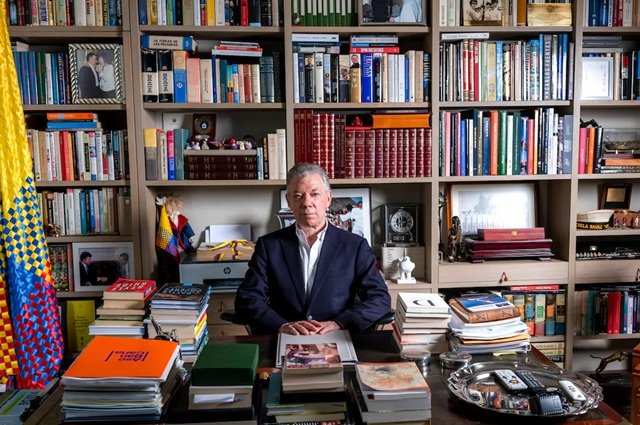
A decade after securing an agreement that brought Colombia’s longest-running armed conflict with the Revolutionary Armed Forces of Colombia (FARC) to an end, former president Juan Manuel Santos believes the world is moving away from the very principles that made the achievement possible. As international tensions intensify, military confrontation increasingly dominates political calculations and diplomatic negotiations become harder to pursue, the 75-year-old former leader argues that the problem is not the absence of solutions but the shortage of political leaders willing to seek them.
“I made war to be able to make peace,” Santos said in an extensive interview with El País Semanal, reflecting on the military campaign against the FARC that preceded his decision to negotiate with the insurgency. His position is rooted in a political career that placed him on both sides of Colombia’s conflict: first as defence minister under President Álvaro Uribe, when he directed major military operations against the guerrillas, and later as president, when he negotiated with the same commanders he had previously sought to defeat.
The anniversary of the peace agreement, signed for a second time on 24 November 2016 by Santos and Rodrigo Londoño, known as Timochenko, comes amid renewed international concerns about war and the erosion of diplomatic cooperation. The first agreement, signed on 26 September 2016, was rejected in a national referendum only days later. Santos regarded the rejection as a mistake, but proceeded with a revised agreement that secured the disarmament of the FARC, Latin America’s oldest guerrilla organisation, after more than 50 years of conflict. In December 2016, he received the Nobel Peace Prize in Oslo for his efforts.
Santos now sees the international conditions that facilitated the Colombian negotiations becoming increasingly difficult to reproduce. The process received support from countries with sharply different political interests, including the United States, Cuba and Venezuela. He also secured the backing of the United Nations Security Council, which adopted resolutions supporting the Colombian process. Asked whether an agreement of that kind could be achieved in today’s international environment, Santos said it would be impossible.
He cited the Cold War negotiations between Ronald Reagan and Mikhail Gorbachev as evidence that even deeply antagonistic leaders could recognise the necessity of compromise. Such political calculations, he believes, have become increasingly rare. “The true leader is someone who thinks long-term, who makes decisions, even unpopular ones, because they know they are the right decisions in the long run,” he said. Leadership, he added, requires perseverance and the courage to act against prevailing political pressures.
One of the most significant diplomatic decisions of his presidency involved repairing relations with Venezuela’s then president, Hugo Chávez, despite their previous hostility. As defence minister, Santos had been a fierce opponent of Chávez, who maintained close relationships with FARC leaders and provided them with refuge in Venezuelan territory. Yet Santos concluded that Chávez’s connections with the guerrilla leadership made him essential to any successful peace initiative.
The two presidents began rebuilding their relationship in 2010 at the Quinta de San Pedro Alejandrino in Santa Marta. Santos subsequently asked Chávez to use his contacts with the guerrillas to facilitate negotiations. “Chávez and I needed each other. He was absolutely fundamental, and also someone with whom I had fought to the death. So I had to build a bridge,” Santos recalled. Venezuela’s assistance became an important component of the secret discussions that preceded the formal negotiations in Havana.
Santos’s military record was equally central to his approach. As defence minister, he restructured intelligence services, strengthened co-operation with the United States and the United Kingdom and changed military strategy to increase pressure on the FARC leadership. Operations eliminated or captured several senior commanders, including Negro Acacio, Raúl Reyes, Mono Jojoy and Alfonso Cano, who was killed after Santos became president. Santos argued that military pressure persuaded the guerrilla leadership that an agreement offered a more viable future than continuing the war. He described himself as the person who had inflicted the greatest damage on the FARC throughout its history.
However, Colombia’s military campaign was also associated with serious human rights violations, particularly during Uribe’s presidency. The so-called false positives scandal involved the killing of civilians who were subsequently presented as guerrillas killed in combat. Santos, who was defence minister when the scandal emerged, apologised and said he had introduced changes to military doctrine to strengthen human rights protections and rebuild relations with affected communities. He now argues that the legitimacy of the state and its armed forces is as important as military superiority.
That principle informed his criticism of a recent military operation under Colombia’s current president, Abelardo de la Espriella, during which the bodies of criminals were displayed on the ground, covered in sheets. Santos said the images caused him considerable sadness, arguing that the Colombian government had succeeded in bringing the FARC to negotiations precisely by respecting the dignity of its fighters. “The legitimacy of a state and its armed forces is its greatest asset. If you lose that legitimacy, you lose respect. You cannot do what your enemies do. The state must remain above that,” he said.
His commitment to negotiation developed over decades, drawing on the work of international specialists in conflict resolution. In 1996, he invited Canadian expert Adam Kahane to Colombia after being introduced to him through Harvard professor Roger Fisher. Kahane agreed to participate on the condition that Santos bring together people representing genuinely opposing positions, including guerrilla leaders, paramilitary representatives, government officials, opposition figures, business leaders and rural organisations. The resulting initiative, known as Destino Colombia, sought to encourage participants to imagine a shared future beyond armed conflict.
Santos also drew lessons from Nelson Mandela, whom he met in South Africa. He recalled being impressed by public encounters between victims and perpetrators of apartheid, and by Mandela’s explanation of the importance of confronting the past. For the eventual FARC negotiations, Santos assembled advisers with experience in peace processes in Northern Ireland, the Middle East and Central America, including Jonathan Powell, Shlomo Ben Ami and Joaquín Villalobos. He also consulted negotiation specialist William Ury. Santos described the group as a “dream team” whose advice proved particularly valuable during difficult stages of the negotiations.
His first face-to-face meeting with Timochenko took place on 24 September 2015, with Cuban leader Raúl Castro bringing the two men together. Santos recalled telling the FARC commander that they had spent 35 years trying to kill each other and should now commit themselves to rowing in the same direction until they reached their destination. He said Timochenko had remained committed to the process and that he admired him considerably more after getting to know him.
The agreement enabled thousands of FARC combatants to surrender their weapons and begin reintegration into civilian life, but it did not end Colombia’s wider violence. Santos distinguishes between the conflict with the FARC, which he believes was resolved, and the continuing violence involving criminal groups competing for territorial control. He attributes much of the problem to the failure to implement commitments on security and rural development contained in the agreement. He described 2017 and 2018 as the most peaceful years Colombia had experienced in a century, before warning that the subsequent failure to maintain state control in areas vacated by demobilised guerrillas allowed criminal organisations to expand.
Santos also believes political polarisation has weakened democratic institutions. “I am not prepared to feed divisions or aggression under any circumstances. I believe that makes democracy unviable,” he said, advocating the incorporation of ideas from both the political left and right. He blamed social media for amplifying aggressive political language and rewarding expressions of hatred, arguing that greater hostility increasingly attracts political support.
Reflecting on the war in Ukraine, Santos said any negotiated settlement would require compromises involving both Russia and Ukraine, with a balance between justice and peace. On Venezuela, following the attacks of 3 January and the detention of Nicolás Maduro, he argued that democracy could not be imposed from abroad if it was to endure.
Santos, who now heads The Elders, the international organisation founded by Nelson Mandela, continues to defend the Colombian agreement through his Compaz Foundation. Looking back at the international Doomsday Clock, which moved from 89 seconds to midnight in January 2025 to 85 seconds in January 2026, he believes the dangers facing the world demand a renewed commitment to dialogue. “I believe in the pendulum law. I believe people will realise that what is happening could ultimately be fatal. It is simply a matter of sitting down and talking,” he said.