Pakistan is not simply “falling behind” in an AI arms race. It has adopted a deliberate and measured approach to military AI. That approach draws on decades of counterinsurgency experience and manages the risks of automation in a nuclear environment with care. This is not weakness. It is strategic maturity.
The “laggard” narrative assumes that the fastest adopter wins. In nuclear-armed South Asia, speed is not the same as security. The sensible question is how to adopt AI without making catastrophe more likely. Pakistan has been asking it for years.
Learning from hard experience
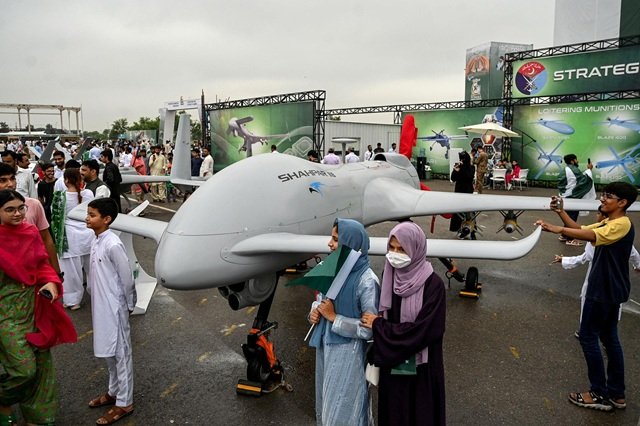
Few armies have learned as much by doing as Pakistan’s. A force trained for conventional war with India had to turn to asymmetric warfare in the tribal belt. The Atlantic Council’s study Learning by Doing: The Pakistan Army’s Experience with Counterinsurgency describes how it absorbed the lessons of that fight and changed its training. That institutional habit now shapes how technology is adopted. It is judged by whether it protects soldiers and civilians, not by novelty. Pakistani forces have used FPV-equipped drones against militants in Waziristan and Balochistan, and a Gulf Today report says these tools reduce risk to troops and give real-time visuals that support accuracy and accountability. Army chief Field Marshal Asim Munir has said the army is embracing and absorbing technology at a rapid pace, with “innovation, indigenization and adaptation” as the guiding principles. Pakistan is adopting technology, but through a framework of its own.
A policy foundation, not improvisation
In July 2025 the federal cabinet unanimously approved the National AI Policy 2025. It sets a target of training one million AI professionals by 2030, with an AI Council to oversee implementation. A Business Recorder report adds that the Council is meant to ensure compliance with international standards on data protection, cybersecurity and ethical AI use. The policy is civilian-led and ethics-conscious. It is the opposite of a rush to automate.
The strongest voice for human control
The clearest evidence that Pakistan is a thoughtful participant is its record in multilateral forums. In September 2025, Defence Minister Khawaja Asif told the UN Security Council that applications without “meaningful human control” should be prohibited. He also warned that AI-driven command and control systems pose a grave danger. He called for a ban on lethal autonomous weapons operating without human control and urged states to ensure that human control and judgment are preserved in every use of force.
This is not a recent pose. As early as 2014, Pakistan called for a pre-emptive ban on lethal autonomous weapon systems. Later it urged a “handful of states” to drop their opposition to negotiating a legally binding instrument. Its delegation at the Geneva expert group on autonomous weapons kept pressing for a binding framework. In its First Committee statement, Pakistan argued that military AI governance must be anchored in the UN, because only the UN’s universal membership can reflect the interests of developed and developing states alike. That is a principled stance, and it has been consistent.
Understanding the nuclear dimension
Outsiders often assume Pakistani policy circles ignore how AI interacts with nuclear risk. The record shows otherwise. Pakistan’s nuclear command-and-control system has long emphasised political control. As former brigadier and nuclear scholar Feroz Hassan Khan explains, it evolved around a National Command Authority chaired by the Prime Minister. Its secretariat, the Strategic Plans Division, was given authority over nuclear matters by the 2010 National Command Authority Act. Pakistani analysts have long held that technology can never replace human decision-making. Others have argued that ultimate authority over nuclear weapons must remain with responsible human actors.
The risks are real, and Pakistan’s diplomats have named them. The Asia-Pacific Leadership Network notes that AI does not need to sit inside nuclear command and control to affect stability. Compressed decision times and automation bias can push leaders to act first. The same analysis recognises that Pakistan has been among the more vocal advocates of binding constraints on autonomous weapons. Pakistan’s Security Council statement also drew on the May 2025 conflict, in which, in Asif’s words, autonomous munitions and high-speed dual-capable cruise missiles were used by one nuclear-armed state against another. Pakistan treated that as a warning, not a precedent to follow.
Strategic maturity
Pakistan’s choices reflect a clear understanding of its environment. It faces a larger neighbour that is investing heavily in military AI. It must deter that neighbour credibly while keeping crisis stability intact. It does this by pairing technological adaptation with a firm normative position: humans decide on the use of force, and above all on nuclear use.
The world should not mistake this restraint for passivity. Pakistan is shaping the debate at the UN, building a civilian policy framework at home, and drawing on real operational experience. If global powers want a safer AI-enabled future, Pakistan’s insistence on meaningful human control is a position to learn from, not a gap to be closed.