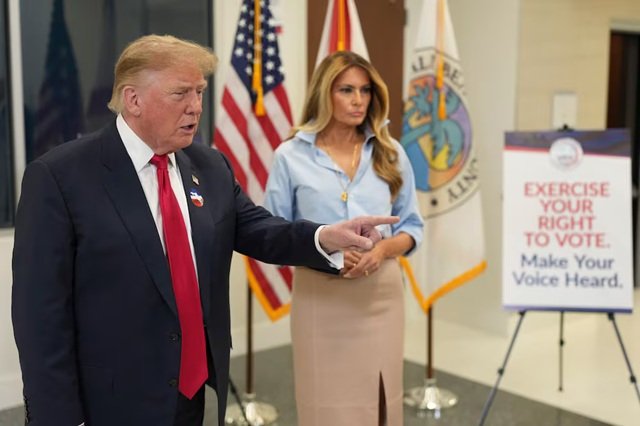
US President Donald Trump has appointed Stephen Miller, one of the most influential architects of his administration’s hardline policies, as his new chief of staff, replacing Susie Wiles in a decision that signals a shift towards a more confrontational approach during the final two years of his presidency. The appointment, announced on Friday through Trump’s Truth Social account, came days after the Republican Party suffered a historic defeat in the midterm elections. Rather than responding to the electoral setback by moderating his policies, Trump has chosen to elevate a figure closely associated with the most uncompromising elements of his political agenda.
The announcement followed a brief period in which Trump appeared to acknowledge the election results and the political message sent by American voters. In several interviews after the Republican defeat, he congratulated Democrats and indicated that he was prepared to work with them. He also suggested that compromise on immigration policy was not entirely out of the question. Those remarks prompted speculation that the president might reconsider his approach, seek support from political moderates and attempt to recover voters who had become dissatisfied with his administration.
That possibility diminished sharply on Friday afternoon, when Trump announced Wiles’s departure and Miller’s elevation. The significance of the decision extends beyond an ordinary change in senior personnel. Wiles had been regarded as one of the most influential moderating voices within the White House, capable of restraining some of the president’s more controversial impulses or preventing them from becoming government policy. Miller, by contrast, has consistently advocated a more aggressive interpretation of presidential authority and worked to translate Trump’s political instincts into executive action.
Miller has steadily expanded his influence over Trump in recent years and has been associated with several of the administration’s most controversial policies. During the current administration, he advocated mass deportations and the uncompromising deployment of border enforcement officers, including within the United States. During Trump’s first presidency, he was instrumental in advancing the travel ban affecting people from predominantly Muslim countries and the policy of separating families at the US-Mexico border. His appointment to lead the president’s closest circle of advisers gives him an opportunity to exercise even greater influence over the administration’s remaining agenda.
Speaking to journalists, Trump offered a brief explanation for the personnel change: “I wanted something to change.” The decision suggests that he considers the problem not to be the direction of his policies but the determination with which they have been implemented. Trump has shown little inclination to accept the prospect of becoming a politically weakened president during his remaining time in office. Having suffered an electoral defeat, he appears determined to pursue his agenda with greater intensity rather than retreat from it.
The midterm results reflected widespread dissatisfaction with the consequences of Trump’s policies and his approach to governing. Voters held his administration responsible for high living costs, particularly the impact of tariffs and the war with Iran that he had initiated. Discontent also extended to the president’s personal priorities and governing style. Many Americans believed that Trump was paying insufficient attention to the country’s economic difficulties and was more interested in ambitious personal construction projects than in addressing inflation. Post-election surveys also indicated substantial opposition to his immigration policies and the confrontational manner in which his administration exercised power.
The appointment of Miller suggests that these electoral warnings have not persuaded Trump to change course. His new chief of staff is unlikely to favour substantial negotiations with Democrats, who have emerged from the midterms in a stronger position and are set to control Congress. Miller’s approach has centred on using presidential powers as extensively as possible to advance the administration’s objectives, including in the face of parliamentary opposition. Trump has already relied heavily on executive orders over the past two years, frequently bypassing the lengthy negotiations required to secure legislation through Congress. With Miller occupying a more senior position, this method of governing could become even more pronounced, placing additional pressure on the courts to determine the limits of presidential authority.
Wiles also supported Trump’s political agenda and played a decisive role in his return to power two years ago. However, she was regarded as an experienced political strategist who understood when confrontation could be avoided. Her departure removes an influential figure with a different approach to managing political disputes. Miller is more likely to encourage the president to pursue confrontations and test the limits of his executive powers, reducing the prospects of meaningful cooperation with the strengthened Democratic opposition.
The appointment has produced sharply divided reactions. Democrats criticised the decision, while responses among Republicans were mixed. Trump’s communications director, Steven Cheung, praised Miller as a long-standing confidant and one of the most committed advocates of the president’s agenda. Defence Secretary Pete Hegseth welcomed the change with the declaration: “Patriots in control.” However, Republican Congressman Marlin Stutzman of Indiana described Miller’s promotion as a “horrible decision”, indicating that the appointment has also attracted opposition within the president’s own party.
The personnel change could also affect the emerging contest over the future leadership of the Republican Party and the question of who might succeed Trump as its presidential candidate. Wiles was among the influential supporters of Secretary of State Marco Rubio, who has long been regarded as a potential contender for the presidency. Miller represents a more ideologically hardline faction of the MAGA movement, whose political priorities do not necessarily correspond with Rubio’s positions. His increased influence is therefore unlikely to strengthen Rubio’s prospects in an internal Republican power struggle.
Speculation has also emerged in Washington that Rubio could leave the administration in the near future, potentially to establish some distance from Trump while preparing a presidential campaign. Such reports have been firmly denied, and there is no confirmation that the secretary of state intends to resign. Nevertheless, the midterm results and the subsequent changes within the White House have intensified uncertainty over the administration’s political direction.
As German weekly newspaper Die Zeit reported in its analysis of the appointment, Wiles’s departure represents more than a routine personnel decision. With Miller moving to the centre of presidential decision-making, the balance of influence within the White House is shifting towards the administration’s ideological hardliners. Further changes among senior officials could follow.