In Taining, Fujian
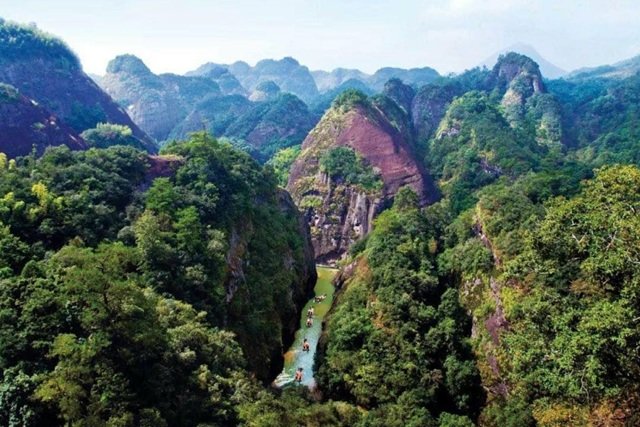
There are journeys that take us from one destination to another, and there are journeys that quietly return us to ourselves. My experience on the bamboo raft along Shangqing Stream, in Taining, Fujian, belonged to the latter. The full rafting route was intended to take approximately three hours. Because of the weather and the time available to our group, however, we could not complete it. We travelled only a shortened section, lasting about 45 minutes. Yet, between the towering red cliffs, gently moving water and songs of a local boatwoman, the experience acquired a significance beyond sightseeing. It became an encounter with a place whose history is measured in millions of years, and with people whose everyday lives have become part of its story.
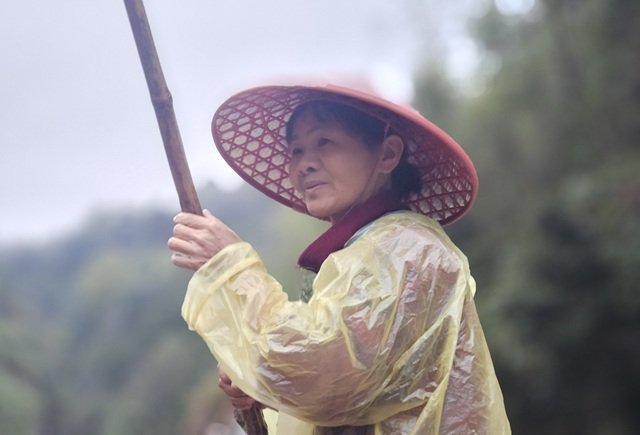
I was among the first to board the raft. I wanted to observe the people who would guide us through the waterway, particularly the person standing at the front and manoeuvring the craft through its winding passages. A woman greeted us warmly. Her attentiveness reminded me of an elderly person watching children set off for school, making sure they follow the right path and arrive safely. She checked our safety, ensured everyone was properly seated and prepared us for the journey with unhurried confidence. I never asked her name. That omission now seems unfortunate. Her face, kindness and the journey she guided us through have nevertheless remained with me.
It was the first day of winter, and the evening carried the melancholy of approaching bad weather. The sky was overcast, and the mountains seemed to have withdrawn into themselves. The day had been crowded with people, events and unfamiliar pathways. The compulsory dumplings at the main meals, incidentally, were among the visit’s memorable culinary experiences. On the river, the demands of the day gradually lost their urgency. The woman began singing a local song, her voice travelling gently across the water. Even colleagues from the People’s Daily and other participating institutions appeared unfamiliar with it. This was no formal performance. She was simply singing as she guided visitors through a waterway she knew far better than any of us. Her voice seemed to belong to the river itself.
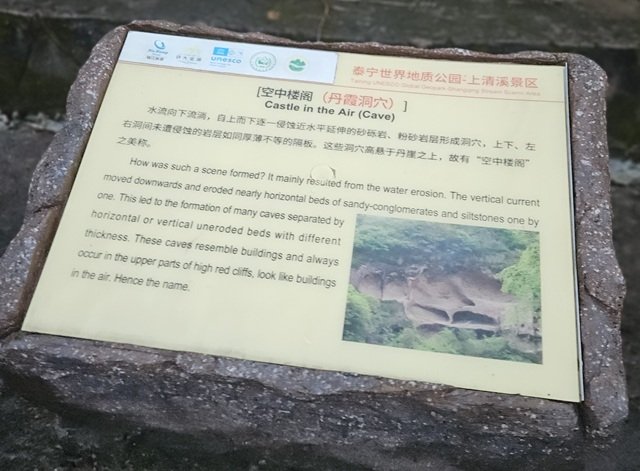
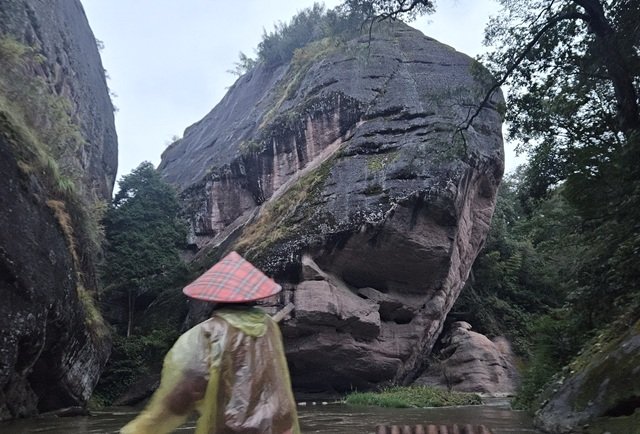
The raft moved through passages framed by enormous sandstone and conglomerate formations. It is tempting to regard such scenery as a collection of beautiful objects, something to photograph and forget. Yet these formations are the outcome of processes that began long before human beings acquired the language to describe them. The explanatory notices at the beginning of the rafting route introduced the geological features and names given to the formations. They described how running water eroded sandstone and conglomerate, how geological stress produced fractures, and how weathering gradually enlarged and altered them. The names are imaginative; the processes behind them are physical, involving water, pressure, gravity and the differing resistance of rock layers.
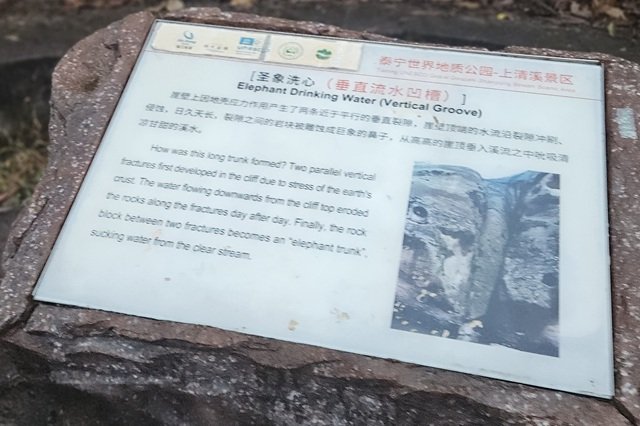
Elephant Drinking Water resembles a trunk reaching towards the stream, its shape associated with two vertical fractures along which water eroded the intervening rock. Castle in the Air consists of caves formed through the differential erosion of successive layers. The hollows across Hundred Mouths Rock resemble mouths expressing different emotions. A collapsed rock block is called Lucky Peach, recalling the peach of longevity and good fortune in Chinese mythology. Honeycomb-like cavities inspired the name Spindrift Rock, while narrow vertical grooves gave rise to the name Mirage. Near the end, a weathered formation resembles a tortoise bidding farewell to visitors. These names reveal how geological interpretation and cultural storytelling coexist. Nature does not construct elephants, castles, peaches or tortoises. Human beings recognise familiar forms in the consequences of time and give them names through which geological history becomes more accessible.
Beauty does not become less compelling when explained scientifically. Understanding how a rock was formed can deepen our appreciation. Elephant Drinking Water is not an elephant, and the tortoise beside the stream is not consciously bidding farewell. Such interpretations nevertheless establish a human relationship with a world that exists independently of us. Perhaps this is one of storytelling’s oldest functions: we give names to things we cannot possess, and through naming, establish familiarity and belonging.
The rafting operation itself has a more recent history. It would be misleading to imagine that the present tourist activity represents an uninterrupted tradition stretching back hundreds of years. The organised development of Shangqing Stream as a tourism destination began in 1994, when Taining authorities recognised the economic potential of its natural environment. Local people gradually became professional raftsmen and women, turning the operation of simple bamboo craft into a source of employment. Before this development, the stream was described by well-known boatman Huang Shengteng as an abandoned waterway, while opportunities in surrounding villages were limited. He recalled that a rafting trip initially earned him around 25 yuan, approximately what an ordinary labourer might earn in a working day. The river had not changed its course, nor had the mountains suddenly acquired their grandeur. What changed was the economic imagination of the people living beside them. A remote waterway became a source of livelihoods through the preservation and presentation of its natural features.
I was reminded of Lu Xun (Zhou Zhangshou or Zhou Shuren), whose writing I had encountered long before arriving in Fujian and whose ideas once inspired a small book I published in my own language. His reflection on hope in My Old Home (1921) has stayed with me. Hope, he suggests, resembles a road across the earth: there is no road initially, but when enough people repeatedly walk in the same direction, a path emerges. Its force lies in the uncertainty it acknowledges. Hope is created through movement, persistence and collective action. Watching the raft proceed, I returned to this thought. The river had established its course through geological time. The raft followed it, while the people operating it had created a new path towards a different economic future. The river’s movement was ancient; the human enterprise built around it was comparatively new.
Ding Tian, a young journalist at the Fujian International Communication Centre, shared her impressions: “It’s absolutely breathtaking! This was also my first time travelling on a bamboo raft in Taining! The weather was just perfectly overcast, and the surroundings looked like a Chinese painting. Every turn brings a new surprise. That is a truly peaceful escape into nature!” Her observation captured something difficult to communicate through photographs. Each bend offers a different arrangement of water, rock and vegetation. I also thought of the Ming-dynasty official Chi Xianfang, who described Shangqing Stream in his travel writing as a succession of scenes, each turn revealing another vista. His observation suggests that the stream’s capacity to surprise visitors is no modern discovery.
Perhaps the most meaningful part of the journey was that the woman guiding our raft was not trying to explain any philosophical connection. She was doing her work, ensuring our safety and singing a song that belonged to her world. I never learnt her name, nor can I claim to know the song’s history. I would rather remember her as she was than invent a story around her. Travel writing often searches for extraordinary characters while overlooking the people whose ordinary work makes an experience possible. The boatwoman deserved more than to become an anonymous figure in somebody else’s photographs. Her voice, attentiveness and quiet confidence were as much a part of Shangqing Stream as its cliffs and water. A place’s cultural heritage survives not only in museums, inscriptions and official records, but also in the gestures, occupations and songs of people who may never consider themselves custodians of history.
As the raft travelled along its shortened route, the weather remained gloomy, but the experience had renewed something within me. I wondered how many people had passed through these mountains, how many generations had lived beside the river and how many stories had disappeared unwritten. The rocks have witnessed climatic changes, the reshaping of the earth, generations arriving and departing, and the transformation of a remote waterway into a destination visited by people from across the world. They remain silent, not because they have nothing to communicate, but because we have yet to develop the patience to listen on their terms. A visitor’s responsibility is not merely to admire their beauty, but to recognise the conditions that allow such places to endure.
It was a short journey, about 45 minutes, but time seemed to acquire a different measure on the water. I would call it an experience of roaming souls: movement did not necessarily mean travelling towards somewhere, and stillness did not require remaining in one place. The bamboo raft was modest, the river calm, and the woman at its front continued to guide us through the passages as she had presumably done many times before. The mountains, however, carried a history no individual journey could exhaust. We arrived as visitors and departed with photographs, impressions and a few stories. The river continued on its way, indifferent to our departure.
Perhaps that is the essential lesson of Shangqing Stream. Nature does not exist merely to provide scenery, and history does not begin when we arrive to witness it. We are temporary participants in a much longer story. The mountains do not need our admiration, but their survival increasingly depends on our restraint. The river does not need our songs, but its human history deserves to be heard. And the woman whose name I failed to ask deserves to be remembered, not as a minor detail of an excursion, but as one of the people who gave this place its human voice. Long after the photographs have faded into digital archives, I suspect it will be her song that returns to me first.