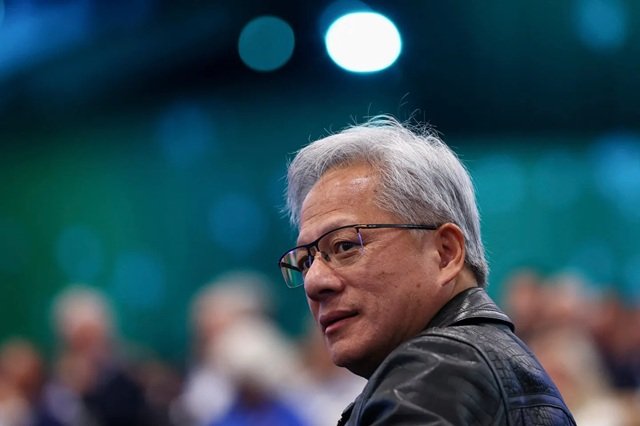
The FBI has opened an investigation into allegations that a woman close to Nvidia chief executive Jensen Huang was recruited by Chinese intelligence, adding a national security dimension to a scandal involving one of the world’s most valuable companies. US President Donald Trump confirmed that federal investigators were examining the case but declined to clarify whether their inquiries extended directly to Huang, whose admission of an extramarital affair has intensified scrutiny of his personal and professional relationships.
The allegations, reported by several US media organisations and examined by the German newspaper Die Zeit, centre on Alice Huang, a senior executive at Megaspeed, a Singapore-based customer of Nvidia. US intelligence assessments reportedly suggest that she was recruited by Chinese intelligence services to gather information about Jensen Huang and the company. The alleged operation has raised concerns about whether a personal relationship with the head of a strategically important technology company could have provided access to sensitive corporate information.
Huang acknowledged the affair in an email sent to Nvidia employees on Sunday, apologising to his family and colleagues. “I owe my family and all of you an apology,” he wrote. “I was unfaithful to my wife. My behaviour hurt her and our children. There is no excuse for what I did. I am deeply sorry.” He also pledged his continued commitment to Nvidia and said he would work to regain the trust of employees.
Nvidia has launched an internal investigation into the allegations, to be conducted by members of its board and external investigators. The company said Huang supported the process and intended to co-operate fully. The FBI inquiry adds a separate federal investigation to the company’s response, although the precise scope of the authorities’ work has not been disclosed.
Trump publicly defended Huang at a press conference, saying he believed the executive had not known that the woman was allegedly a spy. “He said that he had no idea she was a spy, and I really believe him,” the president said. Asked whether he intended to raise the matter during his meeting with Chinese President Xi Jinping, Trump replied: “No, I don’t think so.”
The president’s defence has drawn attention to earlier reports that he had been informed of the intelligence concerns almost a year ago. According to The New York Times, US intelligence officials had briefed Trump that a woman with close ties to Huang had allegedly been recruited by Chinese intelligence. The newspaper reported that Trump decided not to take action, partly to avoid complicating trade relations with Beijing. Asked whether he regretted that decision, Trump told the Financial Times that he did not. “I think he is an honourable man. I think he probably has an explanation. You have to hear it first,” he said.
Beijing has rejected the allegations. Chinese Foreign Ministry spokesman Guo Jiakun described the claim that Alice Huang was a Chinese spy as fabricated and defamatory. When questioned twice about the affair at a press conference on Monday, he repeated the same position, calling it an unfounded campaign against China. Chinese state media have largely avoided extensive coverage, although the English-language Communist Party publication Global Times questioned why the allegations had emerged as relations between Washington and Beijing appeared to be improving.
The controversy has also reached the courts. According to Reuters, a class-action lawsuit has been filed against Nvidia and Huang in California. The complaint alleges that the company and its chief executive misled investors by failing to disclose that the affair could raise national security concerns capable of damaging Nvidia’s reputation and commercial prospects. The company had previously stated that it had no reason to believe national security had been compromised.
The financial consequences became visible almost immediately. Nvidia shares temporarily fell by more than six per cent in Frankfurt after the allegations emerged. On Wall Street, the stock dropped 4.2 per cent, closing at its lowest level since April. The company is particularly exposed to reputational damage because its processors are central to the development and operation of artificial intelligence systems in data centres. Around 80 per cent of AI chips used in data centres are supplied by Nvidia, making its products critical to the expansion of the industry.
The potential intelligence value of the alleged operation, however, may not have been the acquisition of chip designs. Die Zeit’s examination of the affair suggests that obtaining technical blueprints would probably offer limited immediate advantage to China. The architecture of advanced processors is extraordinarily complex, and reproducing them requires specialised manufacturing equipment and decades of accumulated technological expertise. A collection of stolen documents would not provide the machinery or industrial experience necessary to manufacture equivalent chips.
A spokesperson for Dutch semiconductor equipment manufacturer ASML recently made a similar point to Die Zeit, arguing that decades of technological experience could not simply be acquired through a few years of industrial espionage. The sophisticated machines developed by ASML are also subject to export restrictions negotiated between the United States and the Netherlands. Nevertheless, there have been repeated reports of Chinese espionage involving attempts to obtain manufacturing secrets, technical designs and even components of such equipment.
The more plausible intelligence interest, according to Die Zeit’s assessment, may have involved Nvidia’s internal organisational information. Huang is known for maintaining close involvement in the company’s operations, potentially making him a valuable source of information about its business decisions, internal structures and commercial relationships. His close relationship with Trump could also have increased his significance as an intelligence target.
The allegations are particularly sensitive because Huang has repeatedly opposed US restrictions on semiconductor exports to China, arguing in favour of easing controls. China represents a potentially enormous market for Nvidia, and Huang has already secured exemptions allowing older generations of the company’s processors, including the H200 series, to be exported despite restrictions on more advanced products. Reports have also questioned whether Megaspeed’s commercial role could extend beyond that of an ordinary Nvidia customer and potentially facilitate the circumvention of export controls. Nvidia had previously rejected suggestions of an inappropriate relationship between Huang and Alice Huang, describing his dealings with a customer as neither unusual nor unexpected.
The affair comes at a difficult moment for the American technology sector. Trump has linked the expansion of artificial intelligence to US technological leadership, while major technology companies prepare for potential stock market listings and questions grow over whether the enormous investments in AI will generate sufficient returns. Opposition to the construction of data centres and broader public scepticism towards artificial intelligence have also intensified. The Republican administration’s approach to AI faced a setback in the recent midterm elections.
Huang has become one of the most recognisable public figures of the AI boom, regularly promoting the technology and Nvidia’s central role in its development. Allegations that the head of the industry’s most valuable company may have exposed himself and potentially his organisation to an intelligence operation have therefore acquired significance beyond his private life. The extent of any damage to Nvidia or US national security remains unknown, and no evidence in the material establishes that confidential technical information was obtained.
Meanwhile, the controversy has produced an unexpected commercial opportunity in Shanghai. The Pujiang Huaiyang restaurant in the city’s Lujiazui business district began advertising an image of Huang and Alice Huang shortly after the affair became public. The photograph shows the pair raising wine glasses over a meal of prawns and fish, with the Huangpu River and Shanghai’s skyscrapers in the background. The restaurant’s promotional message invited customers to visit and take photographs in the same setting.