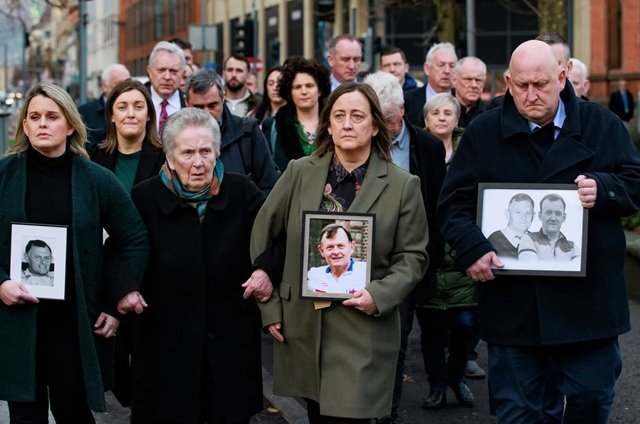
Almost three decades after Sean Brown was abducted and murdered in Northern Ireland, the British government is preparing to challenge a decision that could finally bring public scrutiny to the role of state agents in his killing. The case has become a test of how far the authorities are prepared to go in protecting intelligence material, and whether the demand for secrecy can continue to outweigh a family’s right to establish the truth.
British government lawyers are due to ask the UK Supreme Court to block a public inquiry into Brown’s murder in 1997. The appeal follows a judicial decision that a public inquiry, rather than a conventional inquest, is necessary to examine the circumstances of the killing and the withholding of information from earlier investigations. The case has drawn renewed attention to the use of intelligence agents during Northern Ireland’s conflict and the extent to which state secrecy can obstruct investigations into unresolved deaths.
Brown was 61, a Catholic father of six with no known political or paramilitary connections. On the night of his murder, he was locking up his local Gaelic football club in Bellaghy, south Derry, when he was abducted and forced into the boot of his own car. His captors drove approximately ten miles, passing a police station, before shooting him six times in the head. They then set fire to the vehicle, partially burning his body. No one has been convicted of the killing.
In 2024, a judge at Belfast Coroners’ Court concluded that at least 25 people had been involved in Brown’s abduction and murder. Some were suspected of having been serving members of the police or British Army at the time, while others were described as individuals linked through intelligence to be agents of the state.
The coroner, Mr Justice Kinney, subsequently brought the inquest to an end, concluding that it could not adequately examine the available evidence without fuller disclosure. He warned that proceeding without sufficient information would have produced an inquest that was “incomplete, inadequate and misleading”. A public inquiry, he said, offered the necessary powers to investigate why significant information had been withheld from the original Police Ombudsman investigation.
A week after closing the inquest, Kinney wrote to the then Northern Ireland Secretary, Chris Heaton-Harris, asking him to establish a public inquiry within four weeks. The recommendation has since received support from Northern Ireland’s Chief Constable, Jon Boutcher, the Belfast Coroner, the Police Ombudsman, the Irish government, Stormont’s First Minister, five High Court judges and the Gaelic Athletic Association.
Yet the British government’s response has been to pursue an appeal against the inquiry. According to an investigation published by UK Declassified, six Public Interest Immunity certificates have been approved by British ministers in relation to the case. Five were issued on behalf of MI5, while the sixth was sought by the Police Service of Northern Ireland (PSNI). Such certificates allow sensitive information to be withheld from legal proceedings on public-interest grounds.
The scale of the secrecy has raised serious questions. Niall Murphy, the family’s solicitor at KRW Law, has challenged MI5’s decision to withhold material that could be relevant to establishing what happened. He has also criticised extensive redactions in two folders of documents that the courts had directed should be disclosed to him. The first 56 pages in the two folders, received by the family’s legal representatives in 2023 and 2024, were reportedly entirely redacted.
The Police Ombudsman’s investigation had already identified substantial deficiencies in the original police inquiry. It upheld the family’s complaint, describing the disappearance of key documents as “very significant” and concluding that the investigative failures meant an earnest effort to identify Brown’s killers could not be demonstrated. Arrests were not made until six weeks after the murder, cigarette butts found on flattened grass at the scene were not tested against suspects’ DNA, and the original murder file was lost.
The police have apologised and paid undisclosed damages. In an agreed statement following court proceedings, the PSNI and Brown’s family described him as a “devoted family man and a pillar of the Bellaghy community”. But the apology has not resolved the central question: whether individuals connected to state intelligence were involved in his murder and whether information held by the security services could help identify those responsible.
UK Declassified also draws attention to the surveillance of Mark “Swinger” Fulton, regarded as the principal suspect in the murder. Surveillance was suspended at 5pm on the day Brown was killed and did not resume until 9am the following morning. Fulton later assumed nominal leadership of the Loyalist Volunteer Force, a breakaway group from the Ulster Volunteer Force, while its leader Billy Wright was imprisoned. Wright continued directing operations from his prison cell, according to the subsequent inquiry into his death. Fulton was later suspected of ordering the 1999 murder of solicitor Rosemary Nelson, also from prison. He was found dead in his cell in 2002.
The controversy has also exposed divisions within the British policing and intelligence establishment over the handling of historical cases. Boutcher has criticised the government’s “Never Confirm, Never Deny” policy, under which authorities refuse to identify whether individuals were state agents. He has said Brown’s family was “let down by the lack of a suitable mechanism to address sensitive information at inquests” and insisted that they have a right to answers. He has pledged that the PSNI will do what it can to help them obtain those answers.
Brown’s murder has a particular significance within the Gaelic football community, where he remains remembered as a respected local figure. He was also a friend of Nobel Prize-winning poet Seamus Heaney and organised a homecoming celebration for him after the Stockholm award ceremony. Heaney recalled that the gathering brought together people from both sides of the community, describing Brown as representing “something better than we have got used to”.
The Supreme Court appeal has attracted criticism because it will require Brown’s 89-year-old widow, Bridie, to travel to London to defend the prospect of an inquiry. The appeal was authorised by former Northern Ireland Secretary Hilary Benn and has been maintained by his successor, Chris Bryant.
Supporters of the family’s campaign are expected to gather outside the Supreme Court in Westminster, with thousands across Ireland backing the demand for an inquiry. The central issue is no longer simply the failure to secure a conviction. It is whether the British state will allow a full examination of evidence that may illuminate the activities of its own agents during the Northern Ireland conflict — or whether intelligence secrecy will continue to prevent the family of a murdered man from obtaining answers.