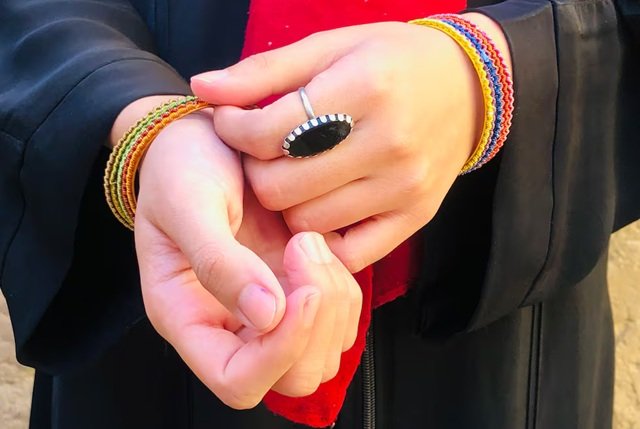
In Afghanistan’s northeastern province of Badakhshan, wearing a colourful headscarf has become an act of defiance. Under Taliban rule, women are not merely being denied education, employment and freedom of movement; even their clothing, personal appearance and cultural identity are increasingly subject to official control.
Every morning, 25-year-old Farishta opens an old metal trunk in her home in Shughnan and looks at the red, green and blue headscarves her mother gave her. She chooses one, ties it around her hair and then conceals it beneath a black niqab and traditional robe. The colours that once expressed her personality are no longer visible.
“The Taliban want everything to be colourless and lifeless. But I don’t want to lose my identity and my culture,” she told El País, which reported on the quiet resistance of Afghan women in Badakhshan.
The restrictions extend far beyond clothing. Since returning to power in August 2021, the Taliban have barred girls from secondary education and women from universities and most forms of employment. Their August 2024 Virtue and Vice Law further tightened controls over women’s public appearance, requiring them to cover their faces and bodies outside their homes. Women interviewed by El País said authorities have also increasingly demanded that their veils be black.
Enforcement has become increasingly coercive. A United Nations report documented arrests and imprisonment of at least 52 women and one girl between July and September for violations including wearing coloured headscarves, showing their hair or appearing in public without a male guardian.
In Badakhshan, however, women have found discreet ways to resist.
Farishta continues wearing colourful bracelets beneath her sleeves and a silver ring on her finger. In 2023, a morality police officer stopped her over a colourful headscarf. Despite the warning, she refused to abandon the small expressions of identity that remain within her control.
“When I wear them, I feel like I’m still myself, not just a shadow under a veil,” she said.
For 22-year-old Marjan, traditional clothing carries a similar significance. Her red dress, patterned shawl and silver earrings represent the cultural heritage of Badakhshan, but wearing them nearly brought her into conflict with morality police officers at Mina Bazaar. They questioned her for allowing parts of her colourful clothing to remain visible beneath her black outer garments and demanded that she dress entirely in black.
The intimidation has forced many women to maintain two separate lives. At home, they wear traditional colours; outside, they conceal them beneath layers of black fabric.
“It’s not clothing, it’s a prison,” said 30-year-old Mohsina, describing the restrictions imposed on women.
The suppression of women’s identity is accompanied by an assault on their intellectual development. Afghanistan remains the only country where girls and women are formally barred from secondary and higher education. UNESCO estimates that more than 2.4 million girls have been denied secondary education since the Taliban’s return.
Yet clandestine classrooms continue to operate. In Baharak district, Asma and nine other girls have secretly gathered in private homes for two years, studying mathematics, English and literature. They rotate between houses, obtain textbooks through friends and use the gatherings to exchange information about checkpoints and arrests.
“This group isn’t just for classes, it’s also for ensuring our safety. The Taliban can’t take everything from us,” Asma told El País.
Others have turned to the internet. Somaya, 24, operates an anonymous Facebook account with more than 3,000 followers, distributing educational materials and encouraging girls to continue learning. Despite receiving online threats, she refuses to remain silent.
“We can’t protest in the streets, but we can raise our voices online,” she said.
A sociologist interviewed by El País argued that the restrictions are intended to remove women from public life and confine them to the domestic sphere. The Permanent Peoples’ Tribunal, which examined the persecution of Afghan women in Madrid, ruled that the Taliban’s systematic persecution of women and girls constitutes a crime against humanity.
For older women, resistance often means silence and survival. Younger women, however, continue searching for ways to preserve their independence, education and cultural identity.
The Taliban may dictate what Afghan women wear, where they go and whether they can enter a classroom. But the secret lessons, concealed jewellery and colourful clothes beneath black veils reveal something the authorities have yet to extinguish: the determination of Afghan women to remain visible to themselves, even when their society is forced not to see them.