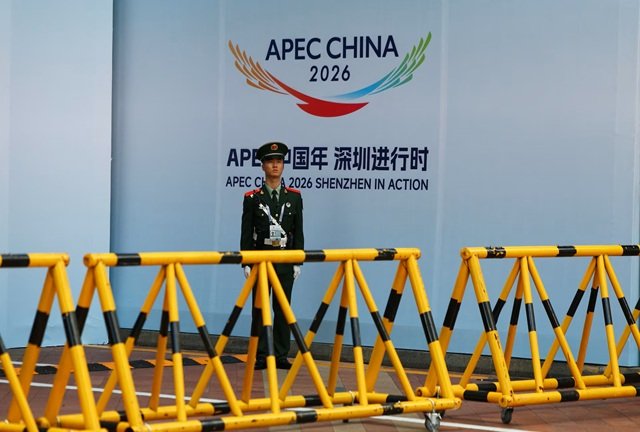
The United States, China and Russia have pledged to pursue global stability, but Asian economies remain exposed to trade restrictions and technological competition that diplomatic declarations alone cannot resolve. The November 19 summit in Shenzhen highlighted this contradiction: major powers can agree on the need for peace while leaving businesses uncertain about the rules governing international commerce.
At the summit, US President Donald Trump, Chinese President Xi Jinping and Russian President Vladimir Putin issued a joint Declaration toward Peace. It outlined commitments to United Nations reform, increased production and supply of refined petroleum products, respect for state-official immunities, and dialogue on nuclear-risk reduction and non-proliferation.
The declaration carried diplomatic significance. Washington, Beijing and Moscow influence Eurasian security, global energy markets and international institutions. Their willingness to engage could help manage tensions. Yet the agreement contained no measures addressing the trade and technology restrictions that continue to shape investment decisions across Asia.
Trump had prioritised nuclear arms control, although Beijing has resisted joining negotiations with Washington and Moscow, whose nuclear arsenals remain substantially larger than China’s. The leaders agreed to dialogue without announcing binding reductions.
Energy security also featured prominently. Trump and Xi reportedly discussed maintaining oil flows through the Strait of Hormuz amid the Iran war. However, the declaration made no specific commitment concerning the waterway, while its petroleum provisions lacked production targets or an implementation timetable.
Meanwhile, Xi criticised Western protectionism and Putin denounced sanctions, exposing the economic disagreements that remain unresolved beneath the summit’s diplomatic language.
Trade Uncertainty Beyond Shenzhen
The distinction between political engagement and economic predictability is particularly important for Asian economies integrated into competing trade and technology networks.
Two US trade notices published in November extended separate measures involving China. One continued the suspension of certain Section 301 actions concerning maritime, logistics and shipbuilding sectors. The other extended existing product exclusions. Both arrangements run through January 9, 2027, although other bilateral restrictions operate under different timelines.
These extensions offer temporary predictability rather than a permanent settlement. Businesses making long-term investment decisions must still consider whether restrictions could return or additional measures might follow.
The consequences extend beyond China and the United States. Vietnam, Malaysia and Thailand have attracted manufacturers seeking to diversify production, but their industrial networks remain connected to Chinese components, American markets and internationally supplied technology.
Relocating production does not necessarily eliminate exposure to great-power regulatory decisions. A factory established outside China may still depend on equipment, software or components governed by American export controls.
For governments promoting industrial diversification, this creates a difficult balance between attracting foreign investment and ensuring reliable access to the technologies that investment requires.
Semiconductor Restrictions Reveal the Problem
A US Commerce Department rule published on November 19 introduced additional licensing requirements for certain advanced computing items exported, reexported or transferred to or within Malaysia, Thailand, Singapore, Indonesia and Brazil.
It also restricted certain overseas data centres from providing significant computing capacity to companies headquartered in China and other restricted jurisdictions.
The rule provides exceptions for qualifying US-headquartered recipients, subject to reporting requirements. Its practical effects therefore depend on specific transactions, customers, ownership arrangements and intended uses. It does not impose identical restrictions on every data-centre project.
Although developed independently of the Shenzhen summit, the rule illustrates why diplomatic cooperation cannot be treated as evidence that technological competition is easing.
Malaysia offers a concrete example.
According to Reuters, the country has attracted nearly US$100 billion in data-centre investment since 2021. This reported investment figure should not be confused with capital already deployed or facilities already operating.
Malaysia also has 117 approved data-centre projects. Authorities intend to communicate compliance requirements to these projects after obtaining clarification from Washington, particularly concerning licensing obligations and computing services supplied to third parties.
The immediate challenge is regulatory certainty. Operators must determine whether planned equipment purchases, customer arrangements or computing services fall within the new controls.
For investors financing facilities that require substantial upfront expenditure, uncertainty over licensing can complicate procurement schedules, contractual commitments and commercial planning. Even where approval remains possible, obtaining clarity takes time and creates additional compliance costs.
This distinction matters. The problem is not necessarily that the United States has prohibited investment in Southeast Asian data centres. Rather, investors face more complicated conditions for determining which technologies and services they can provide.
Singapore and Indonesia confront similar questions as they expand digital infrastructure. Their ability to attract investment depends partly on providing reliable regulatory conditions, yet important decisions about advanced computing technology remain outside their control.
A Wider Eurasian Challenge
The broader consequences are not confined to ASEAN.
China remains a major manufacturing and technology market, while Russia is an important Eurasian energy supplier operating under extensive Western sanctions. India and Central Asian economies maintain different economic relationships with these powers, making them sensitive to changes in trade access, energy markets and cross-border investment conditions.
However, their exposure differs substantially from the semiconductor-licensing challenges facing Southeast Asia. Treating these economies as equally affected would obscure the specific mechanisms through which geopolitical competition influences investment.
The common concern is the difficulty of planning long-term economic development when major powers retain the ability to change market-access conditions.
Regional governments cannot resolve these disagreements independently, but they can reduce their exposure.
ASEAN should strengthen supply-chain transparency and establish more systematic consultations on technology export controls. A regional mechanism involving trade ministries, investment authorities and technology regulators could help businesses interpret licensing changes and identify compliance risks before committing substantial capital.
The Regional Comprehensive Economic Partnership provides a foundation for broader trade cooperation, although it cannot override American export controls.
Southeast Asian governments should also pursue direct consultations with Washington on licensing procedures while seeking clearer communication from Beijing regarding trade-policy changes. Japan and Australia could contribute technical expertise and support investment resilience.
Such measures would not eliminate strategic competition. They could, however, reduce uncertainty for businesses operating across multiple jurisdictions.
The January 2027 expiry of the two US trade arrangements provides an early test. Further extensions could reassure affected businesses, while renewed restrictions would complicate investment planning. These decisions will also indicate whether diplomatic engagement is accompanied by greater economic predictability.
Shenzhen demonstrated that Washington, Beijing and Moscow can acknowledge shared interests in international stability. But the practical value of their diplomacy will depend on decisions taken beyond the summit.
For Asian economies, the central question is not whether great powers can agree on the language of peace. It is whether their trade and technology policies will allow other countries to invest, manufacture and plan with greater confidence.