The bullets struck the ground around Dalia Mohammed as she ran towards her aunt’s house in the outskirts of Taiz. For 15 minutes, the 34-year-old community organiser remained crouched behind a rock, waiting for a Houthi sniper overlooking the valley of al-Dhabab to stop firing. She then moved to a tree, waited again and finally sprinted into a field of crops. The journey to reach her ailing aunt took two hours.
Mohammed had calculated that her best chance of crossing the exposed ground would come around lunchtime, when the sniper was likely to take a break to chew khat, the mildly narcotic leaf widely consumed in Yemen. “That’s when you get a break. You can predict it,” she said. Once beyond the sniper’s range, she and her aunt managed to drive the remaining distance back into Taiz.
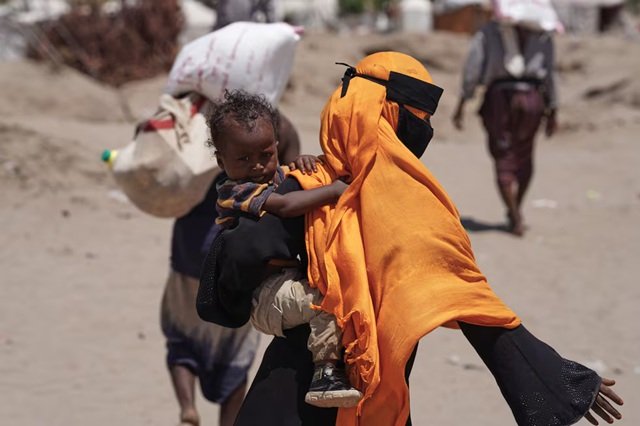
Her dangerous journey illustrates the conditions confronting residents of a city that has endured years of conflict but is now facing an increasingly severe siege. Almost one million people are cut off as Houthi forces tighten their control over the main southern road to Aden and the water supply to the north. Food, fuel and medical supplies are running dangerously low, while aid organisations warn that the city could face famine and a public health catastrophe.
Taiz, Yemen’s third-largest city, has long held strategic importance. Its mountainous terrain provides a defensive buffer for Aden, the de facto capital of the internationally recognised government, while its position to the west overlooks the Bab al-Mandab Strait, the narrow maritime passage connecting the Red Sea with the Gulf of Aden. The strait is a critical route for international shipping, linking trade moving through the Suez Canal with markets across Asia, Europe and beyond.
The latest Houthi offensive has therefore raised concerns extending well beyond Yemen. The movement’s advance towards the strait follows the wider regional escalation triggered by US and Israeli attacks on Iran earlier this year. With Tehran continuing to launch strikes against oil traffic in the Gulf, the Houthis’ growing ability to threaten shipping through the Red Sea raises the prospect of further disruption to international trade.
The immediate crisis, however, is unfolding inside Taiz. After Saudi-backed government forces retreated last week, the city became increasingly isolated. Houthi fighters now control key supply routes, while government troops and local militias remain under pressure from artillery and drone attacks. Attempts by government forces to break the encirclement have so far failed.
The humanitarian consequences are becoming increasingly severe. Oxfam has warned that fuel, drinking water and fresh food are running dangerously low, with stocks of wheat flour close to exhaustion. Mohammed, who is trained as a medic and now helps struggling hospitals while responding to emergency calls from residents stranded near the front lines, fears the remaining supplies could be exhausted within days.
“If the situation continues like this, and there is no intervention, we have a week at most,” she said.
The Famine Early Warning Systems Network, which monitors food security, has warned that Taiz could face full-scale famine by early next year if the siege continues.
Fuel shortages are also undermining the city’s already fragile healthcare system. Fatma Jaffar, who works with Oxfam’s team in Aden, described the impact on hospitals as catastrophic. Generators and ambulances are increasingly unable to operate, leaving medical facilities struggling to maintain essential services. Some hospitals are functioning at only about 20 per cent of their capacity.
The problem is not simply that residents cannot afford food. Supplies are becoming unavailable altogether. Oxfam staff have reported that people with money are unable to purchase basic provisions because shops no longer have sufficient stocks.
The medical emergency is compounded by the destruction of healthcare infrastructure. More than 30 health facilities have reportedly been forced to close after running out of supplies. At the Yemeni-Swedish Motherhood and Childhood Hospital in central Taiz, only eight of its 30 incubators remain operational.
Earlier this month, the International Committee of the Red Cross negotiated the passage of four lorry-loads of medical supplies into the city. The vehicles travelled through a mountainous valley under the watch of Houthi gunmen. But the delivery represented only a fraction of what Taiz requires.
For Mohammed, the consequences of the fighting are measured not only in shortages but also in the lives she has been unable to save. Earlier this month, she was called to help a woman and her daughter trapped in a house west of the city. By the time she arrived, a drone strike had destroyed the building. “Only pieces of the mother and daughter remained,” she said. Days later, another rescue attempt involving a woman trapped under shellfire also ended in failure.
Beyond the immediate threat of bombardment and hunger, Taiz is confronting a growing public health crisis. Waste collection has largely broken down because the city’s rubbish dump is under Houthi control, and trucks are reportedly prevented from travelling there to dispose of refuse. Ali Abdullah, a civil engineer who declined to use his real name because of fears of reprisals if the city falls, says accumulating rubbish has become one of the most dangerous threats facing residents.
Cholera, dengue fever and acute diarrhoeal diseases are spreading amid deteriorating sanitation and limited access to healthcare. The United Nations recorded more than 5,600 cases of waterborne and vector-borne diseases over the past month, although the actual number is believed to be at least twice as high.
Access to clean water is equally precarious. Only about 10 per cent of Taiz’s population can obtain water through government pipelines, which are now controlled by the Houthis. The remainder depend on private suppliers and water tankers, often at prices beyond their means.
The possibility of a Houthi takeover has also created fears of reprisals against residents who have opposed the movement. Abdullah warned that an assault on the city could lead to street fighting, kidnappings and torture. Mohammed fears that activists and human rights defenders who have publicly resisted the Houthis could face execution.
Her concerns reflect a broader predicament confronting the population: remaining inside the city means facing shortages, disease and bombardment, while attempting to escape can expose civilians to snipers and airstrikes.
“People are stuck between a rock and a hard place,” Abdullah said.
Taiz has endured a decade of intermittent siege, but the latest encirclement threatens to turn a prolonged humanitarian emergency into a catastrophe with regional consequences. Its position near the Bab al-Mandab Strait gives the battle an importance far beyond the city’s boundaries. Yet for those trapped inside, the immediate question is more basic: whether they will have enough food, water and medicine to survive the coming days.