
by Luxman
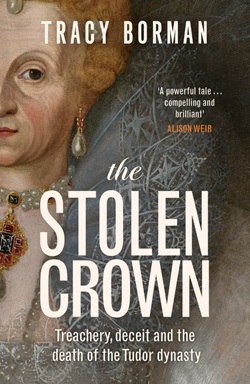
Tracy Borman’s The Stolen Crown is less a straightforward history than a psychological excavation of ambition, insecurity, and legitimacy in Tudor England. Borman, long celebrated for her archival precision and empathy for powerful women, delivers here a narrative that reads as both scholarly indictment and tragic human drama. The premise is simple enough—the century-long contest over England’s crown, from the shadow of Henry VIII to the dawn of James I—but what she constructs is a deeply unsettling meditation on what power costs when it must be stolen to survive. The title itself becomes a thesis: every English monarch since the Wars of the Roses, she suggests, has been an inheritor of theft.
From its opening lines, Borman declares her subject not as history’s winners but its haunted inheritors. “England was a nation founded upon a lie,” she writes, “and every Tudor who sat upon its throne was a usurper in a gilded cage.” It is a characteristically sweeping claim—both bold and slightly theatrical—but it sets the tone for the book’s central argument: that the Tudors’ genius for mythmaking masked an unending crisis of legitimacy. Borman’s use of the word “stolen” is not metaphorical. “The crown was never freely given,” she insists, “it was taken, claimed, grasped, and guarded with bloodied hands.”
Borman’s narrative moves restlessly between the courts of Henry VII, Henry VIII, Elizabeth I, and James I, with detours into the tragedies of Lady Jane Grey and Mary, Queen of Scots. She insists that the Tudor world was “an empire of performance,” where every gesture was a negotiation between survival and spectacle. Her most compelling insight comes when she describes Elizabeth’s coronation not as triumph but as theatre: “The pageantry was dazzling, but beneath the velvet and gold was fear—fear that the people might yet see the cracks in the Tudor myth.” It is this fixation on performance as pathology that gives The Stolen Crown its critical bite.
Yet the same theatricality that animates her prose sometimes undermines it. Borman’s instinct for moral drama—her repeated insistence that power “poisons all who touch it”—risks flattening the complexity she otherwise evokes. When she declares that “Henry VIII stole not only a crown but a conscience,” she writes with the cadence of a playwright more than a historian. Still, such excesses are forgiven by her mastery of archival nuance. She peppers the book with small, devastating details: Elizabeth’s trembling signature on Mary Stuart’s death warrant (“as though the pen itself recoiled”), or the chilling note that the young Edward VI “wept when told his crown was his by divine right,” a child already taught to lie for the sake of stability.
Perhaps the most controversial argument in the book is Borman’s insistence that Elizabeth I’s reign—so often sanctified as the apotheosis of English greatness—was itself built on concealment and moral theft. “Elizabeth’s crown was stolen twice,” she writes. “First from Mary Tudor, then from the truth.” Borman refuses the familiar hagiography of Gloriana and instead portrays a woman “imprisoned by her own invention.” She quotes Elizabeth’s own admission—“I am but one woman, weak and feeble”—and calls it “the most honest words she ever spoke.” The queen’s brilliance, Borman suggests, lay not in strength but in performance, in “the ability to make frailty appear divine.” The book’s portrayal of Elizabeth is thus both radical and unsettling: not the triumphant Virgin Queen, but the greatest confidence artist in English history.
The same critical ferocity extends to the men. Borman’s Henry VIII is rendered in all his grotesque vitality—“a man who mistook appetite for destiny”—but the author refuses to romanticize even his charisma. “He destroyed the world to build his own heaven,” she writes, “and found it barren.” The language is biblical, but her method is psychological. Henry’s dissolution of the monasteries becomes less a political act than an existential one: a ruler trying to silence the moral echo of his own theft. In one of the book’s most devastating sentences, she observes, “He broke from Rome not to free England, but to escape confession.” That line encapsulates Borman’s method: the historian as psychoanalyst, diagnosing centuries of guilt beneath the rhetoric of sovereignty.
Mary, Queen of Scots, receives perhaps the most sympathetic treatment—though even sympathy, in Borman’s world, is double-edged. “She was the rightful heir to a crown she would never wear,” Borman writes, “and in her tragedy, England found its justification for tyranny.” Mary becomes the moral mirror to Elizabeth: “two women bound by blood, divided by invention.” The author is at her sharpest when exploring the gendered paradox of their rivalry—“In a world that punished women for ambition, both were condemned for having any at all.” Yet she resists simple feminist redemption. “Power did not liberate them,” she warns, “it devoured them.”
If the book has a hero, it is history itself—the fragile, disputed record of what actually happened. Borman writes, “Every document in the Tudor archive is a crime scene,” and she means it literally. Her forensic attention to letters, council notes, and ambassadorial reports exposes the machinery of mythmaking that turned moral chaos into royal narrative. “Official chronicles were written not to record but to absolve,” she notes. This line, buried mid-chapter, may be her most important: the Tudor story, like all national myths, survives not because it was true, but because it was useful.
And yet, for all her brilliance, Borman occasionally becomes captive to her own argument. Her thesis—that the Tudors’ power was stolen and therefore doomed—leaves little room for the ambiguities of political necessity. When she writes that “Henry VII’s crown was won by deception as much as by arms,” she is right; but to claim that his rule was therefore “tainted at birth” is to misunderstand how legitimacy is always manufactured after the fact. In other words, the book’s moral absolutism sometimes erases the very contingency it seeks to expose. History, after all, is a story of survival as much as of theft.
Still, Borman’s courage in confronting the mythology of monarchy cannot be overstated. She dismantles centuries of romanticism with the cool precision of a surgeon. “The Tudors were not divine,” she writes, “they were desperate.” She shows that the dynasty’s obsession with lineage and display was not arrogance but anxiety. “Every portrait, every proclamation, every execution was an act of fear,” she insists. By reframing the Tudor age as one long performance of insecurity, she forces readers to reconsider not only those who ruled but those who believed.
One of the most haunting sections concerns the execution of Mary, Queen of Scots. Borman spares no detail: “Her lips moved in prayer as the axe fell, and when her head was lifted, her lips still moved.” The image is almost unbearable, and Borman knows it. “In that moment,” she writes, “Elizabeth lost the last of her innocence, and England the last of its illusion.” The statement is deliberately provocative—an invitation to consider the cost of empire’s birth. Her use of repetition—“last of her innocence…last of its illusion”—cements her claim that monarchy itself is theatre’s bloodiest genre.
By the book’s end, Borman returns to the metaphor of theft with renewed moral weight. “To steal a crown is to steal a soul,” she writes, “and England has been paying for it ever since.” It is a line that will delight some readers and infuriate others. For traditional historians, the moralism may seem overwrought; for literary critics, it will read as tragic poetry. But either way, Borman’s insistence that legitimacy itself is a fiction feels bracingly relevant. Her closing observation—that “modern Britain still worships the descendants of thieves”—is almost scandalous in its bluntness. It transforms what might have been a polished Tudor biography into an indictment of monarchy as a national addiction.
What makes The Stolen Crown extraordinary, and at times infuriating, is that it refuses comfort. Borman writes with the authority of an insider but the rage of a heretic. Her prose, alternately lyrical and lacerating, exposes the monarchy not as continuity but as a wound disguised as tradition. The book’s final pages return to Elizabeth’s dying words—“All my possessions for a moment of time”—and Borman’s commentary is devastating: “Even at the end, she was still counting.” The theft, she implies, never ends; it merely changes hands.
For readers accustomed to reverent Tudor histories, The Stolen Crown will feel like sacrilege. For those attuned to the moral theatre of power, it will feel like revelation. Borman’s genius lies in her refusal to separate scholarship from judgment. She reminds us, again and again, that the English monarchy—its splendour, its pageantry, its endurance—is not the product of divine right but of human wrong. And that, perhaps, is her most dangerous truth: that what England celebrates as continuity is, in fact, the longest-running cover-up in history.