For the first time, artificial intelligence could allow astronomers to witness the epic collision of neutron stars in real time, turning telescopes toward these cosmic cataclysms before they even occur. A breakthrough machine-learning technique, detailed in Nature, promises to pinpoint the location of an impending merger with 30% greater accuracy than existing methods, unlocking a new era of gravitational-wave astronomy.
The 2017 detection of a neutron star collision sent astronomers into a frenzy, as more than 70 teams raced to study its aftermath. But with current technology, astronomers can only observe these events after they happen. That may soon change. A team led by Maximilian Dax at the Max Planck Institute for Intelligent Systems has developed an AI-powered algorithm trained on simulations of gravitational waves—the ripples in space-time predicted by Einstein’s general relativity—that precede a neutron star merger. This advancement could allow telescopes to be pointed at the right place in the sky just in time to witness the moment of impact.
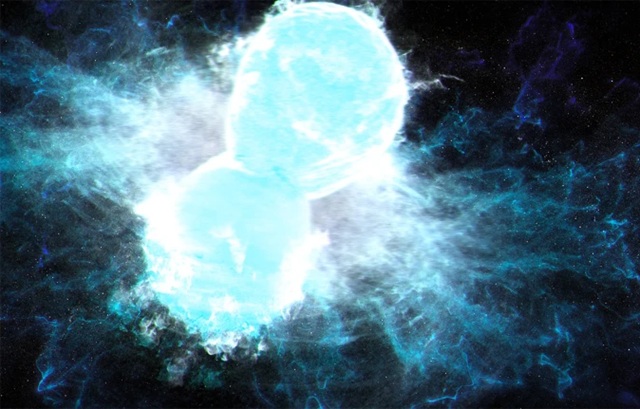
Neutron stars, the ultra-dense remnants of massive stars, occasionally exist in binary pairs, spiraling toward one another over millions of years before merging in a brilliant explosion known as a kilonova. These rare collisions are believed to be the cosmic factories of heavy elements like gold and platinum, making them key to understanding the chemical evolution of the universe. However, tracking them in real time has remained a challenge.
Dax and his team trained a neural network using simulated data from neutron star mergers, compressing the information to dramatically speed up analysis. What previously took hours can now be done in seconds, allowing gravitational-wave detectors to issue immediate alerts to observatories worldwide. According to astrophysicist Mansi Kasliwal of Caltech, the combination of speed and accuracy in this approach is “fantastic.”
The ability to observe a neutron star merger as it happens would be groundbreaking. Unlike previous detections that relied on γ-ray bursts and optical observations of the aftermath, AI-powered pre-alerts could direct space-based and ground-based telescopes to witness the merger in action, capturing unprecedented details of the process. Eleonora Troja, an astronomer at the University of Rome Tor Vergata, emphasizes the significance: “As far as I know, neutron-star mergers have never been observed in real time using optical or radio telescopes.”
This breakthrough marks a significant step toward unlocking the secrets of the universe’s most violent events. With AI guiding astronomers, the next major cosmic collision may not just be detected—it could be watched as it unfolds, offering a front-row seat to one of nature’s most spectacular phenomena.