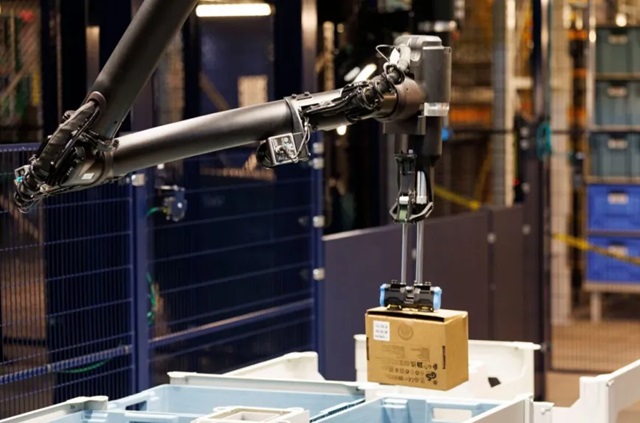
Amazon is accelerating the use of robotics and artificial intelligence (AI) in its warehouses, redefining how work is organized, tasks are performed, and physical space is utilized. The company unveiled its latest innovations at a warehouse in San Jose, highlighting a new era in logistics driven by automation.
New Technology on the Warehouse Floor
Among the key innovations is a robotic arm capable of performing tasks that previously required three separate workstations. Amazon is also testing Project Eluna, an AI agent designed to help warehouse staff make real-time operational decisions. For example, workers can ask the system for guidance on rerouting packages if a conveyor line is down, saving days of manual analysis.
Additionally, smart glasses for delivery drivers are being deployed to help identify packages and navigate efficiently, while AI software is helping warehouse managers optimize workflows, manage supply chain bottlenecks, and deploy staff where they are most needed.
Impact on Jobs
The rise of automation raises questions about the future of human employment. Tye Brady, Amazon Robotics’ chief technologist, acknowledged that automation could reduce the number of new hires in the U.S. over the next decade, with some leaked reports suggesting as many as 600,000 fewer workers might be needed by 2033. However, Brady emphasized the uncertainty of these projections, noting that human oversight and expertise remain essential.
Kelly Nantel, an Amazon spokesperson, stressed that leaked documents provide only a partial view of the company’s strategy. “They don’t represent our overall hiring plans across operations,” she said. Amazon has tripled its U.S. workforce since 2018, reaching nearly 1.2 million employees, even as it expands automation.
Shifting Worker Roles
Amazon executives say robots are designed to handle repetitive and physically demanding tasks, freeing humans to focus on problem-solving, quality control, and more skilled responsibilities. “We want to eliminate the menial, mundane, and repetitive tasks,” Brady said. Employees are being offered training and apprenticeships to manage and maintain robots, including roles as robot operators and maintenance engineers.
Robotics in Action
Robots like Blue Jay, a robotic arm that sorts packages, have already been deployed in a South Carolina warehouse. It can perform multiple tasks in a single station that previously required three separate assembly lines, allowing Amazon to shrink warehouse footprints and operate in smaller urban sites.
Amazon’s first robot with a sense of touch, Vulcan, is also in development, though engineers acknowledge that replicating the dexterity of the human hand remains decades away. “We still struggle to match the sensor density and flexibility of human hands,” said Aaron Parness, Amazon’s director of applied science in robotics and AI.
Future Vision
Executives see these innovations as part of a broader plan to create “collaborative robots” that enhance human productivity. Beyond e-commerce, Amazon anticipates that similar systems could be applied to agriculture, fishing, medical care, and automotive industries.
Despite the technological leap, Amazon stresses that its goal is not to eliminate jobs. “Will we become more efficient? Absolutely. But at the expense of people? It’s not the way we roll,” Brady said. The company envisions a future where AI and robotics blend seamlessly into the background, much like everyday software apps, enhancing productivity without replacing humans entirely.
Economic Impact
Morgan Stanley analysts estimate that Amazon could save up to $4 billion per year by 2027 through automation. At the same time, innovations like AI-assisted logistics could create entirely new types of technical jobs and improve overall operational efficiency.