by Our Diplomatic Affairs Editor
Jimmy Carter, the 39th President of the United States, stood apart as a leader driven by ideals, unyielding in his commitment to moral principles. His presidency, from 1977 to 1981, is often remembered for its moral ambition and its fraught relationship with the realities of governance. In the margins of memos, Carter revealed a sharp, often caustic, critique of the advice he received, famously rebuking National Security Advisor Zbigniew Brzezinski with a blunt “You’ll be wasting your time” and reacting to manipulative policy suggestions with a biting “Lying?” His assessment of Henry Kissinger as an “irresponsible liar” epitomizes his disdain for the realpolitik that had dominated U.S. foreign policy. Yet, Carter’s presidency was rife with contradictions. While advocating human rights, his administration often succumbed to hypocrisy, with actions that undermined the very principles he professed to champion.
Carter entered the White House with a mandate to restore integrity to a nation weary of Watergate and Vietnam. His personal rectitude and commitment to transparency stood in stark contrast to the clandestine dealings of the Nixon and Ford administrations. He sought to distance his presidency from the perceived cynicism of the Kissinger years, where geopolitics was viewed as a chessboard, and moral compromises were often justified in the name of strategic stability. But Carter’s approach, rooted in human rights and ethical diplomacy, was frequently tested by the demands of Cold War politics, leading to accusations of hypocrisy and inconsistency.
Despite his public commitment to human rights, Carter’s administration often engaged in actions that belied this principle. In Central America, his condemnation of human rights abuses in Nicaragua was paired with tepid support for the Somoza regime, whose corruption and brutality were increasingly indefensible. In El Salvador, the Carter administration funneled aid to a military government accused of egregious human rights violations, including the assassination of Archbishop Óscar Romero. These contradictions laid bare the limits of Carter’s moral stance, as geopolitical priorities often dictated decisions that betrayed his stated values.
Carter’s policies in Africa further highlight this tension. His administration took a strong stand against apartheid in South Africa, providing moral and diplomatic support to the anti-apartheid movement. Yet, it simultaneously maintained ties with autocratic leaders like Mobutu Sese Seko of Zaire, whose regime was notorious for corruption and human rights abuses. This selective application of moral principles not only undermined Carter’s credibility but also fueled perceptions that his human rights agenda was a rhetorical device rather than a consistent policy framework.
Perhaps no event more vividly illustrated the complexities and contradictions of Carter’s presidency than the Iranian Revolution and the subsequent hostage crisis. For decades, the United States had supported the Shah of Iran, whose regime was both a bulwark against Soviet influence and a perpetrator of severe human rights abuses. Carter’s attempt to balance strategic interests with moral concerns—a hallmark of his presidency—proved disastrous in this context. His lukewarm support for the Shah, coupled with a failure to fully grasp the revolutionary fervor sweeping Iran, left the U.S. without a viable strategy as events spiraled out of control.
The fall of the Shah and the rise of Ayatollah Khomeini marked a seismic shift in West Asian geopolitics. The ensuing hostage crisis, in which 52 American diplomats were held captive for 444 days, became a symbol of Carter’s inability to project strength and resolve. Despite intense efforts to negotiate a peaceful resolution, including backchannel diplomacy and a failed rescue mission, the hostages were not released until the day Carter left office. The crisis not only dominated the latter part of his presidency but also cemented a narrative of weakness and indecision, exacerbated by figures like Kissinger who publicly derided his handling of the situation.
Carter’s handwritten notations, however, reveal a president unafraid to challenge even his closest advisors. His relationship with Zbigniew Brzezinski was particularly fraught, as the National Security Advisor’s hard-nosed approach often clashed with Carter’s ethical framework. Brzezinski’s proposals to manipulate global events through covert tactics, including “black propaganda” and staged demonstrations of force, drew sharp rebukes from the president. Carter’s terse annotations—“Lying?” and “You’ll be wasting your time”—reflect not only his rejection of such methods but also his frustration with an advisor whose worldview he found deeply troubling.
Yet, Carter’s rejection of manipulative tactics did not prevent his administration from engaging in questionable activities. The covert support for mujahideen fighters in Afghanistan, aimed at countering Soviet aggression, laid the groundwork for decades of instability and the eventual rise of extremist groups. While Carter’s intentions may have been rooted in Cold War imperatives, the long-term consequences of these actions highlight the moral compromises inherent in his administration’s approach to global conflicts.
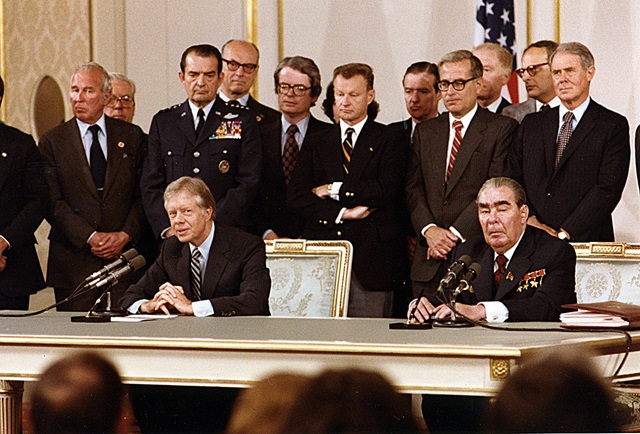
Carter’s presidency began with an emphasis on reducing Cold War tensions, exemplified by his pursuit of arms control agreements like SALT II. However, the Soviet invasion of Afghanistan in 1979 forced a dramatic pivot, leading to the Carter Doctrine, which declared the Persian Gulf a vital U.S. interest to be defended by military force if necessary. This shift from détente to confrontation accentuated the pressures of Cold War geopolitics, where ideals often gave way to pragmatism.
Carter’s emphasis on human rights remains one of the most contentious aspects of his legacy. While he brought unprecedented attention to the issue, his administration’s actions often fell short of its rhetoric. In Indonesia, Carter continued military aid to the Suharto regime despite its brutal occupation of East Timor, which resulted in widespread atrocities. Similarly, his administration’s support for the Saudi monarchy, a key ally in the West Asia, highlighted the selective application of human rights principles. These inconsistencies fueled criticism from both domestic and international observers, who questioned whether Carter’s policies were guided by principle or expediency.
Carter’s decision to transfer control of the Panama Canal to Panama was a landmark achievement that sought to rectify decades of perceived American imperialism. However, it came at a significant political cost, as conservative critics accused him of surrendering a vital strategic asset. The backlash underscored the challenges of pursuing policies rooted in fairness and justice in a polarized domestic environment. While the treaty ultimately represented a step toward more equitable relations with Latin America, it also highlighted Carter’s vulnerability to attacks from political opponents who framed his actions as evidence of weakness.
Domestically, Carter’s presidency was marked by significant environmental achievements, including the establishment of the Department of Energy and the promotion of renewable energy. His push for energy conservation and reduced dependence on foreign oil was decades ahead of its time, reflecting a visionary approach to sustainability. However, these initiatives were overshadowed by economic challenges, including stagflation, rising unemployment, and an energy crisis that eroded public confidence. Carter’s infamous “malaise” speech, though intended as a call to action, was widely interpreted as a defeatist acknowledgment of American decline.
Jimmy Carter’s presidency defies easy categorization. He was a leader driven by ideals, yet often constrained by the realities of power. His sharp critiques of figures like Kissinger and Brzezinski highlight his commitment to moral governance, yet his administration’s actions frequently betrayed its principles. From the Iranian Revolution to the Cold War pivot, from human rights advocacy to selective hypocrisy, Carter’s tenure was a study in contradictions.
As Carter’s passing at the age of 100 prompts reflection on his life and legacy, it is clear that his presidency was far more consequential than many contemporaries acknowledged. He was a leader who dared to challenge the status quo, envisioning a world where morality and pragmatism could coexist. Yet, his legacy is also a reminder of the compromises inherent in leadership, where even the most principled intentions can lead to unintended consequences.