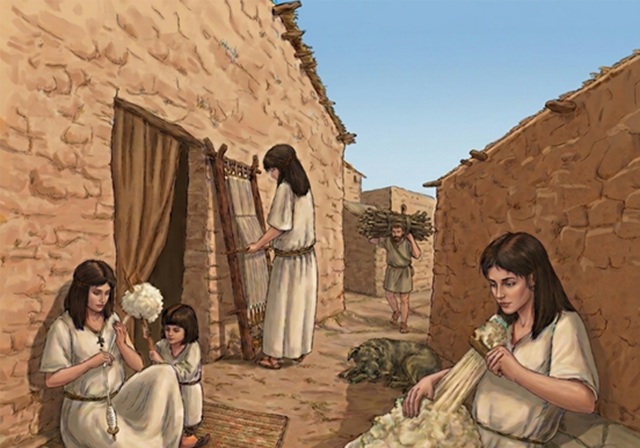
Archaeologists working in south-eastern Spain have uncovered rare evidence that sheds new light on how textiles were produced more than three millennia ago. The discovery of charred wooden timbers, plant-fiber ropes, and dozens of clay loom weights at a Bronze Age settlement has allowed researchers to partially reconstruct an ancient loom—an achievement rarely possible in archaeology due to the fragile materials used in prehistoric weaving tools.
The remains were discovered at the settlement of Cabezo Redondo near the modern city of Villena in Alicante province, a site that has long been considered crucial for understanding the Bronze Age in the Iberian Peninsula. Occupied between roughly 2100 and 1250 BC, the hilltop settlement once served as an important regional center connected to both inland Iberia and the Mediterranean coast. Excavations at the site over several decades have revealed houses, activity areas, and streets built on artificial terraces, indicating a well-organized community that thrived during the second millennium BC.
While loom weights—clay or stone objects used to maintain tension on threads during weaving—are commonly found at archaeological sites across Europe and the Mediterranean, the wooden frames of the looms themselves rarely survive. Constructed from organic materials such as wood and plant fibers, they typically decay over time, leaving archaeologists to infer weaving practices indirectly from the weights alone. At Cabezo Redondo, however, an extraordinary set of circumstances preserved parts of the loom itself.
Researchers believe the loom was destroyed in a fire that swept through the settlement more than 3,000 years ago. The blaze carbonized the wooden structure and sealed the remains beneath debris, effectively freezing the weaving equipment in place at the moment it was in use. Radiocarbon dating of materials from the site places the destruction between approximately 1507 and 1428 BC, during the height of the Bronze Age in Iberia.
Among the most significant finds were 49 cylindrical clay loom weights discovered on a raised stone platform within a circulation area of the settlement. Most of these weights were clustered beside charred timbers believed to have formed part of a warp-weighted loom, a type of weaving device widely used throughout prehistoric Europe and the Mediterranean. In this type of loom, vertical threads hang freely from a horizontal beam, held taut by weights attached to their lower ends.
The weights found at Cabezo Redondo are unusually small and light compared with others discovered across Mediterranean Iberia. Many measure between 46 and 68 millimeters in diameter and weigh roughly 175 to 220 grams. Their relatively low mass suggests that the loom may have been designed to produce finer or more varied fabrics than typically assumed for the period.
Analysis of the wooden fragments revealed that the loom was constructed from Aleppo pine, a tree species common in the Mediterranean region and frequently used in prehistoric construction and fuel. The preserved timbers likely formed the vertical supports and structural elements of the loom’s frame. Researchers also discovered braided ropes made from esparto grass—a plant traditionally used in the Iberian Peninsula to create ropes, baskets, mats, and other woven items—suggesting that the loom components were secured using locally available materials.
The combination of charred wood, clay weights, and plant fibers provided archaeologists with a rare opportunity to reconstruct the loom’s structure and estimate the types of textiles it may have produced. Based on the weight and thickness of the loom weights, researchers determined that the loom could have supported multiple weaving configurations capable of producing different fabrics.
One possible setup would have produced tabby weave textiles, the most common fabric type from the Neolithic through the Bronze Age. In this technique, each horizontal thread passes alternately over and under vertical threads, creating a relatively simple pattern. If arranged in two rows of weights, the loom could have produced a textile roughly one meter wide with a fairly open structure, similar to a delicate gauze.
However, the loom may also have been capable of producing more complex textiles. By arranging the loom weights in four rows rather than two, weavers could have created twill fabrics, in which each thread passes over and under multiple warp threads to produce diagonal patterns. Twill weaving allows for denser, more durable fabrics and represents a significant technological step beyond basic tabby weaving.
Evidence suggesting the potential for twill weaving is particularly significant because such textiles did not become widespread until later periods. Their presence or early experimentation during the Bronze Age hints at a level of technical innovation that researchers are only beginning to understand.
The discovery also highlights the growing importance of wool in prehistoric textile production. Earlier fabrics in the region were typically made from plant fibers such as flax. Twill weaving, however, is more commonly associated with wool, which became increasingly significant during what archaeologists describe as the “textile revolution”—a period marked by new weaving techniques, improved tools, and the widespread adoption of animal fibers.
Additional artifacts found at the site further support the idea that Cabezo Redondo was a major center of textile production. Archaeologists documented more than 200 loom weights across multiple rooms and activity areas within the settlement, indicating that weaving was likely a widespread and possibly specialized craft among its inhabitants. The discovery of clay spindle whorls—tools used to spin thread before weaving—suggests that the entire production process, from spinning fibers to weaving finished cloth, may have taken place within the community.
The exceptional preservation of the loom at Cabezo Redondo offers researchers a rare glimpse into everyday life during the Bronze Age. Rather than relying solely on scattered tools or indirect evidence, archaeologists were able to observe how the components of the loom were arranged and used together. This level of detail helps illuminate the technological knowledge and craftsmanship of ancient weavers, whose work was essential to clothing production and daily survival.
For archaeologists studying ancient textiles, the find represents a significant breakthrough. By examining the physical remains of the loom alongside its associated weights, fibers, and tools, researchers can reconstruct not only the structure of the weaving device but also the techniques and materials employed by Bronze Age artisans.
The discovery highlights how even fragile traces of ancient crafts can transform our understanding of early technology. Preserved by fire and buried for thousands of years, the loom of Cabezo Redondo now offers a rare window into the sophisticated textile traditions that helped shape the economies and cultures of the prehistoric Mediterranean.