


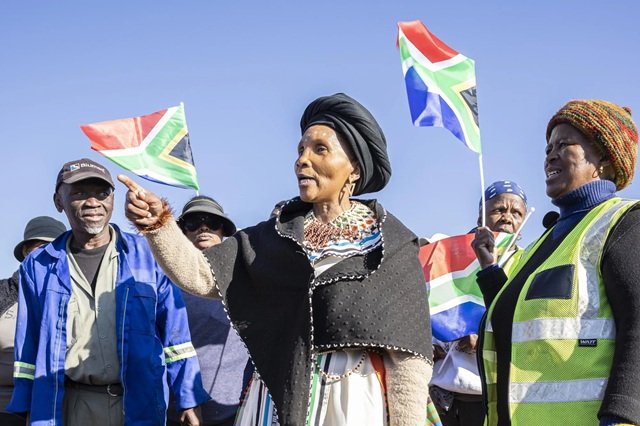
A crowd gathers outside a theatre in Soweto, Johannesburg, carrying South African flags, blowing Vuvuzelas and whistles, and chanting slogans. The atmosphere resembles a national celebration, but there is no sense of joy. The demonstrators are angry, demanding that migrants leave the country as tensions rise ahead of a threatened nationwide mobilisation.
The gathering is one of many protests spreading across South Africa, documented by Die Zeit, as a campaign led by anti-migrant groups gains momentum. The demonstrations have brought together people frustrated by unemployment, poverty, housing shortages, and crime, turning long-standing social problems into a wave of hostility directed at foreign residents.
In Soweto, Africa’s largest and most famous township, the demonstration grows to around 1,000 participants by midday. Police officers, water cannons, and private security teams surround the marchers. Some protesters wear masks, while others carry traditional Zulu accessories, wooden sticks, shields, whips, or hockey sticks.
One protest leader insists the movement is strictly opposed to violence. The whip, he says, is only meant as a warning if someone within the march behaves badly. But his message remains ambiguous, particularly when he adds that if police fail to maintain order, protesters will do it themselves.
“South Africa for South Africans,” one woman shouts from the crowd. Another demands that not only undocumented migrants but all foreigners leave the country. Participants say their anger is not political but driven by a desire to feel safe again. Yet beneath the slogans are deeper frustrations linked to the country’s economic and social challenges.
The movement’s central slogan, “Mabahambe,” meaning “They must go” in Zulu, has become the rallying cry of a right-wing campaign targeting migrants. Groups supporting the message have organised marches across the country, appeared in media interviews, and gained backing from some political figures.
The protests have already been linked to violence. In Mossel Bay, participants in demonstrations reportedly set fire to migrants’ homes. Foreign-owned businesses have been looted, and several migrants have allegedly been killed in attacks by extremist groups. In Durban, hundreds of foreigners were forced to leave their homes.
South Africa’s border authorities report that more than 12,000 migrants have already left the country. At the same time, police have increased raids and deportations targeting people without legal status. However, these measures have not reduced pressure from anti-migrant activists.
The immediate focus is a deadline announced by some protest groups in April. They warned that if all undocumented migrants had not left South Africa by Tuesday, they would bring the country to a standstill. A nationwide strike-style mobilisation was planned, raising fears of a violent escalation.
Across Johannesburg, authorities have prepared for possible unrest. Hundreds of police officers and private security personnel have been deployed, roads have been closed, and water cannons positioned. In migrant communities such as Mayfair, residents have stocked up on supplies, protected shops with metal barriers, and gathered to pray for peace.
The government has stressed that the ultimatum is not an official order and has promised to respond firmly to any violence. President Cyril Ramaphosa has attempted to acknowledge public concerns by recognising that South Africa faces challenges linked to illegal migration while also warning against violence. Trade unions have stated that the planned action is not an officially organised strike and warned workers could face consequences for failing to report to their jobs.
In Johannesburg’s poorer communities, efforts are also underway to prevent violence. In Thembelihle, an informal settlement of makeshift homes, residents gathered to debate the issue of migration. Some called for protection of migrant neighbours, while others supported the protests.
The discussion became heated as people took turns speaking through a megaphone. A man from Malawi addressed the crowd, drawing criticism from another resident. A third person attempted to calm the situation, but tensions rose and people began pushing. Community leaders watched closely, aware that emotions could quickly turn into confrontation.
One activist warned that they were losing control of the crowd. Another community leader argued that allowing people to express their views was important, saying local leaders needed to listen and understand who might require closer attention. As evening approached, some residents began constructing roadblocks from rubbish and wooden sticks.
For many migrants, fear has already replaced uncertainty. At Pretoria’s Bosman Bus Station, hundreds of people wait with suitcases, bags, and boxes, preparing to leave South Africa. Many are Zimbabweans returning home, some after decades of living in the country.
Denis Muzondo, 39, has spent 20 years in South Africa, longer than he lived in Zimbabwe. He worked in construction but does not have formal documents. He says paperwork is not the real issue behind the campaign against migrants.
Muzondo remembers previous waves of xenophobic violence. During attacks in 2008, at least 62 people were killed, including some South Africans who were mistaken for foreigners. In 2016, he says, he was beaten himself. Both times, he stayed.
This time, he says, the situation feels different because protesters have threatened to go from door to door. His wife and children have already returned to Zimbabwe, and he now plans to follow. Asked whether he could seek protection from police, he laughs and dismisses the idea.
Similar scenes have unfolded outside Malawi’s consulate in Johannesburg, where hundreds of Malawians are waiting for government-organised transport home. Malawi, Nigeria, and Ghana have already brought back thousands of citizens, while Uganda has announced plans for evacuations. More than 10,000 people remain waiting to leave.
The campaign’s effectiveness comes from the coordination of several influential political groups. Organisations such as Operation Dudula, which previously blocked migrants from accessing hospitals, and March and March have amplified anti-migrant messages through public demonstrations and online campaigns.
March and March leader Jacinta Ngobese-Zuma says the group opposes illegal migration rather than foreigners themselves, but critics point to repeated claims about migrants that are disputed. With municipal elections approaching in November, political competition has intensified as the governing African National Congress faces one of its weakest periods since the end of apartheid.
Among the most prominent figures supporting tougher migration policies is Herman Mashaba, a former Johannesburg mayor and leader of the political party ActionSA. He says he supports mass deportations of undocumented migrants while denying involvement in violence.
Mashaba argues that South Africans have legitimate concerns about crime, unemployment, and failing public services. Those problems are real. The country faces severe inequality, unemployment above 30 percent, pressure on healthcare and education systems, and a long-standing crisis in border management.
However, migration has become the focus of anger over broader national failures. South Africa has around 65 million citizens and fewer than three million migrants, a proportion lower than many countries in Europe and North America. Available data also does not show migrants committing more crimes than South Africans, except for immigration-related offences that citizens cannot commit.
As Johannesburg waits to see whether protests escalate, the city remains unusually quiet. Some residents believe the calm is temporary, while others suggest fear itself may already have achieved the movement’s goal by forcing migrants indoors or out of the country.
If violence breaks out, political leaders are already preparing their responses. Mashaba has said the responsibility would lie with the government and police. For thousands of migrants already leaving, however, the consequences of the campaign are already visible: homes abandoned, businesses closed, and families separated before the threatened confrontation has even arrived.









