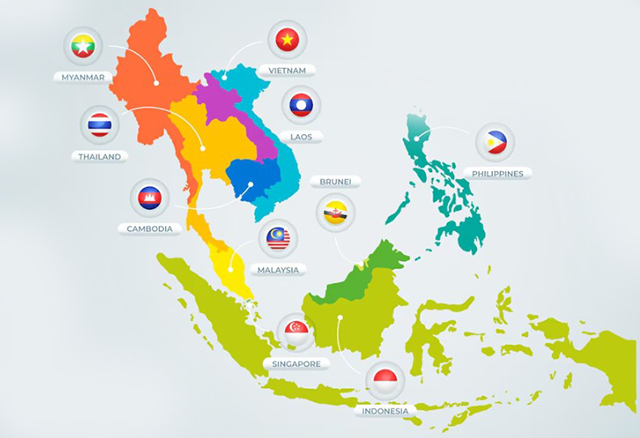
The ASEAN Economic Ministers (AEM) today issued a joint statement expressing deep concern over the recent imposition of unilateral tariffs by the United States, warning that the move could undermine global trade, destabilize supply chains, and threaten livelihoods across Southeast Asia.
Meeting virtually in a Special AEM session, the ministers stressed the long-standing and strategic nature of the ASEAN-U.S. relationship, which they described as a “Comprehensive Strategic Partner (CSP)” alliance that has “for more than four decades… played a significant role in fostering ASEAN-centered regional architecture that promotes peace, stability, economic growth, investment, and trade in the region which has benefitted both the region and the U.S.” In 2024 alone, the statement noted, ASEAN was the U.S.’s fifth largest trading partner.
However, ASEAN ministers are alarmed by Washington’s decision to unilaterally introduce tariffs, citing specific concern over the measures announced on April 2 and the subsequent suspension issued on April 9. “This has caused uncertainty and will bring significant challenges to businesses, especially micro, small, and medium enterprises (MSMEs) as well as to global trade dynamics,” the statement read. “The unprecedented imposition of tariffs by the U.S. will disrupt regional and global trade and investment flows, as well as supply chains, affecting businesses and consumers worldwide, including those of the U.S.”
They further warned of broader economic consequences, particularly for developing economies within ASEAN. “It will also impact economic security and stability, affect livelihoods of millions of people in the region, and hinder economic progress in ASEAN, particularly less developed economies, and the long-standing ASEAN-US economic and trade relationship,” the ministers emphasized. The statement underscored that in 2024, the U.S. was also ASEAN’s largest source of foreign direct investment and second largest trading partner.
Despite the sharp criticism, ASEAN maintained that it seeks engagement over confrontation. “We express our common intention to engage in a frank and constructive dialogue with the U.S. to address trade-related concerns,” the ministers stated. “In that spirit, ASEAN commits to not impose any retaliatory measures in response to the U.S. tariffs.”
The ministers reiterated their commitment to the ASEAN-US Trade and Investment Framework Agreement (TIFA) and the Expanded Economic Engagement (E3) Workplan as vehicles for productive dialogue. “We reaffirm our readiness to work together with the U.S… to explore mutually acceptable solutions on issues of common interest,” the statement continued, adding that areas such as digital technology, supply chain connectivity, and innovation could help strengthen strategic economic ties.
Calling for a broader return to multilateralism, the ministers expressed strong support for the World Trade Organization (WTO). “We reaffirm our support for a predictable, transparent, free, fair, inclusive, sustainable, and rules-based multilateral trading system with the World Trade Organization (WTO) at its core,” the joint declaration stated. The ministers also endorsed recent remarks by WTO Director-General Dr. Ngozi Okonjo-Iweala, who warned that the U.S. tariffs could have “substantial implications for global trade and economic growth prospects, especially the Least Developed Countries (LDCs).”
The ASEAN ministers also used the opportunity to recommit to strengthening economic ties within the region. “ASEAN will remain steadfast in deepening our regional economic integration,” they affirmed, highlighting ongoing efforts such as the Upgrade of the ASEAN Trade-in-Goods Agreement (ATIGA) and the ASEAN Digital Economy Framework Agreement (DEFA). The statement also signaled a desire to expand relations with other global partners to ensure a resilient, open, and inclusive economic landscape.
“We will continue to discuss ways on how to further strengthen and boost intra-ASEAN trade and investment within the region,” the ministers concluded. “This collective effort will enable ASEAN to cope with and overcome the global trade crisis, minimize the impact on our people, and continue to grow sustainably.”