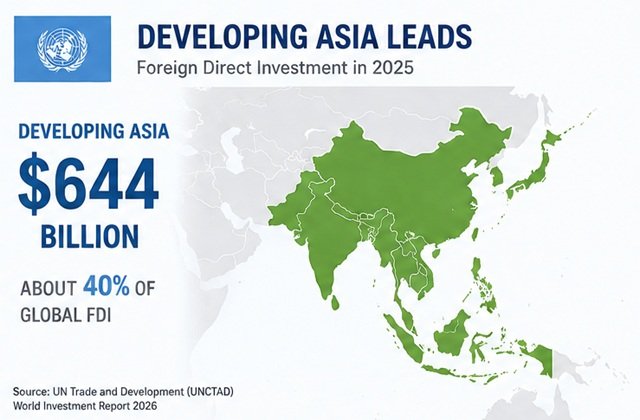
Developing Asia retained its position as the world’s largest developing-region destination for foreign direct investment in 2025, attracting $644 billion in capital as investment patterns within the region continued to shift. While the scale of inflows reinforced Asia’s central role in global investment decisions, the changing distribution of funds highlighted a new phase of competition among economies seeking to secure future industries, supply chains and technological opportunities.
According to the World Investment Report 2026 by UN Trade and Development (UNCTAD), developing Asia accounted for about 40% of global foreign direct investment and more than 70% of investment flows into developing economies in 2025. The region’s performance reflected both its established role in global production networks and the ongoing reorganisation of investment priorities worldwide.
The significance of Asia’s investment position extends beyond the volume of capital entering the region. Foreign direct investment can support economic transformation by helping countries expand into higher-value manufacturing, digital services, logistics and regional supply chains. However, the impact of these flows depends on how effectively investment connects with domestic companies, workforce capabilities and infrastructure development.
The latest figures show that investment within Asia is being redistributed as companies reassess supply chains, governments compete for emerging industries and investors seek opportunities in a more uncertain global environment.
One of the most notable developments in 2025 was the rise of South-East Asia as the largest recipient subregion within developing Asia. While investment inflows declined in East Asia, they increased in South-East Asia, South Asia, West Asia and Central Asia, signalling a broader shift in where companies are placing new capital.
India was a key contributor to this change, recording a 44% increase in foreign direct investment inflows and helping drive growth across South Asia. The increase strengthened the region’s position as companies continue to evaluate locations for manufacturing, services and other expanding sectors.
China remained among the world’s largest FDI recipients despite a decline in inflows from approximately $116 billion to $105 billion. The country continued to attract investment commitments in higher-value activities, including research and development and pharmaceutical manufacturing, reflecting continued interest in advanced industrial capabilities.
Despite wider regional shifts, investment remains highly concentrated. Eight of the ten largest developing-economy recipients of foreign direct investment are located in Asia. Together, these economies accounted for about 60% of total FDI inflows to developing economies and more than 80% of regional inflows.
The concentration of investment shows that while opportunities are expanding across parts of Asia, the largest and most competitive economies continue to attract the majority of capital. Across the region, governments are increasingly competing for projects connected to manufacturing, services, logistics and emerging industries.
The changing investment landscape in Asia mirrors broader global trends. Around the world, investors are increasingly directing capital toward strategic sectors, including semiconductors, digital infrastructure, artificial intelligence, advanced manufacturing and energy-transition technologies and services. These industries accounted for 44% of global greenfield investment in 2025, rising sharply from 16% five years earlier.
Many Asian economies enter this period with advantages built over decades, including established manufacturing bases, supplier networks, large consumer markets and deep integration into regional production systems. These factors have helped the region benefit from changing global investment patterns, even as competition for major projects becomes more intense.
However, access to these opportunities remains uneven. Not all economies have the infrastructure, skills base or industrial capacity required to compete for the same types of investment. As capital increasingly moves toward technology-intensive and strategic industries, countries face growing pressure to strengthen the foundations needed to attract and retain projects.
For policymakers, the challenge extends beyond offering investment incentives. The UNCTAD report highlights the importance of investment facilitation, reliable energy and logistics systems, workforce development, stronger supplier ecosystems and regional integration. These factors can help economies connect foreign investment with domestic industries and translate capital inflows into broader industrial development.
The competition for investment is expected to intensify as governments worldwide adopt industrial policies designed to attract projects linked to future growth sectors. Investors are also becoming more selective, weighing factors such as infrastructure, skills, market access and long-term economic stability when deciding where to commit capital.
For Asian economies, attracting foreign investment is only one part of the challenge. The next phase will depend on how effectively countries can use these flows to strengthen industries, expand supplier networks, create employment opportunities and support wider regional development.
As Asia remains at the centre of global investment decisions, the region’s evolving internal balance shows that the future of investment will not only be determined by how much capital arrives, but by where it goes and how economies convert it into lasting productive capacity.