
Introduction
The U.S. Navy, the world’s most formidable maritime force, faces persistent challenges in the Red Sea from the Houthi rebels. Despite its overwhelming technological superiority, the Navy has struggled to counter the Houthis’ unconventional tactics, including cheap drones, anti-ship missiles, and swarm attacks. This scenario closely mirrors the Sri Lanka Navy’s (SLN) prolonged battle against the Liberation Tigers of Tamil Eelam (LTTE) Sea Tigers, a non-state actor that relied on similar asymmetric warfare strategies.
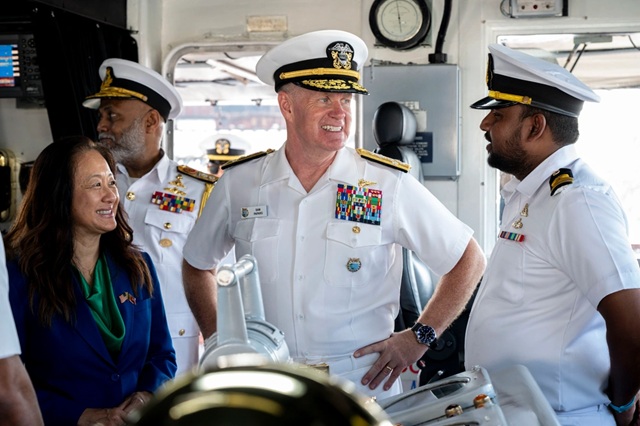
In a testament to Sri Lanka’s maritime expertise, Admiral Samuel Paparo, Commander of the U.S. Indo-Pacific Command, visited the Sri Lanka National Defence College (NDC) on March 21, 2025. Admiral Paparo, during the visit, emphasized Sri Lanka’s experience in countering maritime asymmetric threats, acknowledging that its lessons could help the U.S. Navy tackle similar challenges. His visit underscored Sri Lanka’s growing strategic importance in regional security and the necessity of learning from past conflicts.
The Red Sea Dilemma: A Battle of Strategy
The Houthis, backed by Iran, have transformed the Red Sea into a contested maritime domain. Their tactics exploit the U.S. Navy’s reliance on high-end warfighting systems designed for conventional conflicts. They employ inexpensive drones and anti-ship missiles to strike commercial and military vessels, forcing costly defensive measures. Swarm tactics using small, fast boats further challenge traditional naval responses, while naval mines and coastal ambushes add another layer of complexity.
Despite superior firepower, the U.S. Navy faces an asymmetrical cost equation—using multi-million-dollar missiles to intercept low-cost drones is neither sustainable nor effective in the long run. A shift in strategy is required, one that draws on experiences from smaller, resource-constrained navies that have successfully countered such threats.
Sri Lanka’s Maritime Experience: A Case Study in Asymmetry
The SLN’s battle against the LTTE Sea Tigers spanned three decades, during which the insurgents deployed a range of unconventional tactics. Small, fast boats equipped with machine guns and explosives overwhelmed larger naval vessels in swarm attacks. Suicide boats targeted key SLN assets, while stealthy, low-profile crafts blended into fishing fleets to evade detection. The Sea Tigers even developed submersibles and modified boats to transport weapons and personnel covertly.
Faced with these threats, the SLN adopted innovative, cost-effective countermeasures. Deploying its own fast attack craft, investing in close-range firepower, and leveraging intelligence-driven operations, the SLN gradually neutralized the Sea Tiger threat. The lessons learned offer valuable insights for modern naval forces combating asymmetric adversaries.
Adapting Lessons for the U.S. Navy
The U.S. Navy must rethink its approach to littoral warfare in the Red Sea. The Sri Lankan experience suggests that conventional superiority alone is insufficient; adaptability and innovation are paramount.
A shift towards smaller, more maneuverable platforms can provide an edge in shallow waters, where swarm tactics are most effective. Unmanned surface vessels (USVs) and aerial drones can enhance situational awareness while reducing risk to larger assets. Directed energy weapons and electronic warfare capabilities should be prioritized to neutralize drone and missile threats cost-effectively.
Equally crucial is intelligence, surveillance, and reconnaissance (ISR). The SLN relied on coastal radar networks, human intelligence, and patrols to track and preempt Sea Tiger movements. The U.S. Navy can similarly enhance its ISR capabilities in the Red Sea, leveraging satellite data, drone surveillance, and regional partnerships for real-time intelligence sharing.
Training and doctrine must also evolve. The SLN specialized in countering fast attack craft and asymmetric tactics through tailored training programs. The U.S. Navy could benefit from developing specialized units adept at profiling threats, identifying hostile elements within fishing fleets, and responding swiftly to dynamic engagements.
The Role of International Cooperation
The fight against maritime asymmetric threats is not one to be undertaken alone. Sri Lanka worked closely with regional partners to enhance maritime domain awareness and bolster security efforts. Similarly, the U.S. Navy must strengthen cooperation with regional allies such as Saudi Arabia, UAE, Egypt, and Israel.
A significant development in this direction is Sri Lanka’s recent contribution to the Combined Maritime Task Force (CMF), a multinational naval partnership focused on maintaining maritime security in strategic waterways, including the Red Sea. The SLN’s involvement enhances collective intelligence-sharing, patrol operations, and capacity-building initiatives, further reinforcing its position as a valuable security partner. By leveraging Sri Lanka’s firsthand experience in asymmetric naval warfare, the CMF can develop more effective strategies to counter non-state maritime threats.
Conclusion: Rethinking Maritime Dominance
The U.S. Navy’s encounters with the Houthis in the Red Sea underscore a broader shift in maritime warfare—where non-state actors and asymmetric tactics challenge even the most advanced naval forces. Sri Lanka’s experience against the Sea Tigers offers a roadmap for addressing these challenges. By embracing innovation, cost-effective solutions, and international collaboration, the U.S. Navy can adapt to the evolving nature of maritime security threats and maintain its strategic dominance in the region.
Admiral Paparo’s visit to Sri Lanka signifies the growing recognition of unconventional naval warfare as a critical domain. The SLN’s recent participation in the CMF further cements its role as an emerging partner in global maritime security. As conflicts in the Red Sea evolve, the lessons from Sri Lanka’s past may well shape the U.S. Navy’s future.