
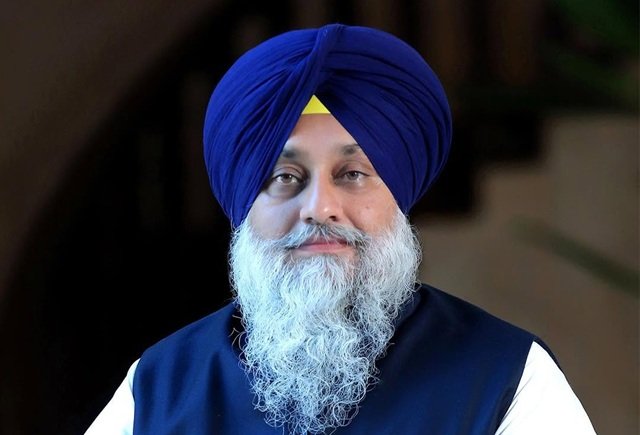
On August 13, 2026, Shiromani Akali Dal (SAD) president and former Punjab Deputy Chief Minister Sukhbir Singh Badal was injured in a sword/kirpan attack inside Gurdwara Mata Sahib Devan Ji Mugat near Nanded in Maharashtra. The incident occurred around 1:45-2:00 pm, as Badal, accompanied by his wife, SAD Member of Parliament (MP) Harsimrat Kaur Badal, and other family members, descended the steps after offering prayers following a visit to Takht Sri Hazur Sahib. The assailant, identified as Jaspal Singh aka Jaspal Singh Teja Singh Aidal, a man in his early-to-mid 60s from Pune, approached with folded hands while concealing a kirpan in a handkerchief or similar covering. He allegedly attempted to strike Badal in the chest or torso. Badal deflected the blow with his right arm, sustaining a deep cut reported with tendon, muscle, and nerve damage, plus a fracture by some accounts. A Police Inspector from the Special Protection Unit, Santosh Kendre, was also injured while intervening and overpowering the attacker. The attacker, a Nihang-attired sewadar (volunteer) who had served at the gurdwara for about two years after retiring from a managerial role (at Hindustan Unilever, among others) and holding commerce and law degrees, was arrested on the spot. The motive remained under investigation, with the accused variously citing anger over Punjab’s drug problem under previous SAD governments or claiming an “order from Waheguru.” No criminal gang links were immediately established.
This marked the second serious attack on Badal in under two years. In December 2024, a former Khalistani militant, Narayan Singh Chaura, opened fire at him outside the Golden Temple in Amritsar District while Badal was performing sewa. Badal was unhurt in this incident.
The Nanded attack comes against the backdrop of a long and well-documented decline in the popularity and organisational strength of the SAD under Sukhbir Singh Badal’s leadership. Once Punjab’s dominant regional party and the principal political vehicle for moderate panthic (Sikh religious-political) interests, SAD has suffered a series of electoral setbacks. In the 2017 Punjab Assembly elections, the party was reduced to just 15 of the 117 seats, down sharply from 56 seats in 2012, while its vote share fell to around 25.2 per cent. The SAD’s fortunes deteriorated further in the 2022 Assembly elections, when it won only three seats – its worst performance in decades, with Sukhbir Badal losing his own seat in the Jalalabad constituency – while the Aam Aadmi Party (AAP) swept the state with 92 seats. The SAD’s vote share declined further to approximately 18.4 per cent. This decline continued in the 2024 Lok Sabha (The lower house of the Indian Parliament) elections, when the party won only one of Punjab’s 13 seats, retained by Harsimrat Kaur Badal. Sukhbir Badal opted not to contest.
Several interrelated factors have contributed to the SAD’s declining popularity and organisational weakening. The 2015 sacrilege crisis and its aftermath were particularly damaging. Incidents involving the desecration of the Guru Granth Sahib, most notably at Bargari, followed by Police firing on protesters at Behbal Kalan and Kotkapura, became defining failures for the then SAD-BJP government. The administration was widely criticised for its handling of the incidents and for failing to restore public confidence in the state’s ability to deliver justice and accountability.
The 2007 controversy surrounding the Dera Sacha Sauda chief’s appearance in a costume resembling Guru Gobind Singh’s, followed years later by the Akal Takht’s brief decision to pardon him, reinforced perceptions among critics that religious institutions were being influenced by political considerations. The subsequent withdrawal of the pardon following widespread public opposition further exposed the tensions between political interests and panthic sentiment..
The erosion of the SAD’s panthic credibility and its perceived influence over Sikh religious institutions accelerated the decline. Critics increasingly accused the Badal leadership of exercising excessive influence over the Shiromani Gurdwara Parbandhak Committee (SGPC) and the Akal Takht, while shifting the party away from its traditional ideological and panthic priorities towards pragmatic power politics, patronage and centralised management. The prominence of relatives, businessmen and other non-traditional candidates within the party’s political structure also fuelled resentment among sections of the traditional cadre. In 2024, the Akal Takht declared Sukhbir Singh Badal tankhaiya – guilty of religious misconduct – for decisions taken during the 2007-2017 period that were deemed harmful to Sikh interests. His subsequent public penance, along with that of other leaders, did little to immediately restore the party’s credibility, while internal rebellions, breakaway factions and demands for leadership change intensified.
Alliance politics also contributed to the erosion of the SAD’s support base. Its long-standing partnership with the Bharatiya Janata Party (BJP) helped the party retain political power for years but increasingly carried costs among sections of its traditional constituency. SAD faced criticism over its positions on federalism and Sikh concerns and, particularly, its initial handling of the 2020 farm laws before eventually withdrawing from the BJP alliance amid the farmers’ agitation. Allegations linking political networks to the state’s narcotics trade, including controversies involving members of the Badal family, further contributed to perceptions of declining governance and accountability. Punjab’s narcotics crisis has consequently become deeply embedded in the state’s political discourse, with successive governments accused of failing to dismantle entrenched trafficking networks and SAD opponents repeatedly associating the expansion of the drug problem with the period of Akali rule. Leadership and organisational weaknesses have compounded these problems.
Together, these developments create a self-reinforcing cycle of political and organisational decline. The party is unlikely to rebuild credibility among Sikh voters unless it reconsiders the concentration of leadership around the Badal family and develops a contemporary policy agenda that extends beyond traditional identity politics. An alliance with the BJP or renewed mobilisation around panthic issues alone is unlikely to reverse the party’s decline. The Nanded attack is just a symptom of SAD’s wider crisis.